Jason VandenBerghe is telling me about the time he broke his kneecap.
Checking in at well over six foot, fingers wrapped in mysterious silver jewellery, and coming off, for all this world, like a three-way split between Jeff Bridges, Lars Ulrich and the Devil Himself, VandenBerghe clearly isn't a man who does things by half measures. Creative director at Ubisoft's Paris studio, he certainly went all in on his knee, shattering the cap itself into a jagged star formation of splintered bone and severing three tendons during a sprightly tumble on the devious cobblestones of Paris.
After surgery, VandenBerghe started walking with a cane. After a barnstorming appearance at E3, he kept carrying that cane even though he doesn't really need it any more. The cane, the satanic hillbilly beard, the mysterious silver - something clicked. Lesson learned: appearances are important.
VandenBerghe wouldn't have to wait very long before putting the fruits of his painful education into practice. Do you remember Red Steel? As a first-wave Wii game, it suffered from an unconvincing take on Japanese crime culture filled with much hollow chatterings about honour, before swiftly devolving into a succession of tiny rooms, each holding a single man patiently waiting for their turn to do you an injury with a sword.
Like a lot of early wagglers, it muddled along with plenty of interesting ideas regarding the potential of Nintendo's tricksy console, but it never threatened to cross over into the realm of genuine entertainment. It sold relatively decently, but back then it was pretty much Red Steel or Fruit Fall after you'd picked up Zelda. Production values aside, there probably wasn't that much in the decision either way.
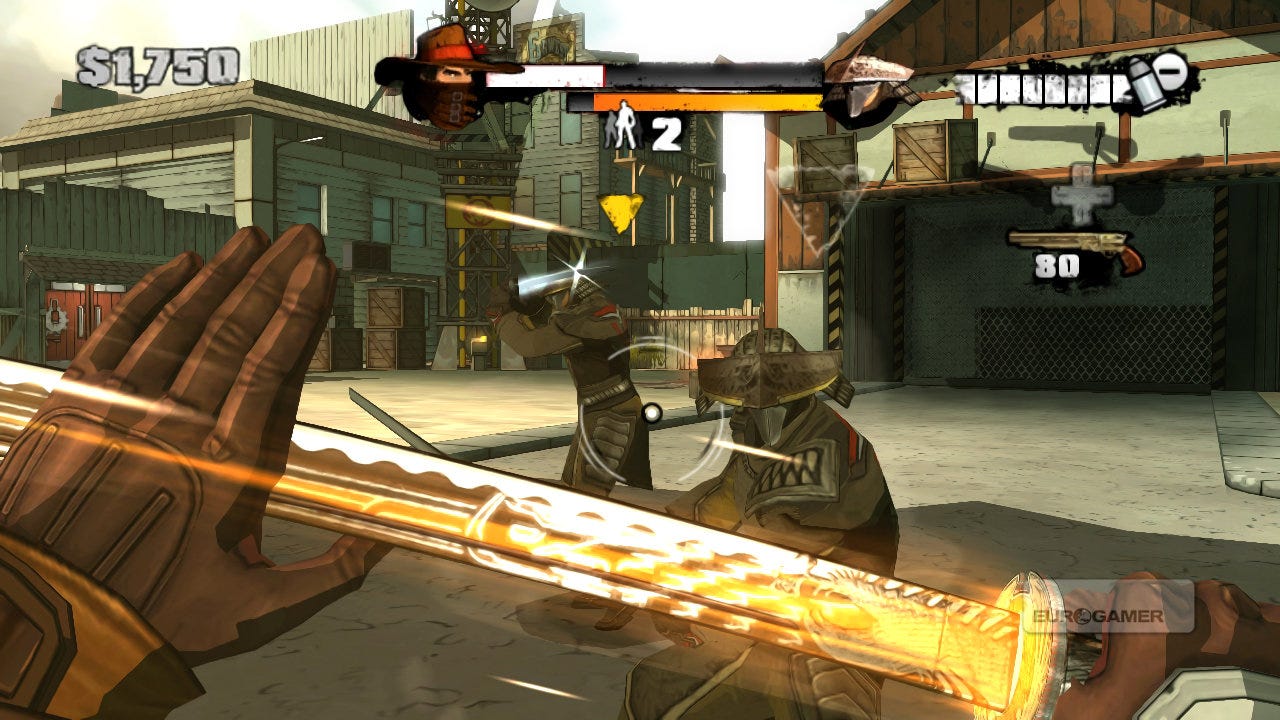
Brutal animations make up for the absence of blood. In easy mode, at least, your health seems to recharge after every encounter.
Red Steel 2, however, makes quite the first impression - and not just because it's gone cel-shaded, a move that is fast becoming the "checking into a sex clinic" equivalent for any series that has barrelled its debut title into a tree. Ubisoft's sequel has ditched the contemporary crime world entirely, replacing it instead with a fantastical futuristic weirdoland, sticking you into the dusty boots of a taciturn stranger who is so much of a platinum-grade badass that he sports buckles on his face. You heard me.
Beyond the buckles, the murky dives and gleaming penthouses of Tokyo have been swapped out for a bizarre collection of cinematic references. VandenBerghe's team pondered their options and returned to Red Steel's core weapon-set for ideas, deciding that if the katana represented the east and the six-shooter represented the old west, perhaps they could just jumble the two cultures together.
"It's shaken, not stirred," laughs VandenBerghe. "Pushing these two elements into the same space only really works if you just throw them in but keep the pieces separate: try to blend things together as one cohesive whole at a deeper level and it just doesn't work. Juxtaposing distinct elements is the key, and it's Reese's Pieces, really: Samurai Cowboy? Weird, but I like it!"
Reese's Pieces indeed. In Red Steel 2's world, east and west rub against each other in a lovely, unbothered manner as you plod past towering pagodas, through cog-driven electrical gateways, and find yourself in the midst of a dusty old cantina with a buffalo skull hung above the bar.
Mad Max technology - cobbled and jury-rigged - provides the mortar between the different blocks, and it all fits well into the game's structure, a rough-and-tumble overworld hub where there are missions to accept, weapons and ammo to upgrade, new moves - offensive and defensive - to learn, and occasional spills down into more elaborate dungeons filled with bosses and simple puzzles.
It's pretty handsome, too, with its clean lines and rich, flat slabs of colour, and a horizon riddled with mesas and palms. Squint a bit and it looks sort of like Borderlands let loose on the iPhone. (Please do this, Gearbox. I'd help pay for R&D myself.)
Does it play as well as it looks? The answer to that question lies largely with the MotionPlus - mandatory for Red Steel 2 and available, by the sounds of it, in a bundle. Thankfully, VandenBerghe and his team haven't expected Nintendo's seemingly forgotten peripheral to deliver their game by itself. Instead, the result looks like a clever mix of player freedom and canny developer subterfuge, with MotionPlus' increased input fidelity used both for moments of one-to-one mirroring and other periods where it provides a smarter means of interpreting what you're trying to do before spitting out the pre-canned attack you wanted.
"We make the decision of how to use MotionPlus differently for different actions," says VandenBerghe. "On the one-to-one end of the spectrum, we have blocking, where the motion is as close to accurate as we can have it while still making you look like a hero. What we found, though, is that if you do true one-to-one, you just look like an idiot. You look terrible. It's just so bad. So bad.
The original Red Steel had a handful of fairly interesting multiplayer modes - the sequel, probably wisely, has focused entirely on the single-player campaign.
"The fantasy of the hero doesn't survive that one-to-one modelling, so we're always doing a little bit of handholding. Every attack goes through the centre of the screen, for example, no matter where you're swinging - but the angle of that attack is 100 per cent determined by you and what you did. It's not like there's eight slashes - there's an infinite number of slashes.
"On the other end of the spectrum, we have special moves which are deliberately triggered actions," he continues. "You push a button and swing in a particular way, and as long as you get the input right, we're going to pull off a cool move that may not always look that much like what you physically did. We're using the MotionPlus to get a better idea of what you want to be doing, and then we make sure you get the result you wanted."
This all sounds pretty tricky. "You have no idea," says VandenBerghe, jewellery clinking as he claps his hands together. "We've done a lot of playtesting. We've been looking at what people do with the remote, then asking then what they were trying to do. We look for patterns, and then create algorithms that try to capture those patterns."
Handholding aside, MotionPlus has forced Red Steel 2's developers into something that approaches mimicry much more than the combat of most other titles does. In Zelda, to take a very early example, sword-fighting was simply about shaking the remote back and forth: it was little more than a violent take on maracas with some nice sound effects. Here you need to stand up straight, draw your arm back before swinging and really mirror the actual moves to get that katana sighing through the air for your most basic, reliable attacks.
It's a system that has made the team think about the difference between tutorials, which are good enough for most games, and actual teaching. It's a distinction that clearly fascinates VandenBerghe. "In most games, gamers already have the skill that they need to play your game," he suggests. "You move your character with one thumb, move your camera with the other thumb, and then chain inputs with buttons to cause actions. Most gamers are already good at that, so all you have to say is 'press A to do this'. Everything else is already taken care of.
"The problem that we have is, instead of 'press A' we say 'swing the sword horizontally'. Well, turns out, there are about an infinity of different ways to do that. Different angles, different forces, different degrees of movement. You can't create an algorithm that can interpret all of those different takes on the same action. That is just not doable. So we realised we were going to have to train the player in a physical skill.
Ubisoft's game comes off as a cross between Stranger's Wrath and MadWorld - in terms of the enemies - at times.
"In Red Steel 2, we have to teach you the right kind of arc to swing with, and we need to actually teach you that rather than tutorialise about it. That means we have to break the action into micro-steps, and then build successes on top of each other.
"So the first thing we need to teach people is not to just swing the sword, but to actually draw your arm back first. Then we build the swing on top of that, before slowly introducing other mechanics that players have to learn physically. It's a completely different approach to just getting people to press a button. It's no longer about getting it - it's hardly complex, and everyone gets it instantly; it's about being able to actually do it too."
Based on an hour or so of slicing - and shooting - through the game's first few missions, the approach seems to be working. Red Steel 2 has a surprisingly steep learning curve, but the result is a significant improvement on the first outing.
Sword attacks begin with a simple range of strikes and stabs before working up to more powerful unlocks like rush moves and downward swings. Dashes are crucial for getting out of the way of lunges or working around behind armoured foes, while switching to your gun is handled instantaneously via a quick squeeze of the remote's trigger, sending a bullet whizzing towards wherever the reticule is currently hovering.
Thankfully the game does an excellent job of working out when you're using the remote to move the camera about and when you're actually trying to lop someone's head off - probably due to the fact that you need to pull your arm all the way back before bringing the blade down on an enemy - and there's a nice rhythm to the action provided by the combo system.
Focusing on variations of knock-'em-down and finish-'em-off, you can shoot enemies in the knees to bring them to the floor before killing them with a swipe from your sword, daze them with a bullet to the head prior to stabbing them through the chest, or slice them into a confused wobble before blowing their brains out.
Combat's easy enough in one-on-ones, even when you're facing off against a rampaging mini-boss with a massive hammer, but there aren't that many one-on-ones this time around. Enemies tend to attack in groups, meaning that creating enough room for yourself to pull off a finisher without getting stabbed between the eyes in the process is a vital part of your training.
Parries and dodges are vital tricks to learn when the mobs move in on you.
If there's a potential problem, it's the automatic lock-on, which can dither slightly when there's more than a few baddies on-screen at any time, flickering back and forth between the closest foes when you really need it to choose one and stick with it.
Any slight frustrations will hopefully start to fade after a period of acclimatising, however. Watching VandenBerghe - who, granted, has had a fair bit of experience by now - play through one of the game's later stages suggests that once you've really got to grips with things you can blast around Ubisoft's world with real style, leaving an expert series of gored nasties in your wake. It must be how John Humphrys feels every weekday around nine in the morning.
The main difference between Red Steel 2 and the original, however, may not be the improved controls so much as the fact that you'll genuinely want to put in the time to master them in the first place. With a sugary rush of missions, dungeons, and upgrades riddled with collectable Sheriff's badges and oddball unlocks, 2010 might just be the year that face buckles finally go mainstream.
Red Steel 2 is due out for Wii on 26th March.
