Version tested: Xbox 360
Pausing and restarting is such an integral part of games like PGR and GRID, where you want to begin every race perfectly, that it surely can't be long before someone binds it to a button, just as the time trial festishists who make TrackMania have done on the PC. But having perfected the start, what do you then do when you try and vault the chicane at 150mph on the last lap only to end up in a tyre wall? Traditionally, you shout and scream. In GRID's case, though, you just hit a button, rewind your mistake and try again.
Flashback is what they're calling it, and it does for GRID what the Sands of Time did for Prince of Persia in 2003: removes unnecessary repetition (and stops us throwing the control pad around the room). Like POP, Codies restricts Flashback's use, allowing you four of them on Normal difficulty. You can also wager your stock of Flashbacks to try and gain more reputation points - which unlock later challenges - by increasing the difficulty; whack it up and you earn more reputation points, but the pressure's on you not to screw up so much.
See the Flashback feature in action as James crashes into a wall repeatedly. (Double-click while playing to go full-screen.)
Not that this would count for anything if Flashback were awkward, complicated or slow to load, but it's none of these things. As soon as you start spinning out, you reach for the button, and after a short pause for a rewindy noise you're deposited on an instant replay screen watching the last few seconds of gameplay. The bumper buttons allow you to switch camera angles to judge when you'd like to retake control, at which point you hit the resume button, the game makes three flashbulb noises in quick succession, each accompanied by a still of the action from an arty angle, and you're back in the driving seat as if nothing went wrong. During 20 hours of play on the 360 retail copy provided for review, we only experienced a handful of split-second pauses at the flashbulb stage. Overall, it just works, and works without incident, and because it's tightly integrated and bound to difficulty level, it feels like a tool rather than a cheat. Flashback, then, is great. But what of GRID itself?
Like TOCA Race Drivers 2 and 3 before it, GRID is a collection of disparate racing sub-disciplines brought together in a single career mode. At the traditional end, there are races in Detroit muscle cars, professionally tuned Japanese sports-cars, open-wheel track cars from Formula 1000, and - lest we all forget where the series began - touring cars. But unlike 2 and 3, GRID builds on this not by veering into the esotericism of classic cars, ovals and rallycross, but into unknowns like Pro Touge and Drift Battles, and Demolition Derbies in the hunt for our love.
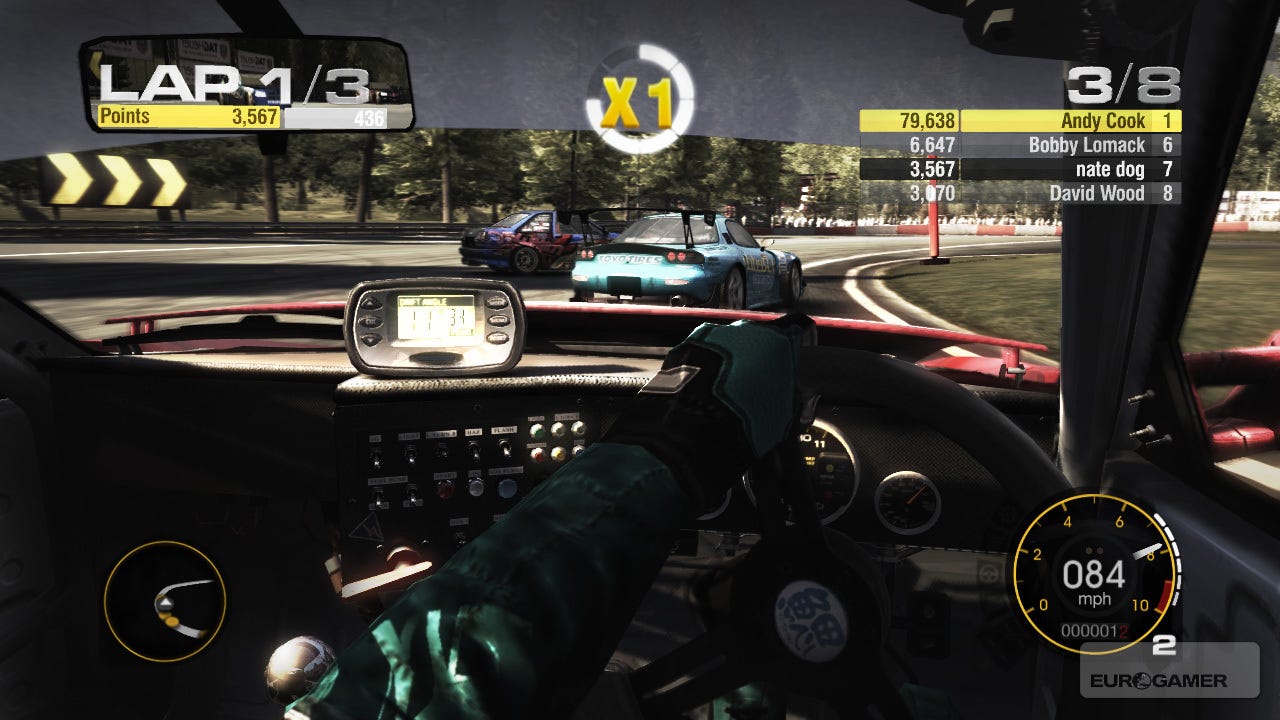
Drifting feels different to PGR, but it grows on you in the same way.
We're only too happy to oblige, as they're almost all great picks. Pro Touge, for instance, is a furious one-on-one race on tight Japanese mountain roads in slippery Japanese cars. You start marginally ahead of your rival and blast down the hill in the first phase, drifting around tight corners, and then start marginally behind him for the second, belting back up to the summit. Contact between cars is forbidden, with the second-place racer hit with a time penalty for any shunts, and the winner is determined by the cumulative gap in seconds between the two competitors. Pausing and restarting sends you all the way back to the top of the hill, so it demands concentration, and its sibling, Midnight Touge, is a one-way, no-holds-barred descent in the dark, and occasionally terrifying.
Less terrifying, but in need of just as much concentration, are Drift Battles and Drift GPs, which feed into the game's competitiveness with PGR. The mechanics are similar to Bizarre's game - as you overpower the wheels into a turn, the backside of your car slides out and you massage the acceleration and braking triggers to maintain stability. The faster you're going, the more acute the angle, and the closer you are to any flags on the inside kerb, the more points you accumulate for each stunt. By fishtailing along straights and moving seamlessly between opposing drifts, you can build up a combo, with a short grace period after each drift to execute another one and build up a multiplier for your eventual score.
Where it differs from PGR is that you can't rely on riding the kerb, going through traffic-cone gates or performing other "Kudos" manouevres to bridge the gaps in your combo. Even so, the appeal's the same, and the Drift Battle approach of putting you on the same track as seven other drifters, offering more points per drift if you're higher up the field, works superbly alongside the more traditional soloing of the oddly-named Drift GPs, which are knockout tournaments.
EGTV's James Hills takes a spin around San Francisco. Forgive his inability to steer and admire the scenery. (Double-click while playing to go full-screen.)
Pitched in a happy middle-ground between PGR and things like Gran Turismo, GRID's breezy accelerator has you feathering the right analogue trigger through corners, anxious not to let the rear wheels run away with themselves, with a handling model that happily supports everything the game allows you to do. Fearsome Mustangs, screaming through city streets, struggling to stay in a straight line ahead of so much power, are governed by the same programming as Supras going sideways into banking mountain hairpins and wobbly balsa-wood TVRs, but there's still great coherency. And thanks to the Flashback tool, the threat of proper damage being done to your car (which can flip, lose its wheels, and even go flying over the railings, and loses some of its performance if it takes a big enough knock) isn't enough to stop you firing yourself dauntlessly over the brows of unknown hills, and swinging the nose of your Skyline under the front end of a parked lorry trailer on a Yokohama dockside to achieve a perfect drift on the inside of a competitor.
For those keeping score, that means we're talking about a potential PGR-beater - one that articulates its vehicles and disciplines keenly and distinctly, and encourages you to take risks throughout each race. Completing the formula is the competitiveness of your AI opposition, which fights you right up to the finish line, seizing on your mistakes but making a few of its own too. Cars spin out, nudge one another by accident and misjudge the odd corner, rather than studiously following the racing line, and you soon realise that if a rival ahead of you spins out and you follow him, rewinding with Flashback allows him to rethink his actions too. The damage model also means that violently bullying cars out of the way, corner after corner, is less effective than it has been in other games.

Okutama looks like a basic loop, but it's a tough track to master.
This means, particularly as you close in on the latter stages of the game, that you won't always win. We're not used to this - normally we just pound away until we succeed through weight of experience. But GRID's reputation points system, and the range of things to do, copes with this well. Podium finishes all contribute to your rep, and if you're having no luck whatsoever, there are six events for each of the US, Europe and Japan on the first two tiers, so there's always an alternative. GRID World, the single-player career mode, tasks you with building up a racing team from nothing, and while this begins with a straightforward goal - win GBP 40,000 by completing freelance race contracts so that you can restore a sexy Mustang and start racing for big rep bonuses - before long you're part manager, part driver, sifting through potential team-mates to help you win constructor championships in key events, and micromanaging sponsors.
This side of the game is a bit superficial, but it gives you something to do between races and there is something peculiarly satisfying about going through your sponsor slots and deciding whether to take up Fila's offer of a few thousand quid every time you place above 5th, or taking a bigger total from Max Power but only for podiums. Likewise, hiring a team-mate may be expensive, but it will pay off if you go for a Pro Tuned specialist just before you tackle a run of those races, although we could do without the radio banter from mechanic and team-mate, which is repetitive and mildly irritating (even if you can get him to call you "Maverick"). You can also buy and sell cars on eBay Motors instead of just buying and selling them, although beneath the slightly different listings it's just the same menu with some advertising on it.
And despite the sideshows, GRID World's season-by-season racing-team structure is a bustling success, building up a bit of basic Princess Peach in Mario Kart-style rivalry (Tom Kristensen - spit!), allowing for showpiece head-to-heads with your hated rivals (Ravenwest - spit!) at the end of each tier and a seasonal outing at Le Mans, beginning as a freelance for third- or fourth-tier teams struggling for 12th place, and eventually slugging it out in ten-million-pound Audi R10s at 250mph for the win. Each Le Mans lasts 12 real-life minutes, going through a complete day-night cycle, and the monstrous high-speed straights of Circuit de la Sarthe are a welcome alternative to the usual Nurburgring Nordschleife, which has been the arcade racing game's massive lap of choice for the last few years.
A soaking Shibuya hosts some extremely tricky GT1 races later in the game. (Double-click while playing to go full-screen.)
Most of GRID's other tracks share Le Mans' agreeable blend of tricky technical demands and showpiece visuals, whether it's the long left-handers at Okutama with their awkward, jutting rumble-strips in the shadow of a mountain; learning to cut corners by riding sideways across the raised pavement in San Francisco, dancing between opposing right-angle corners on a tarmac and tram-rail floor amongst tall, oppressive buildings next to the bay; riding the Hachiko Drift circuit in the politely and apologetically cone-ringed, rain-slick Shibuya; the lollipop hairpin at Long Beach; or staring incredulously into the dark during the night-time lap at Le Mans, scared of the next corner. Wherever you are, Flashback means you can actually laugh at the odd spectacular crash, and then zip the image backwards and forwards like a DJ scratching a turntable for your own amusement.
We're not quite in Burnout Paradise territory with the visual representation of damage, but in many other respects GRID is a truly beautiful racing game: the cars are dazzling, whether you're watching the evening sun glide down the side of your first Mustang or watching an F1000 go-kart take off onto a crash barrier as you brake poorly into a tight turn. There's a slickness and polish at work that rarely slips. It's most apparent in the little things: the serenity of the garage scene menu backdrop, with the camera bobbing slightly as if on the breeze; the crash-zoom GRID World intro to starting grid close-ups; the Achievement progress notifications on the loading screens; the seamless ghost-car downloads for world records in Test Drive mode; the range of driver assists, which most will want to turn off, but which reduce the strain on those who struggle.

We prefer the bumper-cam view (in all things, you know), but the in-car and external views are great for showing off to friends.
Where GRID loses out is in relative trivialities - until you've learnt the track layouts, for instance, you might pine for PGR4's "racification" finish, which illustrated braking distances and racing lines subtly but effectively and is missed here. Despite the damage modelling, it's also still possible to bully the other racers out of your path - although not to the same degree as GT or PGR - and in a game this good looking, not being able to save and share replays online is disappointing.
Otherwise, GRID is a great success: the single-player is varied without being confusing; the online multiplayer supports 12 players and damage modelling, reducing the number of first-corner pile-ups; tracks and cars are well chosen and recreated; and Flashback allows you to race with the same determination on lap three as you did on lap one, mitigating risk in a manner of which other racing game developers will soon be envious. Even if GRID doesn't give Codemasters parity with PGR in US sales, as the developer hopes, it's a fine achievement and an early leader in the race to be 2008's best driving game.
9 / 10
Race Driver: GRID is due out on PS3, 360 and PC on 30th May.
