Version tested: Wii
"DS" has never really stood for anything. Well, that's not entirely true - it's stood for Drill Spirits, Dual Strike, Dawn of Sorrow, Deadly Silence, Dal Segno, Dermatan Sulphate - but in the grander sense it's never really been given a purpose.
From the Wii's perspective though (and you'll excuse me if I apportion sentience to it within two paragraphs, but it makes me feel better when I'm hugging it), DS must seem like a double-edged sword. On the one hand, its phenomenal, delightful success paints Nintendo as a company admirably determined to innovate and capable of doing it. But on the other hand, its phenomenal, delightful success took a while to justify itself, with a slack launch line-up remembered more for novelties than imagination in depth.
And so to the Wii, where initial expectations are similar. Wii Sports, for one, has been devalued by the preponderance of pre-launch pondering, and instead of rescuing the game, Nintendo has only amplified its perceived slightness, bundling it with the console to capture the interest of gamers outside traditional channels, and failing to demonstrate any depth during celebri-tedious presentations featuring Tim Henman, Greg Rusedski and Germany's own Mystery TV Man.
All of which was a bit silly of them, really, because Wii Sports is marvellously good fun.
As even Gabby Logan knows, Wii Sports is five games that use the legendary Wii remote control to direct the action. In tennis it's a racket, in bowling it's the ball, in golf it's a club and in baseball it's a bat. The exception to this rule of simplicity is boxing, where the remote joins up with its friend the nunchuk, and you clasp them in your fists so the console can measure your weaving jabs.
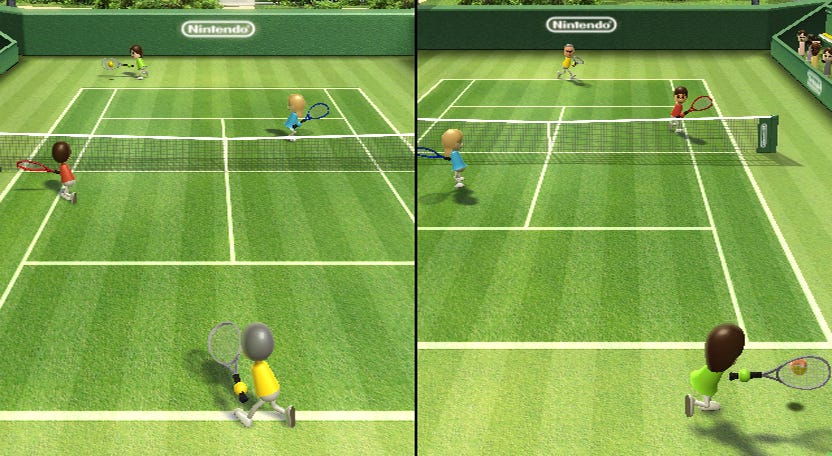
Best of the lot, this, with more to it than Henman realised. (No wonder he lost.)
In Rob's house, Sports has already kindled the multiplayer fire with more speed and spice than a Concord passenger snorting wasabi. Over there, they're already comparing it to Samba de Amigo, because it's so simple, approachable, and enjoyable. But more important than that from a Eurogamer's perspective, I suspect, is that it's a deceptive simplicity, with genuine subtlety lurking beneath the surface. Not all of the games justify the hyperbole, but the ones that do will see the disc creeping to the top of the pile more often than you'd think, and the others - well, we all get drunk and bring people home sometimes, don't we?
Tennis is my favourite. Flick the ball up and then swing to serve, with forehands and backhands played much the way you'd imagine, and height and spin available to those who master the gestures that command them. Knee-jerk criticism has focused on the fact the players move about on their own, but that's surprisingly unimportant in the long-term as you become obsessed with mastering your swing. Timing is essential. Receive the ball on the right side of the baseline and you can place it wherever you like on the other side of the net - swing early to play it cross court, swing when it feels most natural to hit a safe return, or swing just as you feel the ball slipping away to push it down the line. Finding the sweet spots that keep the ball just within the tramlines is rewarding, and developing the ability to find them regularly is satisfying.
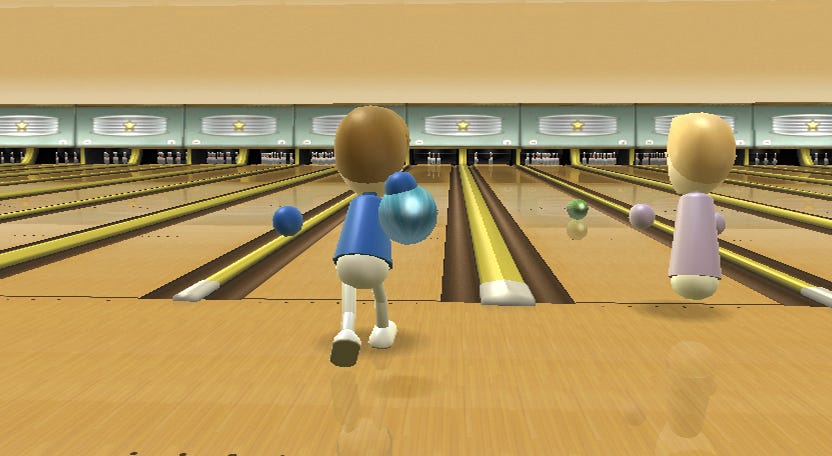
Bowling's another winner, standing poised to replace Monkey Ball as the 'pin-up' of choice.
Bowling doesn't demand quite as much, but the rewards are similarly worthwhile. After positioning your bowler so he's on the line you want and facing the lane at your preferred angle, you hold the Wii remote aloft and grasp the B trigger. You then draw your arm back behind you as though the remote were a bowling ball, and as you swing through again you release the B button to send the ball down the lane. Timing is key to speed, and by flicking the wrist left or right as you release the ball you can add varying degrees of spin, with the curve of the ball tightening as it reaches the pins. You may be surprised in the short term at the success you glean, but you'll have great fun in the process, and it proves itself the perfect multiplayer game. Like Monkey Ball's classic bowling effort, understanding the technique can only get you so far, and the rest is skill and practice. Like all the other games in the Wii Sports package, you don't need much understanding to have fun, either way.
Indeed, the same's true of baseball, golf and boxing, although these don't fair quite so well as the above examples. Baseball is just batting and pitching, sensibly, but where tennis and bowling transcend novelty, this one is stuck at the plate. In the long term it's as dull as that metaphor, really - too one-dimensional next to the flowing panic of tennis - although if you're trying to exhaust yourself while having fun, this is certainly the one to go for. Swinging at pitches is, again, about timing, while pitching uses particular button combinations for fastballs, curveballs, screwballs and splitters. Boxing, meanwhile, has more problems - the idea is to clasp the remote and the nunchuk in your fists, jab at the TV screen to, well, jab, and punch downwards diagonally to aim for the body, with the ability to duck and weave by holding the sticks to your chest and (yes) ducking and weaving. Except it doesn't do as good a job of registering input as the other games, and feedback isn't as satisfying.
Golf picks things up for the finale though, doing a simpler job than seasoned golf games like Tiger Woods at the expense of some depth, but not as much as you'd imagine. With an overhead view and a power meter that fills and empties to differing degrees depending on the strength of your golf swing, the ability to take practice swings without disrupting play and a decent range of holes, this just works. It asks more of your mind and your preparation than your golf swing, which is somewhat at odds with the other games in the bundle, but it has another trick up its chequered woollen sleeve when it comes to retaining your interest, and it's this that proves to be one of Wii Sports' best kept secrets: its training mode.
This is "training" in the Kawashima sense: ongoing, and an enjoyable quest for new high scores every time you pick up the remote. Bowling's training modes are better than the actual 10-round game for single players - trying to pick up spares from increasingly difficult situations and manoeuvring the ball around barriers to strike the remaining pins being the two best scenarios - while golf training has the requisite putting and approach practices but also, best, a bit of wind-affected target work, where the idea is to land the ball on an island in a lake, measuring its descent so the first bounce falls within a high-scoring target area. Even boxing has its best moments in training, with the weaving game - designed to impart body movement skills - a sort Wii Sports' dodge-ball bonus.
Golf's alright, although unlike tennis and bowling its departure from the norm doesn't really magnify the fun.
Elsewhere, tennis training has you trying to amass an unbroken series of returns, alternating between slow baseline shots, net volleys and service sequences as the game demands. It also works to refine your targeting skills, having you aim for a narrowing field behind the other player that moves around to confuse matters. The third task involves playing against a brick wall, the idea being to hit pop-up targets somewhere on the wall - and the problem being that if you hit the wall too much and not the target, the brickwork starts to crumble, and eventually you run the risk of losing by sending the ball through a hole.
Aiming for high scores in these modes ought to keep you occupied when you haven't got anybody around to play with, enticing you back with medals to earn that won't be given up easily, and for those who imagine a daily habit, there's a "Wii Fitness" mode that uses a combination of tasks to generate a "fitness age", too. See, mum was wrong - you don't need friends! And really, despite Wii Sports' multiplay pretension - and don't get me wrong, it's certainly at its best played with other people - there's a surprising amount to do here if you're on your own. Tennis, again, does the best job, with the game keeping track of how good you are, measuring your progress with a graph like Brain Training on the DS, and offering tougher AI opposition as you progress. Even after investing countless hours on the training courts, it'll have you struggling, with AI players making more use of their doubles partners and spin shots, producing maximum-speed serves, and forcing you to lean on your own partner to avoid being bested.
Out of the park! No, seriously, get out of the park.
Yet for all this affection, Wii Sports is still relatively slight, with no extensive campaign modes to be found, just exhibitions, and no online options either. It's been beaten up for this, of course, as well as for its presentation, which is certainly functional, perhaps as a corollary to its decision to use your "Mii" avatar as the in-game character (although, if you ask me, complaining that this doesn't look like Virtua Tennis 3 or Tiger Woods on Xbox 360 is a bit like whinging because Advance Wars DS doesn't look like Civilization IV). With less obsession over polygons, though, there's been more effort thrust into things like use of the remote's built-in speaker, which perfectly matches your swings, strokes and strikes, even if you've got the volume of the main game turned down. On the whole, I'm inclined to praise simple design when it translates into a game with as much broad appeal as this.
Because whatever line Nintendo takes with its promotion of Wii Sports - and everything up to now has positioned it as a sideshow - what it's actually got here brilliantly embodies the Wii's dramatic premise: that this kind of control can appeal to people who don't play games and people who used to play games as well as people who've been playing them for as long as we have. That's not to say that it's all things to all people, or that it's without flaws - but when you get lost in tennis late at night, you can be playing because your opponent's smart, and needs to be forced out of position with varied ground shots, top spin and precisely angled shots; or you can be playing because, golly Michael, come see what Tom's brought home, it's a sort of magical tennis racket. It's more than the parlour game that we all expected, then, but perhaps the beautiful thing is that it still can be that if you want it to.
8 / 10
