The Elder Scrolls IV: Oblivion
Good grief.

Spellbound
But all this grand scope for freeform adventuring would mean little if the fundamental combat was broken from the outset, but things have improved massively since the last Elder Scrolls came out almost four years ago. For a start, the game works well in either third- or first-person view, and you'll find that both play an equal part, depending what you're doing at any given time. For most of the combat, you'll probably prefer the up-close-and-personal view that first-person gives you, allowing you to deliver lunging blows and blocks with precision, not to mention casting spells from afar, or, of course, pulling off a tricky headshot with your bow. In a sense, the combat feels every bit as free and fluid as any comparable first-person title, and on the 360 the two-stick control works superbly, with just the right amount of sensitivity meaning you'll slip comfortably into the game right from the start. A simple two trigger system of attack and block fits the game perfectly, and with eight 'hotkeys' mapped to the d-pad, you can quickly assign heal spells, fireballs, specific weapon changes or whatever you like by hitting the pre-determined direction then the right 'bumper'. It's seamless, effective and well-implemented.
Clicking the right thumbstick flicks you out into third-person, giving you a much better view when traversing the sprawling outdoor environments, while also negating the possibility of someone sneaking up to you (which happens, of course). After a few hours you might even find a horse to ride (which really does need a third-person view), and although riding through this incredible world doesn't quite give you the cinematic buzz as something like Shadow of the Colossus, it's by far the best way to travel in Oblivion - plus, you can leave it in the forest to kill all the wildlife, and then go tut tut and play "nature's executioner" by galloping off a cliff. Fumito Ueda never thought of that, did he?
Even on a trusty steed, though, getting around the map is an incredibly time-consuming process, and one that could quickly get quite frustrating if it weren't for the ability to simply call up the map (when outdoors) and point your arrow cursor to where you want to head off to. Although you miss out on the opportunity to stumble across uncharted territory (and all the cool things that accompany that), if you're on a determined questing session, it's a lifesaver. A short loading pause later, you're there, saving yourself often 10, 20 minutes in the process - a design decision that we heartily approve of.
On the tabs
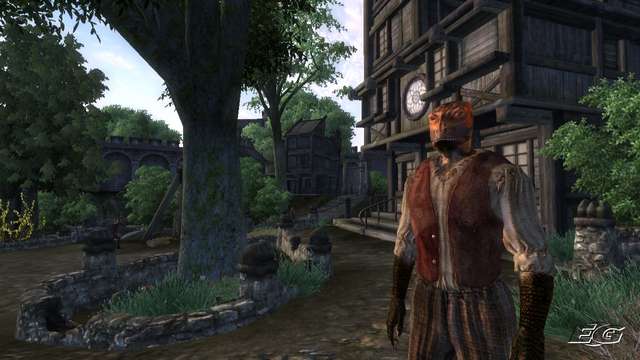
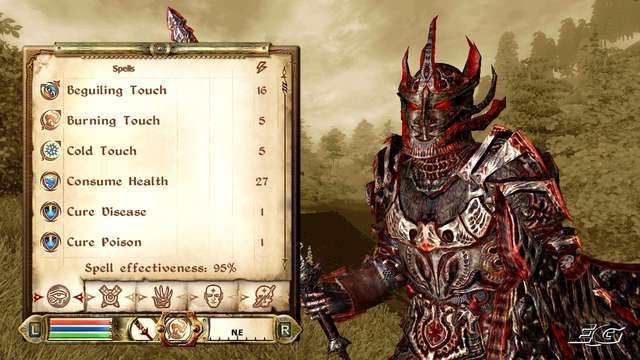
While we're on the subject of the general construction, you can't help but admire the slick tab-based interface that makes browsing through all the different aspects of the game an absolute breeze. With further layers of filtering within each, you can, for example, check out specific parts of your inventory, look up your skills, scan different parts of the map, check out your active, current and completed quests and basically any piece of pertinent information simply by hitting a single button and using the two sticks to navigate the tabs. For what most people would have assumed was a PC game on a console, it's not the case at all - if anything, the interface is tailor-made for the living room, allowing you to finally play a deep, involving RPG on the big telly in the comfort of your living room. Just don't plan to watch any telly for a few weeks, that's all.
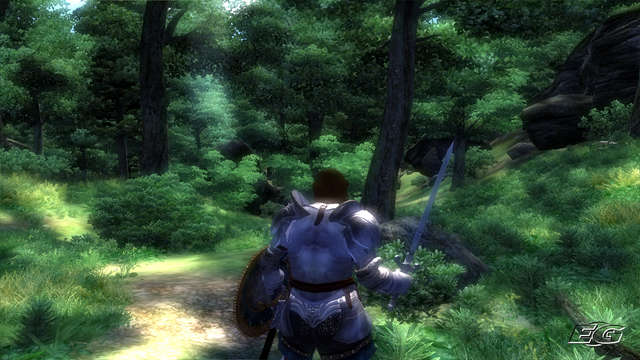
Although we've touched on the beauty of Oblivion, it comes at a price, but one well worth paying in every sense. At first, second, third glance, the external views of the game are amazing - almost picture postcard in their quality, and if there's one game worth investing in a big screen HDTV for, it's this. Once you've been through the day-night cycles (and seen the wonderful sunsets and stars - man, the stars) and been through various extremes of weather, you'll swear blind that this next generation lark was well worth waiting for. The interiors, too, are - in their own way - just as impressive, with massively detailed, hugely atmospheric locations above and below ground, filled with fearsome creatures that not only look impressive, but move and act with the kind of intelligence and fluidity that used to be beyond RPGs. Admittedly, they're still not up to the same refined standard as the best of the FPS bunch, but given the vast context, they're way more than adequate.
Even the biggest, most forgiving fan of Oblivion wouldn't claim that it's all perfect, though. On the 360, at least, you'll (eventually, very occasionally) find the already low-ish frame rate heading south into the netherworld of single-figure unacceptability. The fact that this only seems to get really bad when you're a) outside b) it's raining c) around complex rocky environments and d) you're not involved in combat means that it doesn't have any bearing on the gameplay - in our experience at least.
Holes in the fabric
Less acceptable is the way the foliage visibly fades into view, and how the sides of entire mountain ranges can appear peculiarly smooth even when you're not actually that far away (notable, for example near the Blades hideout). This is all massively nitpicky for such a marvellous-looking game, admittedly, but just be aware that you will encounter the odd winceworthy moment, but then come to accept them. It's also worth pointing out that none of this is an issue indoors, where the game engine has much less to sweat over. In fact, for the most part, the 360 copes brilliantly with a game that requires a hefty beast of a graphics card to run to the same level on the PC.
Whether you'll like the overall art style is open to question, though. It certainly has an overtly 'western' feel to it that won't be necessarily to everyone's taste. The character models, for instance, still lack a certain something. You can't fault their detail level, but they can look a bit plastic, and animation's not quite up the same standard as the rest of the game's stunning artwork - particularly the lip-synching and expressions, which aren't even in the same league as, say, Half-Life 2. There's also the occasional tendency for the lighting to show them in an unflattering (and actually quite odd) light, but we're being impossibly harsh over what is almost always an amazing visual showpiece.
The actual interactions you have with the NPCs are generally well-handled, though. Using a basic topic/question-based conversation system, you get the chance to grill almost everyone you meet, giving Oblivion the feel of one of those old-school adventures where you end up making progress almost as much by being plain nosey and inquisitive as your actions. This might frustrate the type of gamer that just wants to wade in and kill everything, but for the investigative gamer who admires storytelling, interaction and questing, all of this is instantly intoxicating stuff. The voice acting's of a pretty decent standard, just about managing to veer away from tired stereotypes and amdram inflections, with the occasional exception. In terms of the main characters, it's all sturdily handled by the kind of grizzled actors that wouldn't sound out of place at the RSC (like Patrick Stewart, Sean Bean and Terance Stamp). It's only the lesser NPCs that you meet that invariably let the side down a little, but it is only a little. Alongside that, there's one of the finest game soundtracks imaginable, with seemingly hours of haunting, lilting, uplifting, and dramatic scores from long-time Elder Scrolls composer Jeremy Soules.
A problem shared...
The only slight regret about Oblivion is that you have to go through this majestic experience all on your own. Although it'd probably cripple the frame rate even more, the idea of co-op questing is something that would work perfectly for a game like this. Maybe in the next next-gen?
If you've stuck with us this long and not simply rushed out to buy it (which we suggest you do before the weekend is out), then you should have the distinct impression that it's the kind of must-have game that has Game of the Year contender written all over it. There's so much we haven't even talked about, that's the crazy thing, 3000 words in. The prospect of things like Vampire hunting (or, even being a vampire) is just the stuff of gaming legend, or being the ultimate warrior or assassin for hire. Frankly, there's way too much stuff to talk about in the confines of a review - it's one of those games you've got to experience for yourself.
Oblivion is a staggeringly ambitious game that successfully unites some of the best elements of RPG, adventure and action games and fuses them into a relentlessly immersive and intoxicating whole. If the irresistibly picturesque visuals don't draw you in, then the ability to engage in a massive, unique and above all hugely entertaining adventure ought to tip the balance for anyone doubting how good this game could be. If ever a game was worth the full asking price, Oblivion is it - to miss out on it would be tantamount to a dereliction of duty.