New Super Mario Bros.
Super smashing. Great?

It's a deceptive little thing, this game-card.
"Game-card". Feh. It's been hard for Nintendo. Tech lingo's shifted into a language they've often had difficulty speaking - certainly in the years since the curtain fell on Yoshi's Island, the last true Mario game of the type we're addressing. The good thing is they're catching up though. They've done their language tapes. The last few months have been virtually poetic - even if Reggie Fils-Aime sometimes gives the impression of speaking in tongues.
By that token, then, you might argue that New Super Mario Bros. is a bit of an anomaly. Scratch the surface and it looks and feels like an old Mario game. Go outside and poke it with a shovel and it's like a geological cross-section of nuance ripped from the swing-ropes, bounce-pads, wall-jumps and graphic procedures of a decade of furrowed pretenders. Old words in a new mouth.
Keep going though and you'll want to throw off your wellies and kiss it on its spangly chops. Because New Super Mario Bros., which only takes what it needs from the technological diversity of the DS dialect, proves there's a difference between the language of gaming technology and the language of games - and that's a fundamental part of Nintendo's 21st century rhetoric. It may be on a "game-card", with all that imparts, but what makes a good new Mario is still the same.
Which is all a ponderously indulgent way of saying: If you dig in properly, it really is more than just a ploughed up genre patted down with a butt-stomp. (Although, sadly, this intro really is just a rubbish language metaphor thrown together with some sort of demented gardening riff. Apologies.)
New Super Mario Bros. is actually a bit of a pain to review, you know, because there's a massive temptation, when you start, to simply name-check everything you might expect to find in a Mario Bros. game. It's all here. Similarly, you can reel off a list of everything of any worth that's been introduced to the genre outside Mario games, probably glossing over some of the things that make such a big difference to the sheer - oh go on then - playability of the thing in the process. I simply can't be bothered to do that. It'd take all day. So I'm not going to.
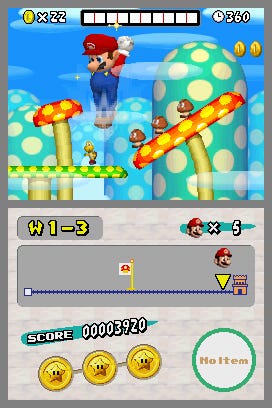
(Oh alright then: Running jumps, fireballs, butt-stomps, wall-jumps, piranha plants, goom-bahs, big boos, question blocks and winged ones, koopa troopas, bom-ombs, castle whomps, guppy fish, fortress levels, ice worlds, desert worlds, lava worlds, sub-bosses, three hits, forced scrolling, warp pipes, beanstalks, Hammer Bros., moving platforms, ghost houses, flagpoles, smash blocks, Bow-ser, Prin-cess, gold coins, spike traps, castle doors, spring pads, 1-ups, toadstools, rising lava, falling water. Swing-ropes, led-ges, shape-shift, dang-ling, etc. Also: did you know that NSMB houses the mini-games from Mario 64 in subtly tweaked and single-card-multiplayer versions? Coo, eh?)
So instead of doing all that, I'd rather... oh for heaven's sake stupid revisionist editing procedure - well instead I would have rather sat here and talked about things that make me smile. Like how absolutely, totally and utterly right the controls are.
During my reading around of all things Mario in the last few days, I came across a favoured old-days review of Yoshi's Island (a game which I'm going to bore you all to death about shortly). And there's a line at the start which I'm going to paraphrase here because the simple fact that it holds true today is evidence enough of how seamlessly all the new stuff blends in (and also because, as my old English teacher used to tell me when he realised I was nicking ideas pencilled around the margins of my War Poems book by its former owner, if you can't think of something new to say then for god's sake rip off somebody who was right the first time). So then: Mario moves with the same cunningly imparted inertia as the original Super Mario World, leaving him always doing on-screen what you were telling him to do via the pad.
Actually, Mario feels a bit heavier than I remember, here, but rather like the shift from Mario World to Yoshi's Island it's a learning curve for which there is no syllabus besides common instinct.
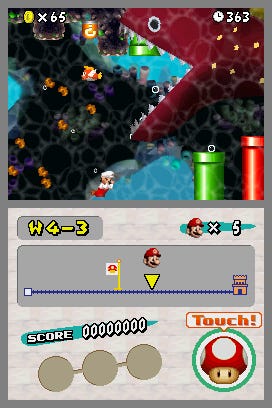
And with all that in mind, New Super Mario Bros. is wonderful because it's a brilliant distillation. Varied and accessible but still deep and punishing if you push it that way. It hoovers up the values of Super Mario World and Yoshi's Island. Mario World was brilliant at challenge and secrecy. The satisfaction of conquering the game's 96 levels was virtually incomparable at the time - and every one you found was another little firework show in your heart (and the last few you found were like Guy Fawkes heart attacks). Yoshi's Island was different. Forget your Half-Lifes, nippers, this was the blueprint for set-piece gameplay, with something new to grin about lurking down every warp-pipe.
Here there are eight worlds and many of them are the usual archetypes, but the content is never boring. Whether you're riding an auto-platform formed out of snaking blocks through the fiery hazards of Bowser's castle or leaping acrobatically around swinging toadstools, you're always in control and always having fun. There are new challenges everywhere, and their distribution is consistent. There's every type of platform - even ones whose movement you control with your positioning. Giant electric eels force you into narrow corridors of water just as whirlpools fight to pull you off the bottom. Intersecting auto-platforms deposit giant piranha plants on each other to snap at your positioning. Volcanoes spew crushing rocks from the distance which rain down, shattering platforms and blocks around you, just as snarling pumpkins become aggravated at your feet and start sprinting around unhelpfully. Ledges that you sidle along or hang from introduce themselves, as Hammer Bros. start lobbing fireballs as well as boomerangs. Giant boos deflate as they puff themselves out following but grow if you let them sit still - and they're not the only new additions to the haunted houses, popping up in close proximity to oily-footed charging brutes that you can manipulate to smash through into inaccessible areas. You could argue that there's more actual imagination concentrated in the first world of Yoshi's Island than there is in the entirety of NSMB, but you can't argue that this is less fun to play - and that owes a lot to fresh takes on old themes.