Broken Sword: The Sleeping Dragon Review
Can Revolution revive the sleeping genre?
Version tested: PlayStation 2
The adventure game genre must be a tough one to sell to risk averse publishers these days. Here's roughly how a fictitious developer-publisher meeting might play out.
"So it's an adventure game?" utters The Suit, an Oswald Boateng-clad publishing exec, creaking back in a black leather chair arching a carefully plucked eyebrow. "But you can't shoot anyone..."
This wasn't a good start, but it was a predictable one. A sarcastic smile began to creep across the already-cynical publisher.
Shifting in his seat, the nervous bearded developer waved assertively "but the emphasis is on the narrat..."
Too late, The Suit had already tasted blood.
"And where's the fighting, the driving, the flying? You seriously expect gamers to get excited about wandering around playing Sherlock?"
"But this is about atmosphere, ambience... a rich storyline... character developm--"
The Suit sported the smile of the cynic: "If I want a story I'll read a frickin' book. This is about as far from our vision of an adventure game as you are from getting a deal! Next!"
And with that, our plucky developer was escorted from the room, tail between legs, wishing it was 1993.
With bills to pay and a kid on the way, he's forced to rejig the design doc and produce Generic Action Adventure 56. He returns clean shaven: "Imagine Tomb Raider crossed with GTA and Mario set in a near future-past".
"You've got a deal", The Suit beams. Game signed, bills paid, publisher happy, developer wishing it was 1993.
Sweet talking'
So how did Charles Cecil and his band of Revolutionaries manage to convince THQ - a publisher not normally associated with risk taking verve - to sign up his first adventure game in six years? Apart from being one of the nicest men in the games industry, Cecil has a fairly compelling track record of success. Not only have all his adventure titles (and we're including his procession of Artic-published text adventures on the ZX Spectrum such as Ship Of Doom here, fact fiends) been critically well received, but the two Broken Sword titles even managed to dispel the myth that you can't sell point and clickers to a console audience. In fact, in one year the readers of Official PlayStation Magazine voted the original in the top five best PSone games ever released. So stick that in your fact pipe, Mr Publisher.
The return of the series after such a long period in the wilderness has presented the team with numerous problems, but also opportunities, notably how to take the series into full 3D while retaining its unique graphical styling, how to overhaul the controls, and, perhaps most importantly, how best to reinvent a narrative/puzzle-based genre without diluting what made it so popular in the first place.
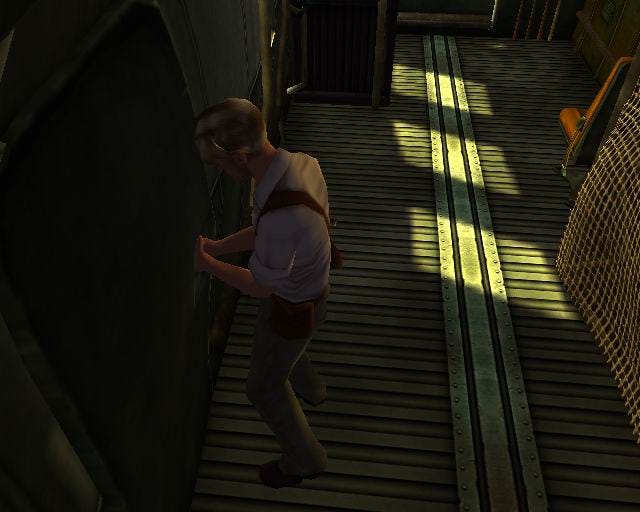
The bedrock of its success is Revolution's ability to spin a compelling yarn that sucks the player in and keeps them there, held together by a cunning puzzle system that's satisfying without straying too far into the realms of obscurity. The third episode once again features George and Nico, sucked into a good vs. evil tale that kicks off with a plane crash in the Congo and a murder in Paris, before following the trail of evil via Glastonbury (that's Glastonbreee and not, for the benefit of our American readers, Glastonberry), and eventually Prague. An evil bunch headed up by a deathly ill looking man by the name of Sussaro are determined to harness the power of Ley lines or Dragon Power to their own nefarious ends, and naturally you've got to put a stop to their plans in true save-the-world-and-get-the-girl adventure game style.
Rave from the grave
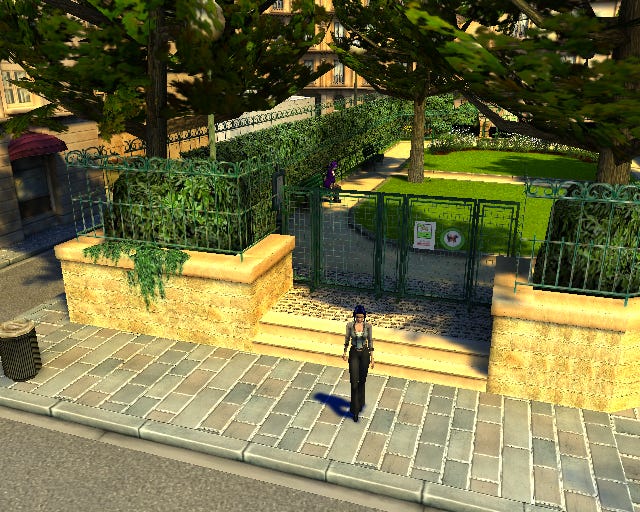
At the core of The Sleeping Dragon, the fundamentals of the gameplay remain mercifully intact. It's still very much a case of talking to everyone you possibly can, picking up everything that's not nailed down, being incredibly observant and applying a degree of lateral thought that only ever seems to be required for adventure games. Anyone hungering for a gaming style long since thought defunct will be delighted to see the whole concept dragged up to date with a better (console) control system, radically improved graphics and a less frustrating interactive element. Whether they'll approve of the action elements is another matter, but more of that later.
The first area Cecil and co. tackled was the controls. In a genre designed for mouse control, it's fair to say that until now no-one had worked out a satisfying system on consoles, and the team came up with a neat solution to the perennial headache; scrap it completely. A couple of years back they crammed The Shadow Of The Templar into the GBA so successfully and with a control system so head-slappingly intuitive that it was obvious that it would have to form the basis of The Sleeping Dragon. Thus, instead of scouring the screen for 'hot spots' with a cursor, players now get a context sensitive system that allows for direct control over George and Nico's basic movements, with commands such as open, push, pull, pick up, talk, examine, jump, listen and so on assigned to the four main joypad buttons - only appearing when the character is in range.
In practice the system makes the game incredibly easy to negotiate, although forces you to walk up to everything in order to see whether there's anything to interact with, whereas before a quick sweep of the cursor could tell you that. As a compromise, we can't imagine there being a more graceful solution for console owners, and as such it's a success.
That's cheating
As any hardened adventurer will ruefully note, many a gameplay hour was lost to the old gameplay mechanic of having to literally trawl your mouse cursor over every last pixel in order to discover some obscure object that you had to pick up. The Sleeping Dragon 'cheats' by basically displaying twinkling stars on anything that you can interact with. But die-hards don't need to worry about the dumbing down effect too much - the game's full of random tat that doesn't actually do anything, but can be examined for curiosity's sake anyway. In effect it just serves to keep the frustration value down, although the game features far too many incidental objects that turn out to be red herrings.
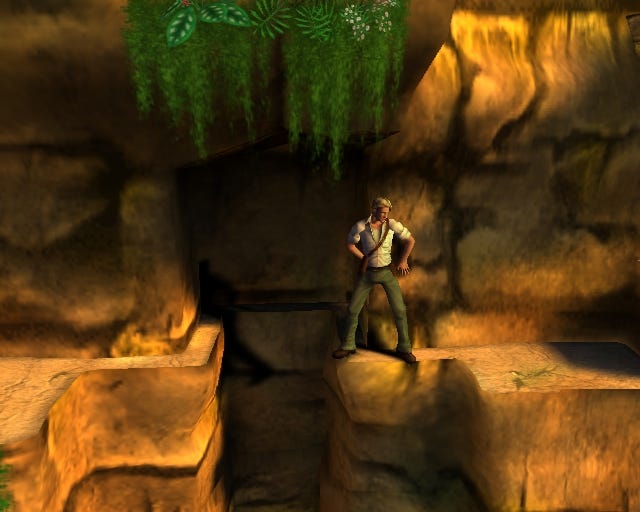
What might cause some sleepless nights for purists are the regular action-inspired elements that force you to solve numerous (gasp) block-moving puzzles in classic Tomb Raider style, as well as more Lara-inspired moments that have George and Nico forced to leap across gaps, shimmy across ledges, negotiate spike traps and so on. But unlike Core's finest hour, there's no falling to your doom or pixel perfect precision required; if there's a chasm to traverse or a thin ledge to shuffle across, the command interface will indicate this in the bottom right hand corner of the screen and allow you to perform said task with one click of a button. The rest is merely a case of holding the left stick in the appropriate direction, and so any sense that Revolution has gone all action-adventure on us is kept to a minimum.
In terms of its interface, it's as fluid as we've ever seen being almost totally free of menu layers and clutter. Hitting select calls up the inventory subtly in the top left of the screen, allowing you to cycle through your random tat and combine the egg with the hoover (or whatever) in a couple of button presses, without ever taking you away from the main screen. In common with most adventure titles, there's no combat and therefore no need to worry about health or ammo stocks. It might feel restrictive if you're used to third-person action adventures (and that's what it feels like, given the direct control over their movements), but once you return to the mindset of pure adventuring it makes for a refreshing change to actually have to think your way out of a situation rather than merely charge in with a rocket launcher.
Overhauled
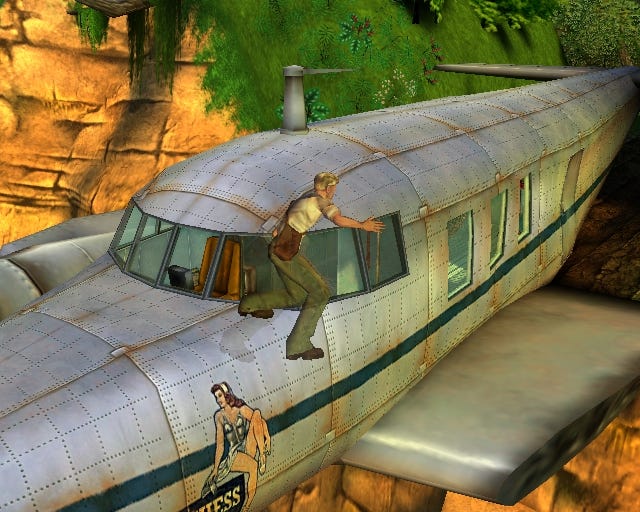
As we touched on previously, the visuals have been radically overhauled, dragged kicking and screaming out of their cartoon-style 2D world into a fully 3D environment that tries to capture what was so unique and refreshing about the originals. Although it uses RenderWare, it's a unique feel among videogames and does an excellent job of aping the subtle, alluring palette and slightly elongated characterisation of the originals. The animation works well with the exceptionally detailed environments and some superb lighting/shadowing effects combine to deliver one of the most carefully considered games of its time. Even the camera work is excellent, taking the Resident Evil concept of providing fixed atmospheric positionings, but obviously without the tiresome need to shoot things you can't even see.
It's by no means perfect, however. The lip-synching, for example, rarely conveys what it's supposed to, and some of the facial expressions and animation aren't quite up to the standards we were hoping for. Compounding this is also a questionable array of voice 'talent' plagued by truly dreadful casting decisions and awful stereotyping that bears little resemblance to reality. Without exaggeration the game is populated with truly cringe-worthy clichés from the word go; the Aussie bum, the weeping Goth girl, the slimy amorous French skateboarder, Tristram the trustafarian hippy, his hatefully plummy girlfriend, the sergeant major dad, Eamon the weary alcoholic Oirish TV presenter, or in fact almost all of the characters you come across for that matter. If they're not being unnecessarily vile and sarcastic, they're just plain unhelpful - or worse - just not very interesting.
One thing you could rely on in LucasArts adventures were the exceptionally well designed characters, who were usually funny with it as well, and the fact we're still harping on about games 10 to 15 years old games is telling. In keeping with previous Revolution titles, The Sleeping Dragon doesn't try to compete with the Lucas approach and plays it straight for the most part, albeit with a wry edge. Now, this isn't a bad thing per se, but we literally wanted to kill every single character within minutes, and hence any real interest in the script soon faded into the ether as we struggled to maintain any connection with anyone.
Kill them now
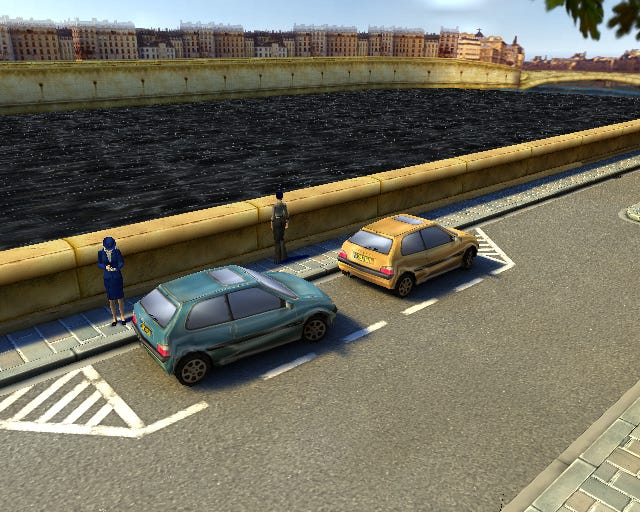
Even the lead characters can't save it; George's attempts at being funny are fairly feeble, and Nico's too wooden to be interesting. You just want one of them to liven things up, for something really bad to happen to them, or for them to stop being so interminably dull, but the sad result is the script isn't up to the job, and the voice actors can't hope to save it anyway. We're almost weeping with anger that this is the case; we so badly wanted The Sleeping Dragon to be the answer to our next-gen adventuring dreams, but it just isn't.
As hardened gamers of twenty odd years of square-eyed vintage with a high tolerance for less than satisfying narrative, we tend to cut some slack to these areas in most games. In fact, you'd be right to argue to that The Sleeping Dragon does a much better job than most games ever bother. It does... but... It does, but we're talking about a game that puts its narrative qualities in the front line, and shines them out like a neon sign. Anyone who reads a lot of literature or watches a lot of movies just won’t accept this, and it's a real shame when the platform it's built on is so solid.
It sounds like a contradiction, but the actual story isn't bad. Without giving too much away, the game is structured to allow Revolution to weave various simultaneous strands before finally joining them all up and allowing you to make sense of it all. Fans of the previous titles will also appreciate the way old characters make an appearance, and elements of the old titles' story make sense in the light of events in The Sleeping Dragon. It's not essential to know much about the previous games, but it will definitely help, and maybe old hands will appreciate the style far more than newcomers.
Click on everything. Examine everything. Talk to everyone about everything.
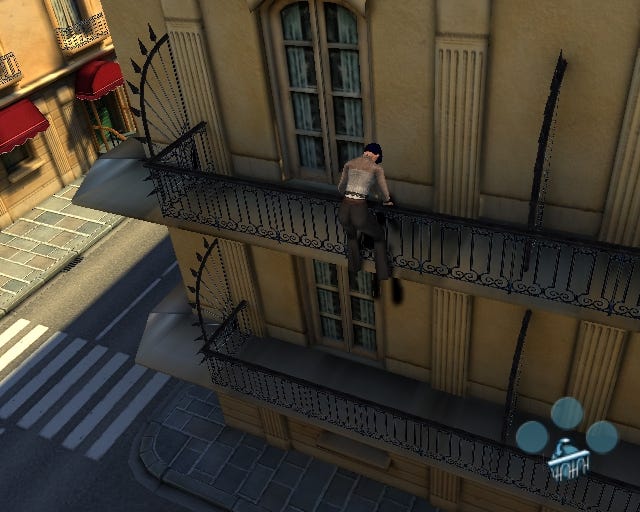
As many of you will know, some good old-fashioned adventure-puzzling can help make up for many a lacklustre script, but we're sad to report that The Sleeping Dragon often fails to engage here too. For most of the first half of the game, the puzzles are generally so obvious, and the locations so sparse that it's merely a case of applying a tiny amount of logical thought with what's in your inventory and mechanically talking to everyone about everything until something clicks. Only if you've overlooked something (you mean I can climb over that wall?!) does the game come to a grinding halt - otherwise you'll blitz through the first six or seven hours without too much trouble. After that there are some great puzzles that hardened players can really get their teeth into, but it's a long time coming and by then it's tough not to already be somewhat disillusioned with the stereotype frenzy at work in the script and the irritating voiceovers.
Occasionally the game throws in the odd spanner that has you wondering how on earth it reasonably expects anyone to progress without some kind of walkthrough, but that's par for the course in this genre. At least the objects you need to collect are generally obvious, but making every single door an interactable object was a bone-headed design decision given that approximately 90 per cent of them are permanently locked. A good chunk of the game is spent clicking on all sorts of things of absolutely no relevance, and every single time George or Nico utters an unskippable piece of speech accompanied by an unskippable piece of animation. Honestly, there are so many time wasting bits of The Sleeping Dragon that we could cry.
Unbroken sleep
In many senses The Sleeping Dragon is a leap forward for the genre. The actual play mechanics, the interface and the visuals are great, but you'll be wishing Revolution and THQ had invested as much time and effort polishing the narrative and puzzle element to the same high standards. We're in no doubt that it tried, but we can't lie just because we think Charles is a good bloke. We're caught in two minds, ultimately. One says we're excited to be talking about a largely uncompromising adventure game that does much to revive a dead genre, the other is that we're gutted that it's populated with cast hired from Stereotypes Anonymous that should have been subjected to the firing squad at the concept stage. There's much potential here, but Cecil and co. have some work to do before they can awaken The Sleeping Genre.
6 / 10
You may also like...
-
Happy Action Theater Review
-
Mass Effect 3 Demo: The First 20 Minutes
-
Why Devs Owe You Nothing
-
Face-Off: Final Fantasy 13-2
-
Retrospective: Star Wars Episode I Racer
-
Call of Duty: Black Ops has best game ending ever, says Guinness World Records
-
Digital Foundry: PS3 Skyrim Lag Fixed?
-
Sony's $50m Vita marketing campaign targets PS3 owners
-
Metal Gear Solid 5 expected between April 2013 and May 2014
-
Game of the Week: Catherine
-
Who Killed Rare?
-
UK Top 40: Kingdoms of Amalur: Reckoning beats Darkness 2
-
Lollipop Chainsaw screenshots show off custom costumes
-
Gotham City Impostors Review
-
Fallout: New Vegas dev asks fans what game they would like it to Kickstart
-
App of the Day: Ascension: Chronicle of the Godslayer
-
Alan Wake's American Nightmare gameplay
-
FIFA Street footage pits France vs. Germany
-
Face-Off: The Darkness 2
-
Kingdoms of Amalur: Reckoning Review
-
The Darkness 2 Review
-
Ultimate Marvel vs. Capcom 3 Vita Review
-
Grand Slam Tennis 2 Review
-
EA evaluating FIFA Street features for FIFA 13
-
App of the Day: Sir Benfro's Brilliant Balloon


Comments (63) Latest comment 7 years ago
Comments threads automatically close after 30 days, but please feel free to continue chatting on the forum!
Comment below viewing threshold Show
it better!
Comment below viewing threshold Show
Cos if so, that's one firm sale gone.
Comment below viewing threshold Show
/explodes
Comment below viewing threshold Show
The review seems as confused as the reviewer. To start with Broken Sword is a rarity these days. It represents what is 2003's only true entrant into the adventure game market (and I appreciate that in it self does not make a great game). The narrative, in my opinion, is exciting, well written and more interesting that anything else I've played through this year. However such matter is subjective, and I am sure my preference in reading is not the same as the reviewers (after all John Connolly is harder going than Rowling!). Therefore to knock a game (especially an adventure game) on personal preference on the narrative is unfair.
Using a score to justify it as 6 out of 10 for a computer game is in a single word cr*p. As an adventure game it's innovative, compelling and rewarding. Graphically it is good. Gameplay is fine though the block puzzles though interesting are frquently the mainstay. Therefore I just want to offer an alternative opinion to the reviewers.
As an adventure game this is the best of 2003. It delivers as you want and takes the genre forward. If your a self confessed arcade fan then this won't deliver.
Comment below viewing threshold Show
It's not a point'n'clicker.
/pedant off
Comment below viewing threshold Show
Anyway, don't agree at all with the score. But hey ho. Just my opinion.
Comment below viewing threshold Show
That's nonsense. A review is just one person's opinion - by your reasoning there should never be any such thing as a book review, since that's just a judgement based on personal preference as regards the narrative.
There are remarkably few absolutes in the area of characterisation and narrative - it all boils down to preference. However there are certainly popular and unpopular viewpoints....
Given how narrative driven this sort of game is, I think it's entirely fair to knock it if the characters were cliched and the story dull. You wouldn't knock an FPS game for the same reason, but adventure games are all about storytelling...
Comment below viewing threshold Show
Personally I think it is a neat addition to the series and better than The Smoking Mirror.
Regarding the stereotypical characters, Broken Sword has always had that element in it: the matronly english lady, the evil clown, the european cult attempting to destroy the world (/glares at otto/).
I think this is the game that Angel of Darkness wanted to be or would have been better off being.
Comment below viewing threshold Show
Maybe it's a sign of the times that we listen to dialogue-heavy games with the expectation that they're going to be bad, and this is inevitably colouring our judgement? Or perhaps, more positively, it's a sign that a game like this can be reviewed on the merits of its narrative rather than technical accomplishment...
Oh well... If someone told you last week that Eurogamer would review both SmackDown 5 and this, and that one would score 9 and one score 6...
Comment below viewing threshold Show
I'm definitely inclined to agree with the reviewer about the dialogue and voice acting. Talking of stereotypes, I can't believe that Nico's own voice wasn't mentioned - the most overracted French accent I've had the (dis)pleasure of hearing since those "Bibliobus" tapes in secondary school
Comment below viewing threshold Show
Umm, what on Earth do you mean by "American" readers? I'm from New Zealand and figured the last part of Glastonbury would be pronounced the same as the last part of Canterbury. Why would you only expect Americans to think it was pronounced Glastonberry?
Comment below viewing threshold Show
Food for thought indeed...
Comment below viewing threshold Show
I haven't played the game, so can't comment. I wasn't voicing an opinon on the matter - simply pointing out that narrative is incredibly important to an adventure game and as such, a reviewer's views on that narrative are a rather important element of the review...
Comment below viewing threshold Show
If you saw a film like this you'd turn it off after five minutes.
And that's the point.
Comment below viewing threshold Show
LucasArts need to give us one more, just one every 2 years is enough. Im sure they can handle the losses, itll be offset but the other bestselling tripe.
Otto have a soul, Grim Fandango was great! And it wasnt a point and clicker.
Comment below viewing threshold Show
Want more criticism? Loading times *are* pretty shocking (30 secs plus per area change) and that applies to both PS2 and Xbox, but that didn't bother me that much. (Swapping 15 disks on Beneath A Steel Sky...now *that* was an effort!). My PC review build didn't work, alas, but you'd bet there would be no such issues there.
Comment below viewing threshold Show
shame to see it was so harshly marked
oh and grim fandango over-rated?!??
madness i tell you!
Comment below viewing threshold Show
I contend that there's no such thing in the context of reviewing a piece of entertainment media.
Comment below viewing threshold Show
It's like criticising rock music for using guitars.
Comment below viewing threshold Show
I believe you can have objective insight with regard to the entertainment industry.
The main issue is one of differentiation though. If everybody is objective it then becomes increasingly harder to differ your 'review' or insight from that of a fellow journalist / publication /site, and in the fight for eyeballs differentiation is key (especially for advertisers etc.).
However the above statement only works if you can objectively critique a piece of media. You can do this as long as genres, good examples and bad examples of application are agreed. It then becomes a case of reviewing or critiquing against a standard i.e. does this game have better or worse graphics than the highest ranking game in the genre. This way you have a sequences of +ve and -ve scores against a piece of media. An 'out of 10' score can never be objective as you never agree a standard. By remaining objective you review against previous examples. Genres are used to add variety and to be more precise. Discuss ...
Comment below viewing threshold Show
Nontheless, my four year old nephew thinks it's a great game. One of them's right, so I'm just wondering which review to use
Comment below viewing threshold Show
In that case, Kristan's review was wrong because he has allowed personal prejudice to interfere with the truth
Broken Sword is actually extremely well written, and the voice acting is top-notch
15-0 to TipTop
Comment below viewing threshold Show
Still, long loading times and rubbish puzzles put me off, not to mention the existance of Tomb Raider moves in the game. I haven't played this game yet but really don't fancy the new lack of pointer-interface. I remember a game on the PS1 called Fear Factor that used pretty much whats commented here on the review, ie Silent Hill or Resident Evil type adventure controls with text informing you of an items' existance when you are in its proximity.
To me this game along Grim Fandango and the most recent Monkey Island episode aren't point'n'clickers - that can never happen when you control the character directly.
Still with the few amount of adventures on the market I might just wait some time and get this..
Comment below viewing threshold Show
Okay, your argument here is coming down to the same basic problem as Communism - it looks good on paper, and it's a nice idea, but here in the real world it doesn't work.
You want people to agree on what good examples and bad examples of application are? Well, there's your stumbling block. Human perception is an incredibly fickle and variable thing, and you'll often find that people discussing a piece of media will offer diametrically opposed opinions on something - and then use exactly the same points to back up their contention, or worse yet, use equally opposed (and entirely conflicting) points.
Example. I dislike the majority of western RPGs. Many of my friends - whose opinions I respect - like them very much. The arguments I use to criticise them are often exactly the same as the arguments they use to defend them - it's simply a case that we like different things.
Anothe example; most of my friends like 24, and I personally love it. One of my best friends - and someone with whom I share the majority of tastes - despises it, and when I discuss it with him, he'll often express diametrically opposed views on the same aspects of the show. I find the dialogue fresh, well-written and realistic; he finds it cliched, badly paced and annoying. Stuff like that. There's no common ground here.
So how do you establish a baseline for what's good and what's bad? You can't - hence even under the system you suggest, the best reviews would be subjective, because the baseline would - out of NECESSITY - be subjective in and of itself.
The best we can do is outline very clearly our reasons for liking or disliking a game, so you can make your own decision based on what you think of those reasons, and give you identities for the reviewers so you can establish for yourself whether you lend any weight to that reviewer's opinion.
Comment below viewing threshold Show
Yes. I persevered with it for several hours because I'd been told by so many people that it was good. Then I realised that I didn't give a damn about any of the characters, thought the plot was rubbish and the game world was dull, and I hated the whole underlying game system with a passion. So I stopped.
Opinions, eh?
Comment below viewing threshold Show
Yes. I persevered with it for several hours because I'd been told by so many people that it was good. Then I realised that I didn't give a damn about any of the characters, thought the plot was rubbish and the game world was dull, and I hated the whole underlying game system with a passion. So I stopped.
Opinions, eh?
But some opinions are just so obviously WRONG! Anyway, I'll just copy this quote for the next time someone asks me for my opinion on Final Fantasy.
Comment below viewing threshold Show
I really can't understand all this moaning about the 'pixel-hunting frustration' when it's clear to me that it was part of what made point-'n-clicks successful. Most games didn't even had tiny objects with the size of 1 pixel and the ones that had were few and scarce. I loved playing with the mouse and that's what made the game so adventure-like.
As to Shinji's dislike of western RPGs, I too dislike most RPG be it Japanese or American. I fail to see how anyone can stay hours playing FFX, it's all about improving characters stats and accumulating items. You should try Star Wars: KOTOR though cos it's sheer brilliance. It was the first RPG to truly captivate me since the days of the good old Dungeon Master on the Amiga.
Comment below viewing threshold Show
Hm, have you played many of the good western RPGs of the last few years then? Fallout, Planescape: Torment, Gothic 1+2, to name just a few? There's certainly more to them than just levelling up your character, and though I haven't played Kotor yet, I'd imagine they should be your cup of tea then as well.
Comment below viewing threshold Show
Arc the Lad, Morrowind, Baldurs Gate, Kingdom Heats, NeverWinter, PSO, all of them failed to addict me.
I thought Fallout was ok but it's not better than KOTOR, IMO. I haven't tried the other two, Gothic mostly because I was afraid it would be pretty much like Morrowind (wondering around aimlessly in a massive world having to find stuff to do). I'm impressed with an RPG when the strategic, statistical, adventure and plot elements are very well balanced and I think most of modern RPGs don't achieve this.
Some people might like this games because they love hacking monster after monster, or maybe they love managing all the stats of their characters, or even talk to death to NPCs, and there's nothing wrong with that but I can understand perfectly why it's not everyone's cup of tea..
Comment below viewing threshold Show
several hours? OMG give the game a chance.
If it takes more than several hours (by which I presume he meant more than four or five) to get into a game, then the game sucks.
With regard to shit-hard puzzles in adventure games, you don't have to look any further than the Discworld series. I can't remember which one it was (it might have been Discworld 2), but I remember being stuck for days because of a completely obscure puzzle that involved putting a butterfly into a lantern or something.
Completely wasted oppurtunity. I always got the impression with the DW games that they were chasing the laughs far too much and not paying attention to the more mundane things like, I dunno, logic and fun gameplay. That said, provided you didn't mind following a walkthrough, they were still good for a laugh.
Comment below viewing threshold Show
No, you couldn't be further from the truth. There's a reason why I didn't list Morrowind above. Morrowind bored me. Gothic 1/2 are the best RPGs I have ever played.
And Neverwinter Nights and Baldur's Gate 1 are a bit crappy as well if you ask me, you just weren't lucky in your choice of RPGs, mate. :-D
Comment below viewing threshold Show
/crosses fingers hoping not to be disappointed
Comment below viewing threshold Show
Anyway I'm close to finishing it and I enjoyed it all the way so far... The voices aren't that bad, kind of how I figured the ought to sound while I was playing the old text-only Broken Sword games, and Georges jokes are the same as before so if you liked them then you should like them now, voice or no voice.. grab it!
Comment below viewing threshold Show
I'd have to say the first one is the better, it's puzzles had more depth to them.
I have come to the conclusion that the best p'n'c I have played has to be Day of the Tentacle, it's presentation is marvelous, right from the opening sequence I was hooked. The voice acting on the CD version fits well with the characterisation which has a positive impact on the games humour. The puzzles are wonderful, requiring you to take into account how objects will be affected over time and so forth. Most games of this genre have puzzles that become very linear towards their end, usually a case of being stuck in one scene and moving the next, never to return after solving it's puzzle. DotT isn't immune to this but it doesn't occur till very late in the game, it is also helped by having 3 controllable characters which can be switched between at will so if you are stuck with one character you can relieve your frustrations (and possible find a solution) by swapping around, this is something that was later used in The Dig too. My second place would go to Sam and Max Hit the Road, though the puzzles do not have the ingenuity of DotT, despite their wackyness are still logical and the humour and plot is on par with DotT.
The control method for the PC sounds a lot like the way Grim Fandango worked although on the Xbox when the camera changes you still move in the same direction as before until you centre the stick or push another direction.
Comment below viewing threshold Show
Totally agree with Kristian about the doors. As you can listen at doors too before you open them, it's usually 2 stages of annoyance before you find it's inevitably locked.
It's the crate 'puzzles' that let it down. Whoever thought that would be a good idea should be shot. Such crappy, unoriginal gameplay is unforgiveable. Pushing crates in any game should be a mandatory point deduction from review scores.
Not sure what FeZZ is on about with the controls, as when the camera switches you continue moving in the direction you had pressed before the change, so you don't end up walking back out the door you just went through. Which is cool I reckon.
Comment below viewing threshold Show
o_O
Comment below viewing threshold Show
A good game but it didn't (in my mermory at least) live up to the fantastically atmospheric earlier installments. Somehow the environments seem a little emptier now they are moved to 3D. It felt good to be playing a game with old style puzzles in again but the weren't quite as complex or satisfying as I remember them being. In the charmingly funny characters/grating stereotypes debate I am on the broken sword fan side.
Definately worth picking up and playing through if you are a fan of old school adventure (IMO), especially now you can pick it up cheap. Nice change of pace but not a masterpiece.
Comment below viewing threshold Show
Without am iracle, sadly BS4 will flop as BS3 did.
Comment below viewing threshold Show