Okami Review

Stroke of genius.

Version tested: PlayStation 2

Once or twice a year a game like this comes along. A game so engrossing, so crafted and so life-affirming that nothing else in the world seems to matter. It's snowing outside, you say? Anna Nicole Smith's dead? England beat the Aussies? Meh. You're pregnant?! Hang on a minute, I've just got to finish off this section...

Trying to neatly extol the virtues of Okami's endless charms isn't an easy task. It's one of those gaming experiences with so many interesting quirks about it and so many magic moments that merely running through the back-story and explaining what you do won't give you a hope of relating to how special this game really is. At worst, going into too much detail could turn this into an anti-review.

Bite-sized synopsis? It takes all the best bits of Zelda (the structure, atmosphere, puzzles), throws in wonderfully original combat and the most adorable art style ever seen in a videogame. It's not just one of the most consistently engaging action adventures we've played, but one that feels utterly unique in many ways that matter. It really is an exceptional achievement on so many levels.

Turn on the bright lights
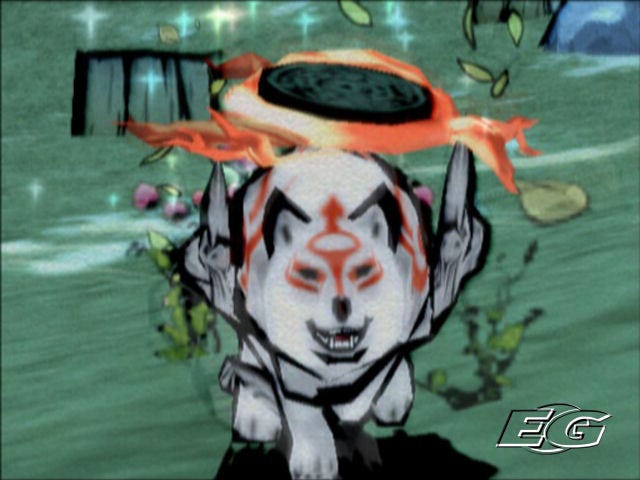
wolfie

We would've called the game Wolfie, in tribute to our dearly departed pet. That's sort of what Okami means in Japan-o-land anyway.

Unfortunately, it's a yet another game where the land has been engulfed in darkness by a nefarious evil force known as Orochi, and, yes, another one where it's up to you to sort out the whole sorry mess, rid the world of evil and allow the nice fluffy villagers to get on and lead their idyllic rural lifestyles.

On the flip side, how you go about playing the all-conquering hero is somewhat more interesting. To combat this rising tide of evil, an old statue of a white wolf, Okami, is infused with the life force of an ancient god called Amaterasu - who just happens to posses the power of the Celestial Brush. And if that weren't improbable enough, you're accompanied by an ill-mannered talking bug called Issun, who also happens to be a calligrapher.

Fittingly, the cel-shaded brush art style matches the game's focus on the Celestial Brush powers. What you see are arguably some of the most strikingly beautiful visuals ever found in a videogame - never mind on the humble PS2. Every scene is like a living ink and wash painting, with stunningly graceful pastel landscapes populated with buildings, wildlife and fauna that are lavished with an equal degree of crafted attention. As captivating as the gameplay undoubtedly is, the process of constant exploration benefits no end by the superhuman effort that Clover invested into the art direction and animation.

Restoring light and nature back into the game world isn't just something to satisfy the gamer in you - its floral carnival turns the game into some sort of interactive digital art gallery. Some of the effects that kick in whenever you've done Something Good are truly sights to behold, and hopefully will help no end in persuading people to buy the game in the first instance - even if they're wary of what the game's actually like.

The brush off
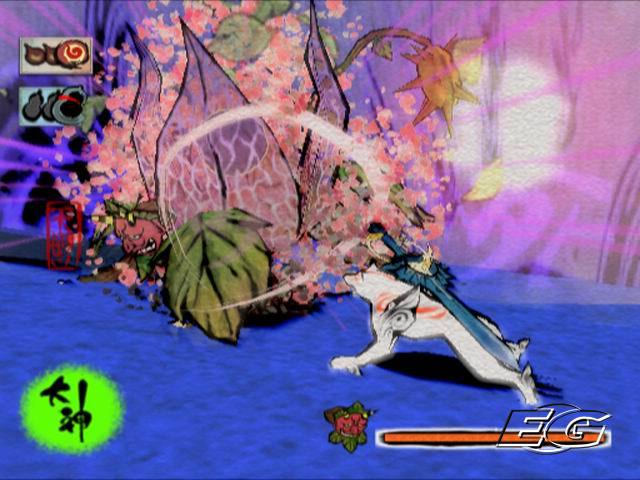
anti

It's like the anti-Gears of War, basically. Therefore +2 on the EG-ometer.

But what's just as important in making Okami stand out as Something A Bit Different is how much of the gameplay hinges on your mastery of the 15 Celestial Brush techniques. On a basic level it gives you the ability to see off enemies and deal with environmental puzzles by drawing on the screen. To begin with, you'll learn basics like Sunrise, which allows you to turn night into day by drawing a circle in the sky, and Rejuvenation, which lets you mend broken bridges and the like. But soon enough, more fundamental techniques like Power Slash creep into the gameplay, which not only help you cleave rocks and wooden obstacles in half, but give you more powerful options during combat.

At first, using the Celestial Brush techniques can feel a little clunky, mainly because reliably drawing straight lines and circles isn't as straightforward as it could have been. To make things easier, the game generally pauses (and goes into a sepia mode to emphasise the effect) when you hold R1 to draw, so there's usually no time pressure to draw a circle or a straight line. Allowing players to take their time over their brush strokes is definitely a key part of helping you get to grips with what is, after all, a very odd game mechanic to have thrust upon you. But with confidence and experience comes added responsibilities, and Okami is positively loaded with them.

At key intervals in the game you'll be rewarded with yet more techniques, such as the Cherry Bomb (to blow up enemies, cracked walls and so on), Bloom (to make withered flora and fauna blossom), Water Lilly (to allow you to traverse bodies of water), and Vine (to reach giant blossoms in high places). Later on, you'll learn even more advanced techniques that give you more control over the elements - without completely spoiling the vast number of treats in store for you. Regardless of the power of these techniques, though, pulling them off is always extremely simple, with just a simple stroke required in most cases. More often than not, context is key, with the game giving vital clues when drawing, such as colour-coded 'holy smoke' allowing you to know precisely what technique you can use on any given piece of scenery or enemy.

Modern art

Thanks to a pleasantly gentle learning curve, getting up to speed with how and when you use the brush is handled very well. By the time you're making decent progress with the game, the sheer breadth of contextual options available to you during combat, in particular, makes it an intriguing and unique game to play - and the feeling of satisfaction when you've dispatched a particularly troublesome foe is palpable. All it requires is often a little imagination on your part.

That said, if there's one thing that threatens to derail Okami from scooping the 10 it so richly deserves, it's the occasionally unreliable nature of whether it 'understands' your brush strokes or not. Although even the most intense battles rarely require complex strokes from the player, the game will sometimes mis-read your intentions - especially when trying to perform otherwise routine brush strokes. Simple acts like the powerstroke can be simply ignored in the heat of combat (usually as a result of your own wavering touch, but still), and, likewise, basic environmental tasks such as blooming (where you draw a circle around a dead tree or a patch of lifeless ground) will fail unless you draw them where the game wants you to, forcing you to have to draw the same thing over and over until it works. The problem is mainly that the PS2 pad just isn't the right tool for the job, and partly because our hands are rubbish; in fact, Okami's ideas would have worked far better on the Wii, but that's never going to happen, now, is it?

fish

Whack flying fish! 11/10!

Using your brush techniques is only part of the story, though. In many respects, Okami sticks to tried and trusted action adventure controls and mechanics, and these definitely help make it feel less like a quirky experiment, and more like something that's building on extremely solid foundations. For example, movement and camera controls stick to the sensible two stick method that most third person games utilise these days, with X to jump, square to slash, triangle to block and circle to fire projectiles. In fact, most of the early combat encounters allow you to slash wildly - but soon you'll face enemies who can block indefinitely - until you bother to power slash their shield, for example. Weapons gradually play more of a part as the game goes on, but throughout you'll have the choice of a main and a sub weapon, which can also be powered up as you buy gold dust at the various merchants that you'll encounter along the way. In addition, you'll be able to learn new, increasingly powerful combo moves at the Dojo, while garnering praise for your good deeds allows you to power-up in other ways, such as increasing your reserves of health and ink. The latter, in particular, becomes more important as powerful brush moves drain a greater quantity of your ink reserves. But like everything in Okami, the rate of progression is judged so well that by the time you need greater powers, you'll most likely have already powered yourself up anyway.

Dig it

But like many epic games, Okami rewards players who are thorough in numerous ways. Feeding animals and birds, for example, gains you praise points, as does making sure you restore withered trees to full bloom, not to mention the endless amount of treasure you can dig up and uncover if you're determined. Such tasks never feel like a chore, though. It's the kind of game where you'll happily while away the hours doing very little, because the actual process of finding treasures and restoring the landscape is calming in its own strange way, and actually beneficial to your overall progress in the long run. It's probably one of the nicest games you'll ever come across, but never in a nauseating or tedious way.

poignant

It's simple, poignant moments like this that make us not want to stop playing.

As flowery as Okami might look on the outside, there's a menacing underbelly around every corner. If you're not careful, you can end up straying into the game's equivalent of a random battle, where a wafting green flag can suddenly trap you inside a mini-arena battle to the death. Happily, these don't ever take that long to finish off, and do earn you money, so it's not all bad. Inevitably, there are tons of mandatory encounters with a handful of enemies that similarly trap you within the confines of a small arena - but after a while you'll have so many cool ways to fight back that the combat actually becomes much more interesting than ever seemed possible. Boss encounters, in particular, have an excellent knack of forcing you to be imaginative with your abilities, and - as a result - offer some of the most memorable (and some of the most frustrating) parts of the game. Bizarrely, the first boss you'll encounter proves to be one of the most taxing - mainly because of the previously discussed control limitations, but also because the camera sometimes just isn't flexible enough to give the player the angle they need to do the job. (You'll know what we mean when you get there).

But no amount of landscape evilry or multi-headed bosses can compete with the challenge of actually playing through the entire game. Estimates put the figure at around 60 hours, which is about four to six times the size of most console games these days (though pretty much on a par with Zelda, obviously). Normally when Mr Publisher spouts "60 hour epic" in our faces, we roll our eyes collectively to the heavens and redirect the jiffy bag to the nearest Japanophile. You might say to yourself that you haven't got the time, the will or the inclination to fight your way through endless battles in order to see what these games have to offer - but when you come across a game a packed full of quality moments as Okami, you'll be grateful that the developers went to such incredible lengths. You'll also be delighted with the little things, like being able to save regularly, and the wishpools that let you teleport between areas, and the fact that dying in the game isn't too much of a big deal because it always checkpoints extremely sensibly. You'll admire the fact that the game's challenging without being annoying, and those silly little 2D digging minigames. And the fishing. And the fact that pressing X repeatedly while the game's loading actually rewards you for your impatience. There are so many nice touches about Okami you'll wonder how on Earth Clover Studios could be shut down after making one of the best games Capcom has ever released. No justice.

Okami is, without doubt, a landmark game, and one that's beautiful in almost every sense. A few very minor control and camera issues occasionally threaten to gnaw away and the ankles of the design perfection running rampant throughout the game, but even they can't possibly undermine what is a fantastic achievement that may not be topped in the genre for some time. Right from the start it conjures an atmosphere of being something special, but to keep that level of quality up consistently over 60 hours ensures that this will be a game that will be talked about for years to come.

A work of art, you might say.

10 / 10

Read the Eurogamer.net scoring policy

Comments (191)

Comments for this article are now closed, but please feel free to continue chatting on the forum!

  • Loading...hold tight!