MMOs' wild frontier • Page 3

Think it takes a publishing sugar-daddy and big budget to make an MMO? Think again.

The MMO market is a strange place: a land of boundless opportunity, or at least perceived to be, going by the tales of hardy adventurers into the unknown like EverQuest and EVE Online and, of course, the great explorer World of Warcraft, who ventured deep in-country and found riches beyond imagining.

So games publishers, seasoned developers and media companies around the world have been busily financing their own expeditions - but few so far have been as successful as their backers might have hoped, and sometimes it's seemed as though the more money they spent and the more sensible and experienced they were, the more likely they were to stumble in Blizzard's footprints. But the huge cost of and risk now involved in these expeditions has surely ruled them out for everyone else. Or has it?

Not hardly. Like any gold-rush, the MMO market also attracts a different kind of adventurer: the fearless, inexperienced, determined and solitary dreamer, making a go of it on nothing but their own resources and pluck. The online distribution and direct revenue streams - be they subscriptions or micro-transactions - make it theoretically possible to make a mint in MMOs without any help from the gaming establishment at all.

Several of these enterprising types were hawking their wares at last month's Game Developers Conference. From the pet project of a multi-millionaire to the abstract vision of one mad coder, these games are all made by start-ups without, to date, any backing or partnership with the games industry - yet several of them are full-scale virtual worlds that lack nothing in their ambition. Do any of them have a chance of striking gold?

Earthrise

We didn't know it at the time, but when we met Bulgarian studio Masthead's mild-mannered CEO with the cosmonaut name, Atanas Atanasov, he was on the point of concluding a deal with Interplay to work on its cherished but endangered Fallout MMO. So this lone rider has turned hired gun already - but Earthrise remains all Masthead's own work.

It's not hard to see what made Interplay think Masthead would be a good fit. No fewer than three of these independent MMOs have post-apocalyptic sci-fi settings, but Earthrise's blasted landscapes, mutant animals and cracked architecture are particularly close to Fallout's. We might question Interplay's enthusiasm for Masthead's engine, however - the framerate was as rocky as the terrain in our demo, and though the detail was impressive, the game had a rather flimsy look.

1

Earthrise: it's not all this lush.

We've covered many of Earthrise's basics in our earlier interview with Atanasov; freeform skill-based RPG advancement with no classes or levels, a focus on crafting and a strategic endgame of player-versus-player territory warfare. He expanded a little at GDC - your character will be shaped very much by its equipment, with your stats dependent on your armour (a naked character will usually die with one hit) and weapons - fists, blades, plasma and laser firearms - dictating which skills will be available (you'll be able to learn them all, but not equip them all at the same time). All of this will be summarised in a "battle rating" to give you something to brag about.

Psionic powers for mind control and electricity and fire magic will also feature - Earthrise isn't breaking the links with the fantasy RPG completely. That goes for combat, too. Although superficially similar to Tabula Rasa, with its lock-on and over-the-shoulder camera, Earthrise has an even slower pace than many traditional MMORPGs. In fact, it's glacially slow, with four-second cooldowns on simple gunshot attacks. The seamless, zoning-free world is an impressive achievement, and it's pretty in places, although with 80 per cent of it being barren and post-apocalyptic, it's not all that inviting.

Earthrise has much that will recommend it to a certain subset of the MMO hardcore, but in its current form it will seem unpolished and obtuse to many. And with the first beta invites due to go out in May with a release planned for the end of 2009, Masthead doesn't have long to do much about that.

Fallen Earth

Fallen Earth is a company so single-minded that it named itself after the game it's creating. Once again, we're in post-apocalyptic wasteland territory, although this time in the nearer future (150 years away) with a very clear sense of space - the Grand Canyon, reproduced to scale.

100 years after a plague has ravaged the earth, politically and ideologically opposed factions are warring over the Canyon's uranium. All player characters are clones, which explains their ability to resurrect in this markedly more realistic setting than most MMOs'. After "birth" in the Hoover dam, the last bastion of civilisation, the tutorial will then take new characters through the basics of Fallen Earth's free, FPS-style combat, which balances reactions and accuracy with RPG number-crunching.

Once again, advancement is classless and skill-based, and though there are levels they're less important than in most RPGs. You get a couple of advancement points to spend every tenth of a level, though there are other sources. As well as skills themselves, you'll spend them on attributes: first aid, athletics, group tactics and social (bartering) skills, for example. Mutations explain away the "magic": telekenesis, telepathy, nano technology and the plague.

2

Fallen Earth: broken concrete as an art form.

Deep research-tree crafting, trade economy, vehicles and factional warfare in a scrappy, hardscrabble Mad Max world is the name of Fallen Earth's game. You can earn experience from crafting alone, and vehicles will be the big money- and time-sink. But going by the ATV we saw in our demo, they'll struggle to appeal in handling practice as much as in theory, which might be a problem when it takes a month to make a car.

Fallen Earth's hearty bleakness, semi-realistic setting, open exploration and clever factional setup (nature versus technology, order versus anarchy, faith versus commerce) are a great draw amongst the much more generic worlds, sci-fi or otherwise, that beset MMOs. But once again, the execution is lacking - stilted animation, unconvincing combat and erratic AI were the first and most glaring issues. Aiming once again for release this year, Fallen Earth has a long hard road ahead of it.

Gatheryn

I was starting to get the sense that these loners' games were all pursuing interesting ideas down niche-interest cul-de-sacs, and that none of them possessed the presentational skills to bring those ideas back out into the light. Gatheryn didn't reassure. Supposedly aimed at a casual audience, here was a proposition so bizarre it seemed to appeal to its makers and no-one else.

3

Gatheryn's mini-games will rely on "tried and true" mechanics, says MindFuse.

Developer MindFuse brings together talent from both ends of the gaming spectrum - LucasArts and Shockwave Flash games. If only they could be said to meet in the middle. Gatheryn is a 3D social virtual world with a top-hats-and-zeppelins Victorian steampunk theme, overlaid with 2D puzzle-game diversions and persistent MMO character development. It doesn't, frankly, make any sense.

Planned for 2009 once more, Gatheryn looks even shakier than Earthrise and Fallen Earth, despite being much less ambitious (technically, at any rate). Its genteel township looks ten years out of date, and the gameplay seems to be drawn from every standard MMO element except the central one - combat - without any thought as to what would replace it. Resource gathering, questing and taking to NPCs are all present and correct but don't appear to have any meaningful design or purpose to them; crafting did, just about, involving a gem-matching mini-game just barely related to the task at hand.

With only 15 mini-games of this sort, plus a few even lighter micro-games, it's hard to see what MindFuse expect their players to do except shop for costumes, pets and housing trinkets with micro-transactions. Gatheryn is free-to-play, but you'll need to pay a subscription for the right to own property and aim towards the big collaborative goals - building an airship, for example.

Up against the likes of Sony Online's ruthlessly polished and broad-church Free Realms, Gatheryn seems like a curio at best, a misguided shot in the dark. The search for a promising indie MMO was starting to look like a wild goose chase.

Global Agenda

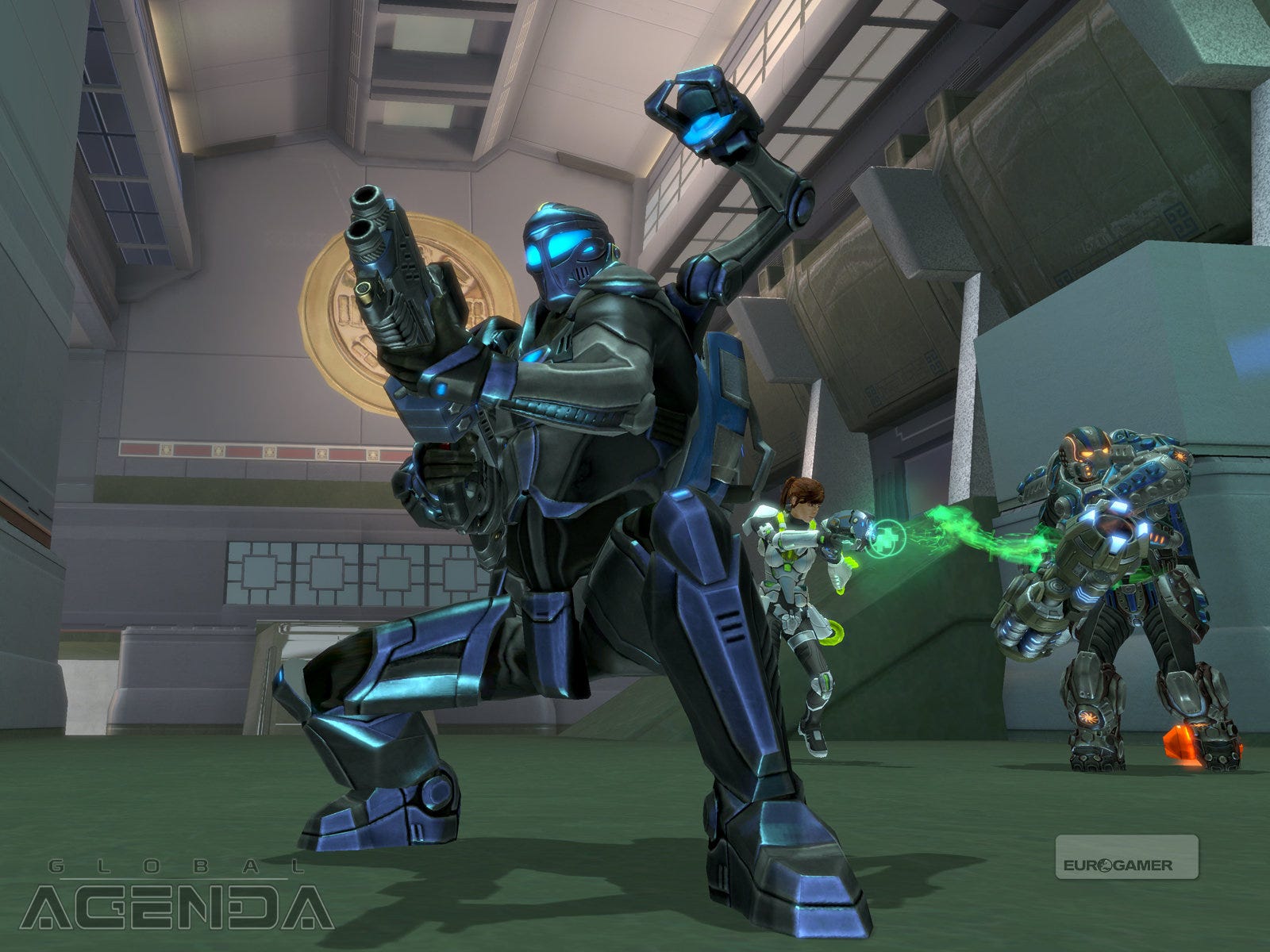
And then along came Hi-Rez Studios' Global Agenda. Playable with the developers on closed alpha servers, this fast-paced blend of "spy-fi" MMO and deathmatch FPS stunned with its professionalism, slick graphical sheen and effortless playability. It puts many games from much larger companies to shame.

Funded by Erez Goren, an "eccentric self-made millionaire" in software who dreamed of being a games programmer in his youth, Global Agenda could be the ultimate vanity project in videogames - if something this focused, smart and appealing can be called a vanity project. A team of 45 based in Atlanta, many without a games background, has been piecing Global Agenda together since 2005.

The core of the game is in 15-minute player-versus-player matches that play into a massive global domination metagame contested by alliances of player-run agencies. This runs in "seasons" lasting around 45 days, after which a winning faction is declared. There's also one big NPC faction to fight: sinister despots the Commonwealth. The matches might involve escort missions or agency raids, but always result in fast and fluid skirmishes between the game's recon (sniping and intelligence), medic, assault, and robotics (remote control pets and turrets) classes.
4

Global Agenda: thankfully you don't have to do the Global Minutes afterwards.

Once again, the quality and specialisation of your gear is your primary concern, with Global Agenda's levelling system advancing versatility rather than power - appropriately for a game whose combat rests so heavily on player skill. Equipment is divided between primary and secondary ranged or melee weapons, jetpacks, and offhand gadgets with cooldowns that act more like your traditional MMO abilities, all fed from the same power source. In an RPG nod, damage comes in four kinds with matching resistances - energy, fire, physical and poison.

Equipping, re-equipping and re-speccing your character for action on a neat loadout screen is half the fun in Global Agenda. The other half is in battles which somehow maintain a furious pace without ever descending into chaos, in part thanks to a busy, colour-coded interface that makes all the damage and healing going on crystal-clear. Unlike so many MMOs, it's a tactile and physically satisfying game to play, too, with the weapons and jetpacks having a finely-tuned feel. The hi-tech future setting is entirely generic, but presented with a bold sheen and clear silhouettes for the chunky and appealing characters.

Global Agenda is very tight indeed, and for once the aimed-for June beta and end-of-year release seem entirely feasible. Score one for the poor little rich guy.

Love

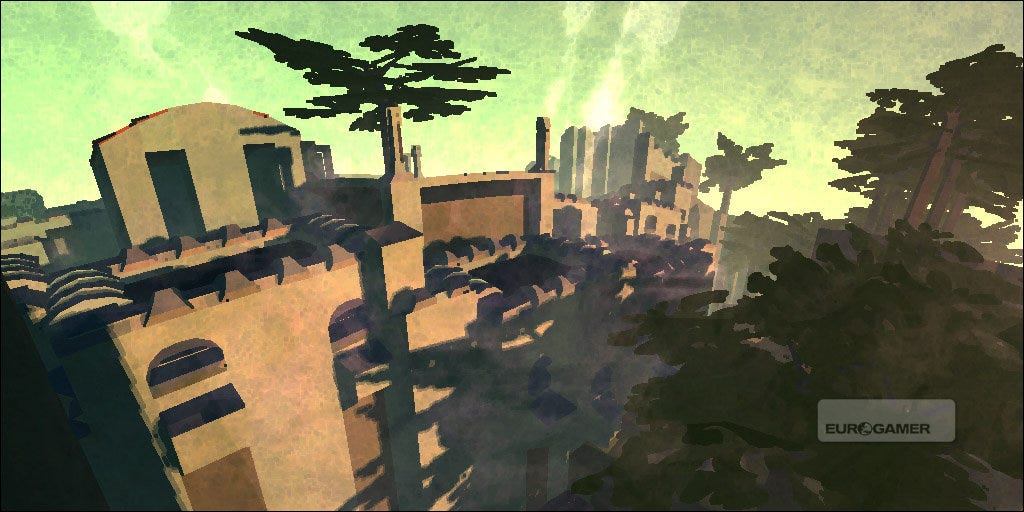
As nice as Global Agenda looks, there's no doubt that the most visually arresting MMO I saw at GDC was made not by an eccentric millionaire's private army, but by an eccentric coder's army of one. Eskil Steenberg may well be mad, but one thing's for sure - he's outrageously talented.

We've covered his micro-MMO, Love, before. Check out Jim's preview from last year's GDC for the full details of this esoteric, atmospheric blend of city-building, FPS action, procedurally-generated worlds and breathtaking watercolour visuals. I confess I spent much of my time with Steenberg talking about his astonishing tools, a series of art and asset management programs with crisp vector graphic interfaces straight out of Rez that allow him to tweak assets on his servers in real-time.

You can debate whether Love - which will have a couple of hundred players to each server - is really a massively multiplayer game. You can wonder whether its fast-and-loose combat and collaborative progress will gel and compel, whether giving players the freedom to deform the terrain is a step too far, whether its tiny world will feel hemmed-in after a while.
5

Love: it really does look like this. Really.

The tactics and puzzle-solving based around disrupting energy lines and power grids to bypass shields - which have an environmental angle too, as wind-turbines die down around sunset in Love's short day-night cycle - are intriguing, and Steenberg says he'll concentrate on enemy AI in the next phase of development. But you can't, at present, tell whether Love will hang together.

You can, however, tell that people will want to play it. Its delicate, impressionistic visuals and lone-wolf indie cred will get it that far. Steenberg's plan to start with one server and grow the game organically may well prove impractical given the level of interest; he will, eventually, need help.

But his story is still an inspiring one. So is Hi-Rez Studios', which may operate at the other end of the financial scale but which is still an outsider in a way, just as EVE Online's developer CCP once was. Even in a post-WOW world, massively multiplayer games can be made outside the system and can still be beautiful, exciting, ambitious - and can work.

Comments (23)

Comments for this article are now closed, but please feel free to continue chatting on the forum!

  • Loading...hold tight!