Version tested: DS
I've been having a lot of weird dreams recently. You know the sort - when you've been playing a game obsessively and its processes become so deeply infused with your thoughts that they infiltrate your consciousness at a very base level, giving you abstract and repetitive night terrors about making colourful elves stand in lines behind deer in dresses.
No? Well it happens to me. More so since I began playing and became thoroughly engrossed by Might & Magic: Clash of Heroes.
On the surface it's a familiar concept - put things in threes as much as you can before your opponent does, matching shapes and colours to each other to clear them. Set in the world of venerable PC series Might & Magic, there are elves and knights and demons and zombies. No one would blame you dismissed it as a cookie-cutter DS puzzle title. But you shouldn't do that, because developer Capybara, the team behind the awesome Critter Crunch, has crafted a real gem from a largely redundant old IP.
Firstly, any veterans of the Heroes of Might & Magic series would do well to leave expectations at the door (and sorry about the "largely redundant" thing, by the way). You will be familiar with the factions of Haven, Sylvan, Infernal et al, but the role-play and turn-based battle strategy of the heroes series has been tempered and forged with a strong element of puzzle. Think Puzzle Quest but with soldiers in place of gems.
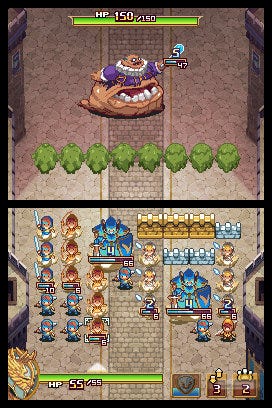
Boss encounters swicth things up a bit, requiring extra precision or planning.
Players begin as the elfy Sylvans, with a complement of fast and basic troops. Your army is quickly expanded with two more types of basic soldier, each taking up one square of the playing field. Organise them in vertical lines of three, either in a Tower of Hanoi-style pick-and-drop or by removing soldiers in the way, and they will activate, charging up an attack over the next few turns to unleash on your enemy.
Attacking means shooting or charging upwards, haemorrhaging attack points as units plough through enemy formations and defences before carving whatever's left from the health bar of the opposing general. Activated units also soak up a lot more damage than individuals, making them as valuable for defence as attack. At this stage the only other option is to arrange your troops, each type assigned to one of the three colours available, in horizontal rows instead. Do this and they form a wall rather than an attack formation, protecting your hero, who's standing courageously at the back, from charging enemies.
Then it all gets a bit more complex. You're given Elite units, which come in all three colours and occupy two vertical spaces on the grid. They need two normal units of the same colour to be stacked behind them in order to charge, and can't be used in walls. They're more effective than the basic units though, as reflected by their increased charge time and limited numbers, and each has a special function - healing, enhancing, extra damage, bypass defences, that sort of thing.
A little later you'll be rewarded with your first Champion unit. These are the behemoths and dreadnoughts of the battlefield - dragons, ents, griffons and efeets, who each occupy a square space of four and require another four basic troops behind them to activate. Once they do, however, they tend to be powerful enough to end a battle, unless your opponent can hastily prepare a counterpart in his own ranks. Each faction also has unique properties for its walls, as well as a powerful spell, cast once a 'rage gauge' is filled by damage.
These three classes of unit, further divided into different varieties, already provide an excellent basis for a strategically developed battle system, offering as they do a variety of options for assault and rebuke, but Capybara has added yet another level of complexity.
Activating a basic or Elite unit behind an identical unit which is already charging will 'fuse' the two, doubling their attack power and adopting the better of their two countdown times. The other tactical option is 'linking', when two activated units of the same colour, although not necessarily type, share the same countdown timer. Any units of the same colour who attack on the same turn will also have their attack power multiplied.
At the end of each battle you collect resources and experience, with both the hero and individual unit types adopting a simple RPG levelling system, while resources buy replacement Elite and Champion units.
Overall it's a pretty complex system, and one which will take a couple of hours to get used to. Picking which troops to take to battle is a vital part of strategy too, as you decide whether to focus on speed or power, attack or defence. Multiplayer games see a further level of customisation in the choice of the five very distinct yet excellently balanced factions.
This depth is initially confusing and indeed frustrating. Trying to follow the developments on-screen as your opponent seemingly racks up endless magical combos, sweeping your tentative strategies from the board, is tedious business. Once it clicks, however, Clash of Heroes begins to reveal just how much it has to offer.
The greasy Necro armies are all about queasy colours, ganky tactics and classy evening wear.
For example, you notice how important it is to remove pieces. Erasing single units causes those above to 'drop' towards the centre line, activating chain reactions and granting you extra moves before control switches back across the board. These tactical gambits, rendered ever fragile by the possibility that they'll be utterly destroyed before they reach fruition, are incredibly satisfying to pull off, and can turn a battle in your favour. In fact, recognising when a turn can be saved by the judicial use of this mechanic is probably the most important thing you can learn.
Hidden areas and secret units dot the environments, which are presented in classic Heroes of Might & Magic map-node style, whilst side-quests break up the narrative action. Another interesting addition are the battle puzzles: set-pieces which see you up against a formation of enemies who must be destroyed in a single turn with only a limited number of your own troops on the board. These are the most mentally intensive of COH's challenges, requiring substantially lateral thinking.
This being Might & Magic there are some familiar gripes among all this praise. Difficulty spikes crop up a little too often, and occasional boss stacking with no chance to save in-between is a low blow. Grinding is a necessity for all but the most gifted too, although battles never really become repetitive, forced as you are to adopt new strategies according to the lay of your armies.
The AI also makes a few strange choices, despite generally playing intelligently enough to offer a decent challenge without resorting to Puzzle Quest's 'convenient' enemy gem sequences. Chance is an obvious element too, and can be irksome when fate's fickle finger falls awkwardly for you, but defeat simply means a very quick reload and another try - chaos giving you the eventual edge in the war of attrition.
All the same, the campaign is huge, with five factions to command through a storyline of solid if unremarkable fantasy guff. There are a good 30 hours of single-player action alone for a talented and lucky player. Add to this the limitless possibilities of multiplayer - accessible with a single cartridge and two handhelds - and you've a huge chunk of game.
During the course of writing this, Eurogamer MMO editor Oli Welsh popped up on my MSN to ask me if I thought it was a puzzle, RPG or strategy game. It has enough elements of each that I honestly couldn't say. What I did do was recommend it to him wholeheartedly, because, whatever it is, Clash of Heroes is a very good game indeed.
8 / 10
Might & Magic: Clash of Heroes is out now in the US and will be released in Europe on 22nd January.
