Version tested: PSP
"We love you, Snake. Don't come back," I wrote at the end of my review of 2008's Metal Gear Solid 4: Guns of the Patriots. I felt that the mad, glorious indulgence of that so-called finale had left the series and its quixotic creator spent. Not all of you agreed.
Well, lucky for you, Hideo Kojima and his Konami paymasters have found a loophole. Snake's not back - not that Snake, Solid Snake. Peace Walker, the PSP game that Hideo Kojima wants you to think of as Metal Gear Solid 5, stars his clone-daddy and sometime nemesis Big Boss, a.k.a. Naked Snake, in another Cold War adventure.
Its story, set in 1974, follows in the footsteps of Metal Gear Solid 3: Snake Eater and PSP forebear Portable Ops, shading in the background detail on Kojima's secret world of walking nukes and superspy soap opera. Those are the two games in the series Peace Walker shares the most with, too; the Central American jungle setting echoes Snake Eater's moody, outdoorsy tone, and there's a squad-recruitment system like Portable Ops' - albeit completely changed, vastly refined and improved, and offering what must be the most absorbing framework for a Metal Gear game to date.
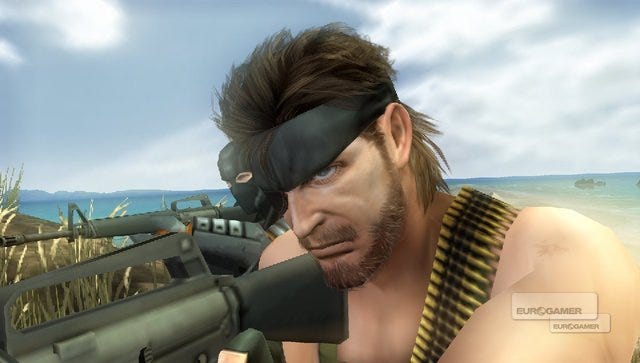
Snake continues to set the bar in videogame facial hair with this Tier One seventies beard.
You also get competitive multiplayer, co-op for two or four players across the full-length campaign (all playable locally or online), a trading system and an extensive suite of bite-sized bonus side missions, all presented with Kojima Productions' customary verve and immaculate sheen. It's an astonishing package that in terms of raw features sets a new standard for the PSP platform, and arguably for the Metal Gear series too.
Directing himself, Kojima has channelled the MGS4 development team's energies from hi-def hyperbole on the PS3 to polyglot completism on Sony's handheld - a wise move, well-informed by the success of portable classics like Monster Hunter Freedom and Pokemon. Another masterpiece of production values from the house of Hideo, Peace Walker is a Rolls Royce of a videogame, something the PSP sorely needs.
But is it what Metal Gear fans need? And does it do anything to convince the rest of the world that it still needs Metal Gear?
Explained by rumours of dinosaurs roaming the Costa Rican jungle, the Monster Hunter bonus missions are a secret easter-egg unlock.
As ever with this love/hate series, the answer - a cop-out, but an inevitable and honest one - is largely "yes and no". Expansive and inspired in some ways, stubborn and reactionary in others, compromised by its platform even as it pushes it further than anyone else has, Peace Walker is the same old maddening, lovable Metal Gear.
You've never needed to look far for contradictions in these games, especially when it comes to Kojima's curious blend of sentimental, preachy pacifism with a drooling fetishism for the real and imagined machinery of war. As in Snake Eater, though, the paralysed conflict of the Cold War makes for a highly appropriate setting for his slightly muddled musings, not to mention a less anachronistic one for his pervasive nuclear paranoia.
Peace Walker sees Big Boss making a home for his Militaires Sans Frontières mercenary enclave in Costa Rica, where he's recruited by a local, peace-loving academic - actually a KGB agent - to investigate the doings of a well-armed, CIA-funded militia in the country. Misgivings melted by a pretty, innocent student called Paz, this exceptionally grizzled and world-weary Snake grumblingly agrees to sneak around and shoot men in balaclavas one more time in the name of peace, or war, one of the two.
Naturally, nothing is as it seems, and Snake uncovers a spook plot to construct nuke-launching mechs that are supposed to create the ultimate deterrent across Central America, but will probably spark another Cuban missile crisis. Falling in with some improbably cute Sandinistas, Snake establishes and grows the MSF at an offshore compound - Mother Base, the beginnings of Outer Heaven - while, rather confusingly, beginning building his own Metal Gear mech, a deterrent to a deterrent. Just don't think about it too hard.
It's actually one of the more grounded and low-key Metal Gear plots (not saying much, I know), and it takes a while to get going. It makes sense both in isolation and in the context of the series' timeline, and thankfully doesn't get too bogged down in the interminable exposition and hapless continuity entanglements that blighted Guns of the Patriots.
But it's also lacking in pizazz, and there's something slightly rote and methodical this time in Snake's disentanglement of yet another military-industrial, conspiratorial super-weapon programme. The setting, though atmospheric, seems samey after MGS4's globe-spanning strides, and the boss fights are probably the least dramatic and most tiresome in the series' otherwise illustrious history.
Vehicle bosses bested in the campaign can be repaired at Mother Base and deployed in the automatic Outer Ops missions. There's a 3D model viewer for absolutely everything.
The delivery is superb, though; even cut-scene haters would have to admire the stylish, animated-graphic-novel style of Peace Walker's substantial but not overlong story interludes. Illustrated with restless, dynamic splashes of ink by Ashley Wood - who also did Portable Ops and the MGS Digital Graphic Novels - and simply but well voiced, they have some neat interactive features and a relatively punchy pace. David Hayter turns in an almost parodic croak of a performance as Naked Snake, but unearths a sweet tenderness in him, too.
In between the dialogue, you'll find yourself engaged in a taut action game that, despite an overflowing cornucopia of tactical options both serious and silly, remains a hardcore stealth game at heart, and is best played that way. No surprises there, then. But Peace Walker does improve on one of the Metal Gear series' long-standing weaknesses - positive reinforcement of stealth play.
It's always been too hard to play Metal Gear well and too easy to play it badly. But Peace Walker shifts that balance in the right direction and also gives you meaningful rewards, beyond tension and enjoyment, for following the stealthy and non-lethal route. The more tidily you finish a stage - with fewer alerts and kills, in shorter time - the more Heroism points you're awarded at the end, and these increase the rate of unlocks across the game's huge spread of items, features and bonus missions.
Snake Eater's useful percentage stealth meter returns, although there's no camouflage beyond a simple choice of costume - it's mostly about movement and environment.
Also, non-lethal and surreptitious takedowns allow you to scoop the sleeping enemy out of the field of battle with your Fulton Recovery System - a comical balloon that whisks him up to your waiting MSF helicopter. That means his body's not there to be discovered, and it gives you a new recruit for your MSF ranks to boot. Prisoners can also be rescued in this way. It's very satisfying.
The campaign is broken into fairly short stages - Main Ops missions - and these are further broken up into very small maps so as to accommodate the gritty texture and attention to detail that you expect of Metal Gear on the PSP. No real complaints there, but the absence of any checkpoints at all within each mission is baffling and infuriating. Many stages are easily long enough and hard enough for you to die a few times - or want to restart if you're aiming for a good rating and slick play - and despite being designed with obvious care, they still have an element of trial-and-error that's endemic to stealth gaming. But you have to start from scratch each time.
It's true that there's an admirable purity and methodical toughness to this, something Demon's Souls has proved that many of us still want from our videogames. But stripped of that game's epic dimension, in Peace Walker's case it errs on the side of frustration and repetition, and it's also notably unsuitable for handheld play. Once you know the game well, however, replaying stages to optimise your performance and reap more recruits and points should be a pleasure.
Those recruits and points feed into Mother Base, a between-mission management meta-game and unlock hub. Here you can assign (or auto-assign) recruits to combat, mess hall, intel, medical and R&D teams. R&D is the most important, since this opens out a huge unlock tree of tasty weapons, gadgets and upgrades. But you need funds for that, earned by your combat team in turn-based, automatic Outer Ops battles that play out while you engage in the game itself. Medical and mess hall teams support your soldiers, while intel supports you with in-mission strikes and supply drops.
It's an exquisitely balanced and wholly satisfying system; expanding and levelling your teams and fleshing out your armoury has the potential to be a great long-haul hook for multiple playthroughs of the campaign, bonus missions and multiplayer modes. There's potential for true devotees to lose Monster Hunter months to this game.
Here's hoping that it develops an online community to support that, although solo play is hardly short of scope, thanks to the Extra Ops bonus missions in particular. Your best option for on-the-bus, bite-sized play, these set a range of discrete challenges, from boss fights to Fulton recoveries to marksmanship and stealth runs, usually with a minutes-long time limit. Finessing your scores in these is more manageable and fun than in the campaign missions, and they too can be played in co-op.
Close Quarters Combat is streamlined and effective, another encouragement to proper stealth play in Peace Walker.
I've only had the briefest opportunity to try Peace Walker in co-op, but it seems like another very smart addition, if you can cope with the incongruity - delivered in typically tongue-in-cheek style - of having multiple Snakes crawling through a level, perhaps in the cosy two-man Love Box. Most missions support two players, and boss fights four; two players sticking close together share health and can even share moving and shooting duties.
That's an excellent innovation that will do a lot to smooth the sometimes rocky path through the campaign if you can find a willing friend. Because, sad to say, Peace Walker's complexity and ambition fights a manful but losing battle with the PSP's cramped control layout. Of the three options - modelled after Portable Ops, MGS4 and Monster Hunter - the MGS4 "shooter" layout is best, allowing you to adjust the camera or over-the-shoulder aim with the face buttons. But it's still sticky and slow and encumbered with awkward transitions.
It's sad, and not entirely Kojima Productions' fault, that at times Peace Walker is just too much game for the system it's on. But it is so very much game - I haven't even mentioned the competitive multiplayer (it's not that exciting to be fair, only supporting six players) or the fact that, of course, it's riddled with hilarious and strange easter eggs, not least the Monster Hunter cameo stages.
Recruited operatives are playable in multiplayer and most Extra Ops missions, and can level up in individual weapon skills and general abilities. This game is a bottomless well of stats.
Mother Base, co-op and Extra Ops are great additions to the Metal Gear formula and luxuriously comfortable fits for handheld play. The subdued campaign is not Kojima at his histrionic and surprising best, but it arguably offers the tightest stealth gameplay since Snake Eater or even the first Metal Gear Solid. It's still an acquired taste, but Peace Walker will satisfy fans, embarrass PSP owners with its riches, and ought to inspire curiosity at the very least in everyone else.
With actual reinvention promised by Metal Gear Solid: Rising while Peace Walker upholds tradition in a compelling new format, it looks like Hideo Kojima has had his cake and eaten it yet again. Alright then, Snake; I guess you can stick around.
8 / 10
