The phone rang with a shriek that would wake the dead before trying to sell them double glazing for hell. I answered. It was Tom Bramwell, his words entering my ears as if a lava flow of rage.
"I want a retro of Max Payne on my desk by the morning, Walker. This is your final chance."
I sneered at the wall. The wall looked back at me with blank indifference. "Sure," I muttered, "Sure boss, I can do that for you."
The game was on Steam, not exactly hard to get hold of. Six pounds. Nothing compared to the fee I'd be dropping on Bramwell's desk for getting the job done.
I stared out of the grubby window as the game downloaded, rain beating against the side of my house like an angry window cleaner. One day. One day I'd have my revenge for the mysterious events in my past that I'm only alluding to at this point. One damn day.
It seemed simple enough. I'm no stranger to retrospectives. You play the old game, you write about it. It sounds simple. It's never simple.
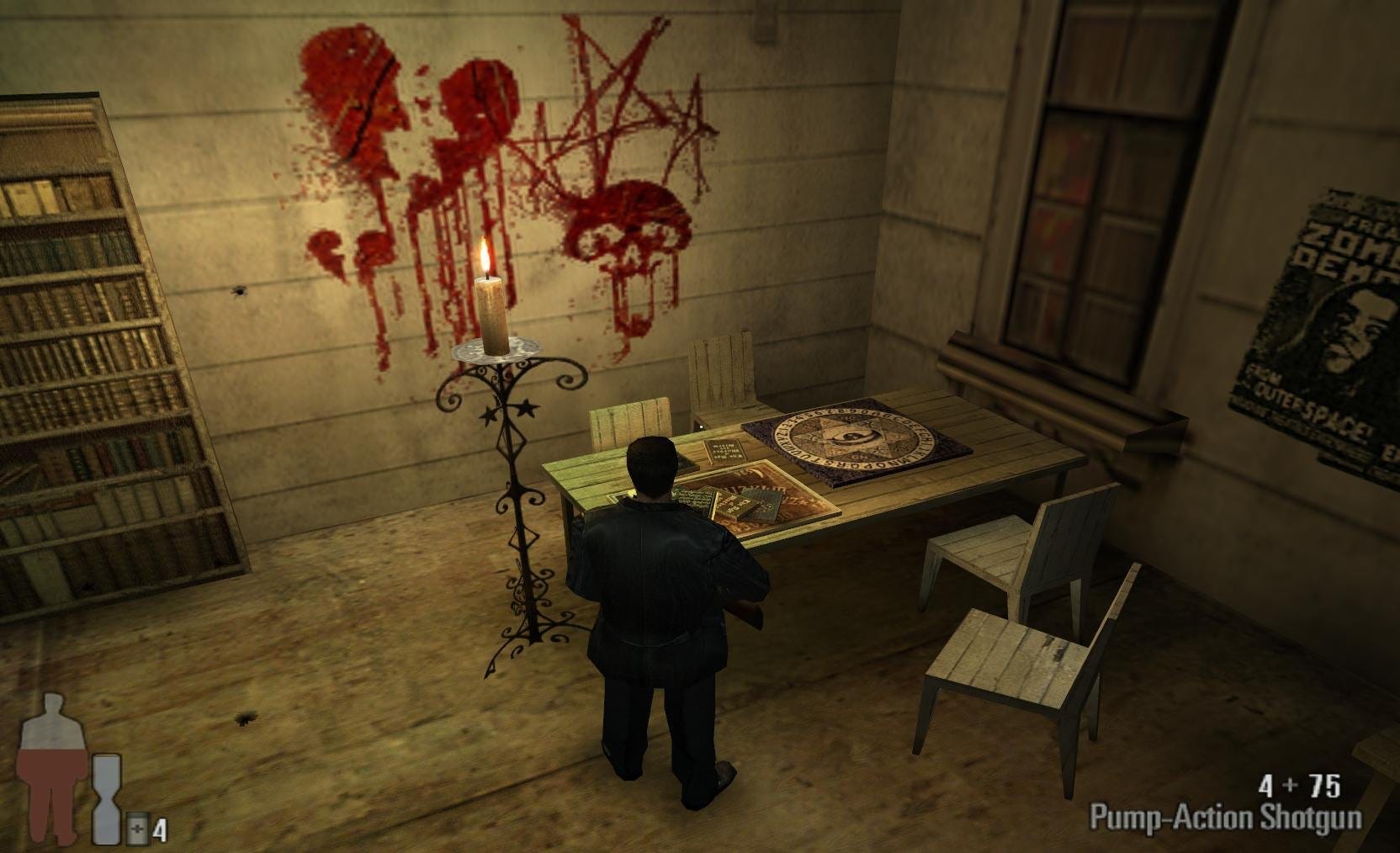
Blood splatter forensics are mystified by this crime scene.
The third-person shooter had been our first dance with Bullet Time. Sure, we've all been to bed with the gimmick now, but this was the first flirtation. For reasons unknown, Payne could enter a slow-motion world like a hand enters an oven glove. It doesn't stay forever, but it can handle a lot more heat when it's there. Able to react in real-time, it allowed Max to demonstrate his super-reflexes, filling enemies with bullets like he was making bullet pie with a human crust.
Oh crikey, I can't carry on with that. Tempting as it might be to write the entire piece in the style of the absolutely horrendous writing in Max Payne, it's actually pretty hard to do it any worse. This is a game that contains, within its graphic novel cut-scenes, lines like:
"The cops arrived, sirens singing in the off-key harmony of a manic-depressive choir."
The static cut-scenes, rotoscoped photographs, are laid out like a comic, the narration and dialogue presented in the appropriate bubbles, voiced by actors.
On some level I can only find respect. It's nigh-impossible to come up with a piece of writing that's as equally awful as it is brilliant. However, more often it's just plain bad. Max informs an enemy,
"Vinnie Gognitti, just the man I've been killing to see."
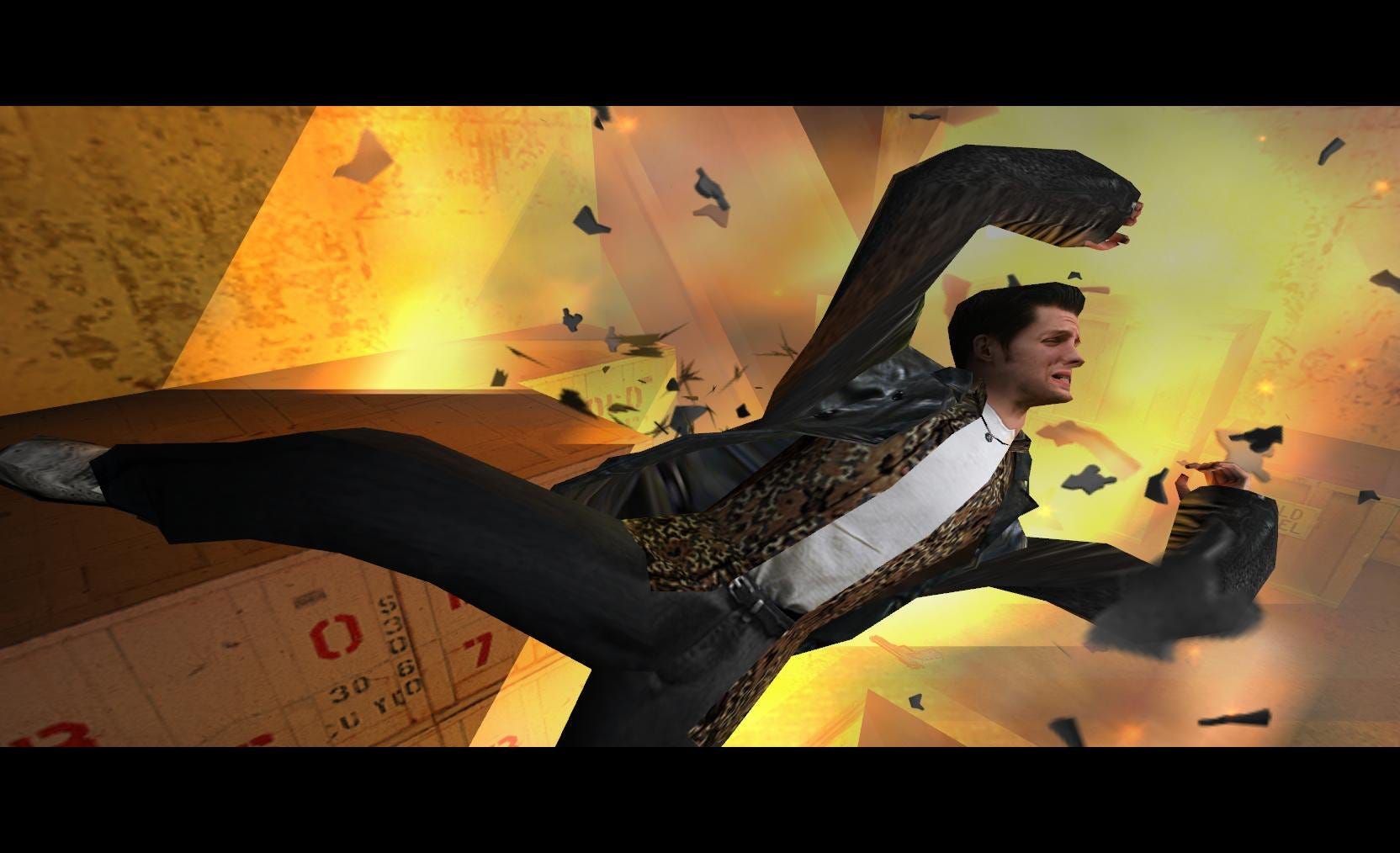
That grimace makes sense here. But it's permanently affixed to his face.
Or how about:
"I hadn't asked for this crap. Trouble had come to me, in big dark swarms."
"I had known there'd have to be a catch in it somewhere, and this one was the Empire State Building of catches."
I'd argue it's something to be treasured. Normally bad game writing is just plain boring. Goodness knows how many shooters seem to have been scripted by a machine more normally used for brewing instant coffee. (Oh dear, it's happening again.) Dreary nothingness, excusing one scene of shooting enemies into the next. At least here the endless scenes of shooting enemies are strung together by what might well be a form of poetry that's simply above my head.
However, rather more importantly, those scenes of shooting people are still really rather a lot of fun.
There's not really much to Max Payne. You're put in a building, and you have to kill everyone inside it. Room to room you go, picking them off from your extensive arsenal of weapons, occasionally slipping into slo-mo for trickier situations. But like any shooting gallery, that's more than enough to be entertaining.
At its original release it was a remarkable thing to behold. Now, because absolutely everything else has copied it, it's a very familiar place to play. Since it's in third-person you use the super-cheaty trick of swinging the camera to look around corners without having to put Max in the line of fire, then jump out, ideally in Bullet Time, and let loose your shower of metal fury. Like a furious thunderstorm.
(Okay, before we carry on, here's another favourite line: "He was trying to buy more sand for his hourglass. I wasn't selling any.")
My memory likes to pretend Max Payne came before the first Matrix film, but it's quite significantly the other way around. The Matrix was 1999, Max Payne 2001. It seems remarkable that it was two years before a game effectively incorporated the effect the Wachowskis had made look so cool. But Max Payne is equally influenced by the films of John Woo, and any number of hard-boiled detective fictions. Jumping sideways with guns in both hands, in slow motion, it's a small wonder doves aren't flying everywhere. Before Max comments on how their wings somehow remind him of the death of his mother.
And let us not forget the dream sequences. Max's anger is fuelled by the deaths of his wife and baby a couple of years earlier. His dreams always take him back to that house, to that night.
Walking along peculiarly decorated corridors, the game dolly zooms to create a sickening sensation of distance, the screams of his wife and cries of his child floating in the air, moving around your surround sound speakers such that you can never catch up with them. It's enormously effective, somewhat bolstered by the game still looking really fantastic a decade on. The character models look daft, but the cities and buildings hold up magnificently.
Enemy AI is a little daft, but fire one bullet and you're in for a tough fight.
The second time Max dreams, this time in a drug-fuelled nightmare, things get really interesting. The first time you learned what the house looks like (although perhaps without quite such a long landing, and it's unlikely to have ended in a path of blood floating in space), especially the baby's nursery. This second time the nursery wallpaper has spread across the whole building, a building that now defies logic.
This climaxes in a looping moment where Max finds himself entering the same room repeatedly, a message on a desk and a ringing phone delivering him increasingly meta thoughts. "You are in a graphic novel," explains a letter written by his wife. Presented in the style of a graphic novel, it's hard to argue with the logic.
"All of my past was just fragmented still shots. Words hanging in the air like balloons."
Then it loops. You're back in the room, there's the letter, the phone's ringing.
"You are in a computer game, Max."
Again, tough to disagree. The middle image shows the weapon options above Max's in-game grimacing head.
"Weapon statistics hanging in the air, glimpsed out of the corner of my eye. Endless repetition of the act of shooting, time slowing down to show off my moves. The paranoid feel of someone controlling my every step. I was a computer game."
Man, that's so meta, dude.
You then shoot another version of yourself. It's one of those sorts of moments.
There's something about that description. It's almost confessional. That's what Max Payne is - endless repetition of the act of shooting. Sometimes you slow down time. There's nothing more to it than that.
In fact, that shooting is remarkably primitive. There's no regioning of the enemy's bodies. A headshot counts for nothing. The targets are also very unevolved. They have no useful AI beyond their scripting, although this is often smartly done. Of course, reload and repeat and they'll walk right into any appropriate trap you might set up. (And the joy of playing the game now is that reloading is instantaneous.)
But there's so very much to love about Max Payne. How about that instead of med packs you have painkillers? They have the same gaming mechanical effect, but it's a statement. Max isn't the sort of guy who stops to put on a bandage. He just knocks back some opiates and gets on with things.
The work was done. I walked into Bramwell's office and dropped the files on his desk with the disinterest of a tree dropping its autumnal leaves. He looked up at me from his morning paper, cigar smoke blowing around his head like a silver curtain parting to begin the play.
"This it?"
I grunted yes. He took the file and flicked through, barely looking at the pages.
"You still here?" he asked, eyes pointed at his office door. I took the hint and turned to leave.
"Oh, Walker?" said the editor through ashen clouds. I raised an eyebrow. "You're in a videogame retrospective narrative device. Now get out."
