Lord of the Rings Online: Shadows of Angmar Review

Nine for Mortal Men doomed to die?

Version tested: PC

It could have gone so wrong. So badly, horribly, terribly wrong. From the very outset - from the first announcement of a Lord of the Rings massively multiplayer title, nine years ago - we had terrifying visions. The much loved world of Middle Earth, mutilated beyond recognition by the clumsy hand of a developer who needed to bludgeon Tolkien's narrative into a levelling grind. Hobbit warriors slaying dragons. Elves throwing fireballs. Bunny-hopping humans called 4rag0rn-LoL bouncing through Rivendell shouting "rofl elfs r gay".

Given the myriad ways in which Lord of the Rings Online could go wrong, it's perhaps unsurprising that a lot of people approached the game with a heavy sense of pessimism. It didn't help that in the wake of the success of Peter Jackson's movies, the game had the sense of a cash-in product about it. It certainly didn't help that the developers of the original iteration of the game, called Middle-Earth Online, blabbed about crazy features like "permanent character death", which instantly turned whole legions of gamers off the idea.

Which is why, sitting down to write about Lord of the Rings Online as it finally launches worldwide, we're thrilled, delighted and in no small measure surprised to be asking ourselves this;

How did it all go so right?

Three for the Elven-kings under the sky

1

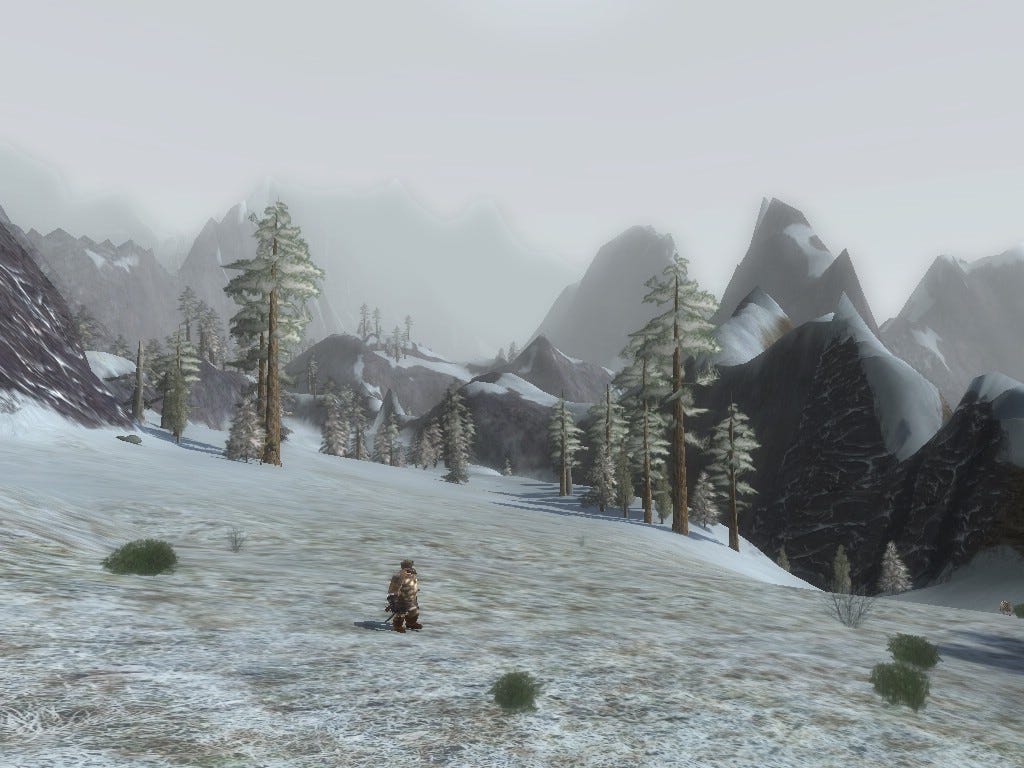
You'll probably have two reactions to Lord of the Rings Online when you first fire up the game. First, you'll think to yourself, "damn, this is pretty."

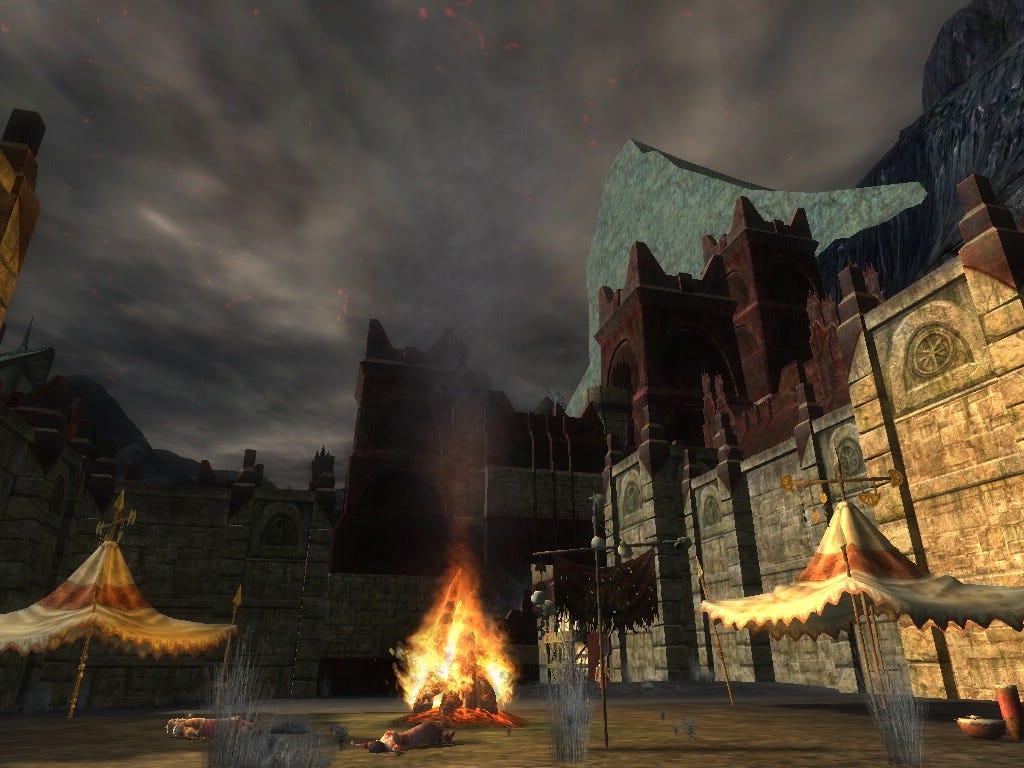
That much is certainly undeniable - LOTRO is very, very pretty. It's far and away the most graphically accomplished MMOG we've played to date, and playing with the high definition client for the game offers lighting, models and environments which really tick all the boxes for this kind of experience. Detailed? Check. Varied? Check. Dramatic? Check and double-check.

Surprisingly enough, the game's visuals don't take as much of a toll on your hardware as you might anticipate. Our test system is an Athlon 64 X2 4800+ with an ATI Radeon X1950 Pro card, which sits somewhere in the mid-range of PC systems produced in the last year or so, and LOTRO runs comfortably at settings a few notches down from the top. The lovely environmental effects still look great, and even the busy, bustling towns in the game don't hammer the framerate down too badly.

Much of the credit for the visuals goes not to the technical accomplishments of the game, however. LOTRO boasts almost uniformly excellent artwork, and it is this - the imaginative creatures, the glorious environments, the superbly detailed equipment on your characters - which really sets the game apart from its rivals. Without downplaying the achievements of the programmers who brought this artwork to life, it's probably fair to say that the art team was presented with a tougher job. To them fell the task of making good on the promise of Tolkien's imagination; of bringing these environments and creatures and characters into being in a way which feels consistent, looks beautiful or grotesque as required, and combines to create a world in which you'll be happy to spend countless hours.

Let us simply say that they succeeded; that Lord of the Rings Online is, visually, a treat which lives up in every way to the imagination which inspires it.

Seven for the Dwarf-lords in their halls of stone
2

Your second thought will probably be, "hey, this is familiar!"

This one could have gone either way. Lord of the Rings Online is a game which is being launched into a market which has been turned on its head by the success of World of Warcraft. It doesn't matter how much the more hardcore MMOG players out there hate Blizzard's creation; it's got more than ten times as many players as any previous game of its type, and it has proved that there's a global market for MMOGs which extends far further than anyone truly believed. The figures speak for themselves.

The team at Turbine know that, and the design of their game reflects that. Vast swathes of interface design will be completely familiar to anyone who has played World of Warcraft before. Many keystrokes perform the same actions; many interface screens offer broadly the same layouts for their options. This isn't a case of wholesale copying or anything unscrupulous like that, though. Turbine simply understands that there's no point in reinventing the wheel when there are already millions of players who are perfectly comfortable with the way it works now.

The good news, then, is that anyone who has played WoW - and, frankly, anyone who has played any PC role-playing title in the last ten years - will be able to dive straight into Middle-Earth and start accomplishing things, with remarkably little in the way of an initial learning curve to scale.

The better news is that LOTRO doesn't rest on WoW's laurels - not by any means. The real triumph of this game is that it takes many ideas which people will be familiar with from WoW and improves upon them significantly. If the MMOG gameplay encountered by millions of players in WoW is vanilla ice-cream, this is Ben & Jerry's Cherry Garcia. There are more flavours, more complexity, more chunky bits - but you can still eat it with the same spoon, and with little additional training learning curve.
3

The introduction to the game is a perfect example. Each of the races has a unique introduction sequence which sees you taking part in a heavily scripted mission - be it rescuing Hobbits from a Nazgul raid, or defending an Elven fortress from goblins in an ancient conflict. These sequences give you a chance to get accustomed to the world and to the controls of the game, while also providing a taste of things to come - of the wonderfully well-written, tightly scripted encounters which are one of the strongest aspects of the LOTRO experience.

The game often uses instancing to accomplish these effects, and takes the unusual step of offering quite a few instanced sections which can be completed as a solo player. However, the game is keenly aware that taking MMOG players out of the world in this manner can have consequences, and while instancing is more common than in other games, it is still applied with a deft hand rather than being splashed all over the place. Most of your play time will still be spent in an open, multiplayer world; but Turbine aren't afraid to drag you into an instance to do some really good storytelling, when the game demands it. Others may have a different perspective, but in our view, that's a Good Thing.

Nine for Mortal Men doomed to die

In almost every other important aspect of the MMOG experience, LOTRO manages either to extrude the gameplay into some new form which hasn't previously been explored, or to simply buff up and polish an experience with which we were already familiar.

The enhancement which really demands a mention, in this regard, is the Fellowship play - what you might describe as partying in any other game. Now, settle down; rest assured that from our experience, you can play LOTRO solo and have a great time, with very little content being genuinely inaccessible to a player who isn't interested in hooking up with strangers for an evening of slaying. However, the game is simply taking a carrot approach to party play, rather than a stick approach. You may not need to be in a party to progress; but the rewards for joining forces are so great that they're very, very hard to ignore.

There are a few bonuses open to you in a fellowship - most obviously, the ability to fill in the gaps in your own abilities by playing with those of other classes - but by far the best of them is the Conjunctions system. Now, we confess that we're still getting our heads around the potential of this system to some extent, but in effect it's a timer-based system which allows you to fire off hugely powerful combo moves. When a Conjunction is available, a set of "gems" appear on your screen; click one and you'll perform a Conjunction move, which may in turn open up further moves in the chain to other players. We suspect that, similar to the somewhat less friendly combo system in Final Fantasy XI, Conjunctions are likely to be the key to end-game play. For now, though, they're a really interesting new aspect to play which is doing a fine job of encouraging players to get involved in parties.

4

Not all of LOTRO's improvements are huge; some are merely a matter of polish. Take, for example, the quest system - which by and large follows the well-established MMOG system of walking up to a person with an quest mark over their head (a glowing golden ring, in this case) and accepting to undertake a task for them. This will be familiar to players, of course - but LOTRO takes things a step further than its rivals by providing far more information about your objectives and where you need to go. Quest markers are provided in a clear form which means you'll rarely, if ever, get confused about where you're meant to be. This may be the first MMOG we've considered playing without a web browser open on a second screen to look up the quests we're doing.

Perhaps our favourite of all the improvements which LOTRO makes to the genre as a whole, however, is the game's efforts to tackle the MMOG grind. Now, we've never seen an MMOG without grind of some description, and LOTRO is no exception; there will be plenty of occasions when you just run around killing oodles of identikit monsters in order to gain money or experience. However, the introduction of the game's virtues and titles system simultaneously lightens the burden of grind, and introduces much-needed variety to the character classes.

In essence, this system allows you to earn "titles" by completing various deeds - a bit like Xbox Live Achievements, if you will. So while these aren't doled out as quests, per se, there are a bunch of things you can do which will earn you various different titles, which you can apply to your name in the game to show off how ace you are at a specific part of the game. In general, if you're grinding, you're also working towards a title or two; it's all part of the game's effort to reward you at regular occasions, rather than making you edge your way frustratingly towards a level-up "ding".

5

Titles are more interesting than simply being a chance to brag, though; they are associated with virtues, which are special abilities you can equip on your character. This is perhaps the most powerful kind of character customisation we've seen in an MMOG of this type, because the traits which you can add to your character can often burst right through the traditional class boundaries. In theory, you could build a Champion with healing abilities or a tanking Guardian with magical powers, simply by equipping traits which confer those abilities; and even at lower levels, playing around with the traits and virtues available to you make for an interesting, varied approach to customisation.

One for the Dark Lord on his Dark Throne

Time to 'fess up; we haven't, as you've probably guessed, made our way to LOTRO's end-game. As with all of our MMOG reviews, we're going to have to return to the game in a few months to get a proper view of how all of these systems work out at the end of the line, and how well the game's end-game content will satisfy those who have marched through the level treadmill. Annoyingly, that also means we can't talk about PvP today; the game is purely PvE (player versus enemy, meaning no inter-player combat) up until about level 40, at which point players can take part in a unique type of PvP battle in one large zone, the Ettenmoors. This works by allowing other players to temporarily don the form of famous monsters from the Lord of the Rings universe - which you can do from level 10, although of course, that's not much use if there's nobody to fight against yet.

What that means in effect is that if you're a PvP player, this isn't the game for you - at least, not yet. It remains to be seen how PvP will evolve in LOTRO, but for now, suffice it to say that it's more of a curiosity than anything else, and is locked away from view at present with the rest of the high-end content. We'll definitely be keen to talk about it more when we return to Middle-Earth, but for now, it's not something we can take into account - since we'd just have to take Turbine's word for how it all works.

However, what we've experienced of LOTRO in the first two dozen levels or so is extremely positive. The stunning visuals and the gorgeous realisation of a much-loved fantasy world are simply second to none in this genre; the brilliant storytelling and incredibly dramatic scripted events, equally, stand apart from the competition in every way.

6

Once you look past the graphics, the writing and the artwork, you find that the beating heart of Lord of the Rings Online also stands up to scrutiny. We've never come across an MMOG which was quite so polished and mature at its launch as this one; the experience of the team at Turbine, and their willingness to learn from both the triumphs and the mistakes of their competition, shines through from every aspect of the gameplay in LOTRO.

A review such as this can merely scratch the surface of a game so huge, of course, but suffice it to say that all of the improvements, enhancements and additions to the MMOG structure which we have mentioned are both typical and representative of the kind of thing you'll find in LOTRO. It's easy to get into, fascinating to travel through - and more so than any other MMOG, it's genuinely fun to play.

Of course, the big question which many of you will want to hear a view on is this; is it worth quitting WoW to play this? The answer to that is... Well, it depends. If you're deeply ensconced in an active WoW guild and enjoying the game, then LOTRO's improvements probably aren't significant enough to drag you away. However, there are many players for whom Azeroth (and Outland) are simply starting to feel tired, and we would whole-heartedly recommend that those players give Middle Earth a shot. What's more, it's absolutely no exaggeration to say that this is far and away the best game for anyone who hasn't played an MMOG before to cut their teeth on. Even more than the familiar universe, the excellent interface and gameplay design Turbine have crafted turn this into an experience which those who have previously avoided the lure of MMOs will find tough to resist.

Nine for Mortal Men doomed to die? Yes. Yes, we definitely think so.

9 / 10

Head over to Eurogamers to see whats happening in the Lord of the Rings Online group.

Read the Eurogamer.net scoring policy

Comments (137)

Comments for this article are now closed, but please feel free to continue chatting on the forum!

  • Loading...hold tight!