Version tested: Xbox 360
The words "game design" tend to get bandied about rather a lot, but usually when people talk about game design what they actually mean is level design. While there's certainly an art to crafting a level in such a way that players are challenged, encouraged and thrilled in an agreeable ratio, the skill that goes into creating the overall experience outside of the actual gameplay is less understood. I'm talking about overall structure, pace and reward - that arcane art of understanding the audience, delivering the right encouragement at just the right time and still managing to offer up delights and surprises along the way.
These are qualities that the LEGO Star Wars games have in abundance. Yes, they're cute and funny and amusing to play, but in terms of general construction they're also some of the best-designed kid's games since...well, since forever. They're that good. The drop-in multiplayer. The ability to go back and replay any level at any time. The myriad quirky details buried in every corner. You only have to watch children playing the games, excitedly discovering all the little nooks and crannies, to realise that Traveller's Tales went to extraordinary lengths to create a game that was accessible to the youngest newcomer and yet still offered fresh thrills and rewards once their skill had matured. That, you see, is true game design at work.
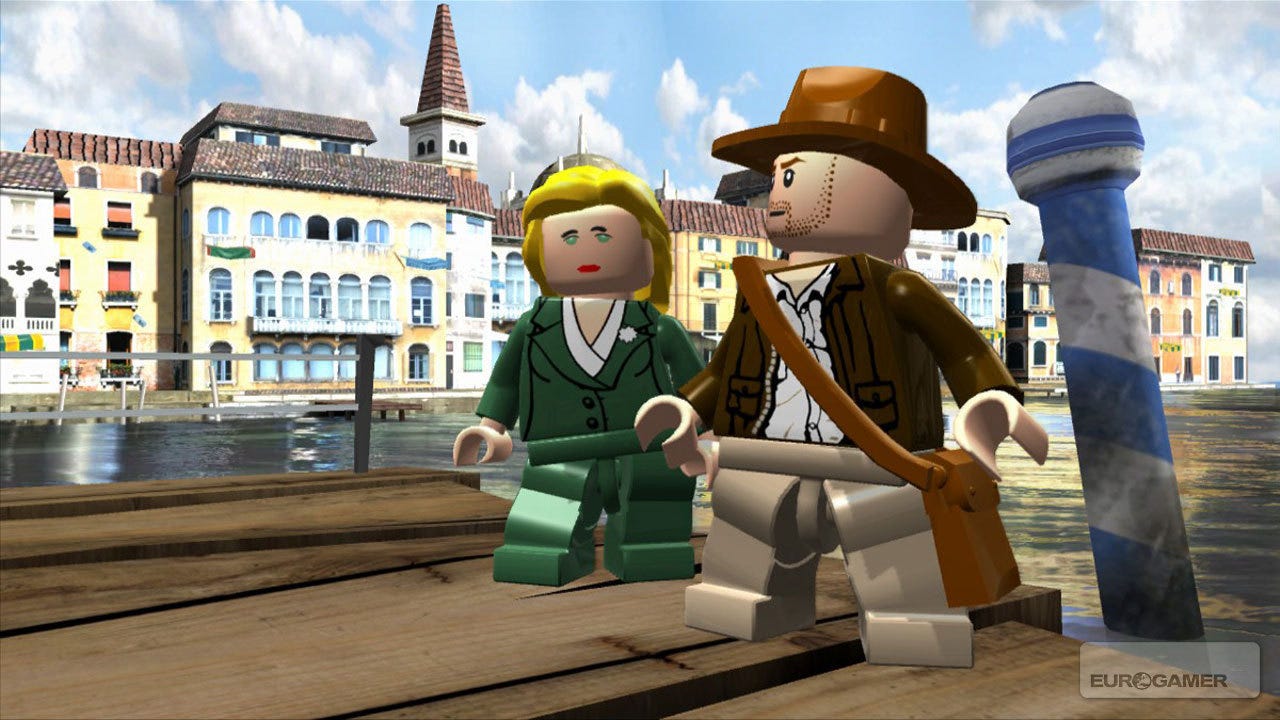
The cut-scenes are still a masterclass in silent comedy, and cheekily irreverent to the movie lore.
All of which acts as both a blessing and a curse for LEGO Indiana Jones. It has a tried and trusted gameplay system to build on (no pun intended, honest) but it also has a lot of expectation to live up to. The good news is that the gameplay is both comfortingly familiar and suitably evolved. The Indiana Jones movies are rather light on aliens, robots and magic space monks so the template of using certain character types to access specific areas has had to change, and it's a change for the better. Indy's all-human cast now enjoys a more democratic gameplay design, with the most common abilities available to all - provided you can find the right tool for the job. You can now pick up a shovel, or a spanner, or even a weapon and keep it with you as you explore. Pistols, machineguns and bazookas can be swiped from enemies and tucked away for later. Swords and spears can be wielded in combat, or thrown to cut important ropes or chains. There are still some elements that are restricted - the handful of women can jump higher than blokes and you still need an enemy uniform to open certain areas - but for the most part progress is now dictated by items rather than characters.
Whereas puzzles in LEGO Star Wars tended to be a simple matter of using the right character to reach a switch, this is a much more involved adventure. For example, you might use a shovel to dig an item out of the ground and discover that it's a cog needed to operate the machine that in turn opens the gate to the next area. Except once the cog is replaced you might then need to find a spanner to actually fix the mechanism. But the spanner is in the hands of a cheeky monkey up on an unreachable ledge, so you need to find a banana and throw it to him in exchange for what you need. Okay, for us grown-up players it's a fairly obvious series of miniature fetch-quests, but for the intended young audience it's smartly paced and encourages plenty of lateral thinking. There's room for free thinking, but everything is constrained by logical parameters that prevent things getting frustrating.
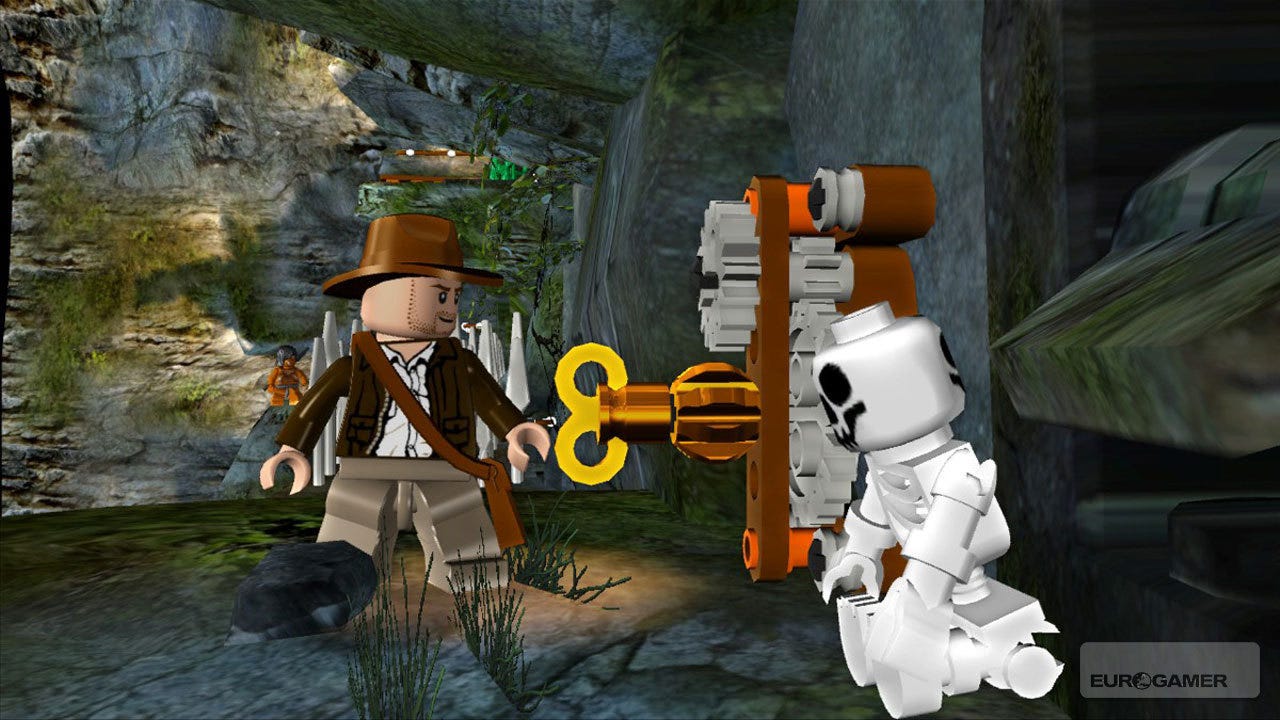
Finding keys for these clockwork mechanisms is just one of the recurring puzzle objectives.
Also new is the ability to swing and climb on ropes, and while the physics isn't exactly cutting edge it's a perfect fit with the Indy series and adds another fun element to the level designs. Each movie is, as with Star Wars, divided up into six levels with the first generally being easier (in case someone opts not to play the movies in linear order) with the last being tougher. Tough is relative, of course, but there were more levels that had me scratching my head here than in LEGO Star Wars. Progress is less linear, while the ability to pick up and carry items means that objectives can now be scattered around a larger playing area, forcing you to explore your surroundings more thoroughly. Teamwork is also more important, with more puzzles that require one character to help the other past hazards. The AI on the non-player characters isn't always great in this regard, sometimes getting in your way or wandering out of range, but the fantastic drop-in gameplay means that parents can easily offer as much assistance as is required to get things back on track.
Where the game unfortunately suffers is in what's been taken out. It's not entirely fair to compare Indy to the feast of content that was LEGO Star Wars: The Complete Saga since that was a compilation of sorts, but even compared to the single Star Wars editions this feels disappointingly light on the features that matter once the story mode has been exhausted. The traditional Super Story mode, in which all six levels of a movie can be played through in one sitting, is gone. So too are the character and vehicle bonus levels. There's no equivalent replacement for the Star Wars bounty hunter missions and the online co-op play and two-player arena battles from The Complete Saga have also vanished.
That's a lot of features to lose, especially since these elements were integral in boosting the longevity of LEGO Star Wars, not only by giving you more things to do, but also by dishing out gold bricks for successful play, which could then be cashed in for yet more shiny new stuff. Kids love collecting things, earning new things to play with, and LEGO Indiana Jones ultimately feels rather thin on that front. All you get to unlock are a short bonus level based on the Young Indy prologue from The Last Crusade, an open-plan LEGO Ancient City to muck about in and - when you collect all the artefacts in the game - a slightly clumsy race track construction set. All are enjoyable, but it does mean that most players will have seen everything on offer all too soon.
Is there anything more awesome than a LEGO elephant? Yes. A LEGO elephant with Indiana Jones on its back.
There are 60 characters to earn, of course, but in an Indiana Jones game you're always going to want to play as Indiana Jones. Unlocking characters like Dancing Girl or British Soldier is therefore more of a completist's errand than a collector's dream. Considering part of the fun of LEGO Star Wars was still discovering and unlocking fun new things to do even after hours and hours of play, this feels like a step backwards. If variety is the spice of life then LEGO Indy offers salt and pepper, not sweet red chilli and ginger.
There are also no dedicated vehicle levels, with stunts like the iconic truck chase from Raiders woven into platforming levels rather than teased out into their own thing. Maybe this is because the vehicle sections in LEGO Star Wars were never the game's strongest suit, but The Complete Saga reworked some of the worst offenders - the Pod Race in particular - into something enjoyable so it's a shame to see things slip back a notch. The motorbikes of Last Crusade are horribly slippery things, while the legendary mine cart chase of Temple of Doom loses all its energy thanks to a circular design that sees you rattling around and around the same small track, struggling with awkward collision detection to hit sequences of switches. Other vehicular moments with gaming potential, such as Temple of Doom's raft ride down the mountain or Last Crusade's brief aerial dogfight, are dealt with only in cut-scenes.
Flaming torches can be used to light fires or scare off unfriendly critters.
This is all starting to sound a bit grinchy, so at this point I feel I should point out that my five-year-old son, who helped me with the hands on preview, is currently at 99.7 percent completion on our second save game with just one character left to unlock. He's certainly commented on the absence of familiar features, and seems less enthused about collecting billions of LEGO studs now that there's not as much to spend them on, but he's still been happily replaying his favourite levels over and over, just as he did with Star Wars. That, to me, is the true test for the value of a kid's game and it suggests that, once again, Traveller's Tales has come up with a core game that inspires and excites its primary audience with laser precision.
None of my critical grumbles, therefore, should be taken to mean that LEGO Indiana Jones is a crushing disappointment or an easy cash-in on a popular template. In gameplay terms it represents a commendable improvement on an already solid framework and seems to captivate its young players with the same gently challenging grip o' fun as LEGO Star Wars did. It's just a shame that this evolution seems to have come at the expense of many of the peripheral activities that made the previous LEGO games a more robust and varied experience in the long term. Parents, and shameless big kids of all ages, should certainly snap up a copy - just be prepared to unearth most of its treasure sooner rather than later.
7 / 10