Retrospective: Kirby: Canvas Curse
Grand master.

When I was recently thinking about the current state of the DS, one game I kept returning to was Kirby: Canvas Curse. Or Kirby: Power Paintbrush. Or Touch! Kirby. Or whichever of its many names it may be going by. Released a few months after the DS, it was a game that came with no expectations, and was absolutely stunning.
But what about now, five years later? Was the magic of this platformer part of the DS's freshness, and the thrill of a game using the hardware well? Or is it a classic?
Platform games on the DS have had to take two routes to be successful. Either they've needed to ignore the screen altogether and rely on the face buttons. Or they've needed to be innovative.
The space between is where games attempted to replicate the perfectly good controls the buttons can offer, but on the touch-screen. That can only lead to frustration - the knowledge that if only they'd not tried to bend and crumple things in such a way you'd be playing a far better game.
Those that defer to the buttons deserve respect. It's a game that knows what it wants to do, what it wants to deliver, and isn't going to let fancy, shiny new things distract it. The Mario & Luigi games stand as the most exemplary. But HAL Laboratory had a better idea for Kirby.
I do not profess to be a Kirby historian. In fact, I have played very few of HAL Lab's games across the various generations of Nintendo consoles. So the pink bird-thing holds no particular affection for me. The series, set in its own private universe across about 20 games, feels to me a bit like Gobots to Mario's Transformers. Duplo to Sonic's Lego. Even the subsequent Kirby games on DS have been decent, but not special.
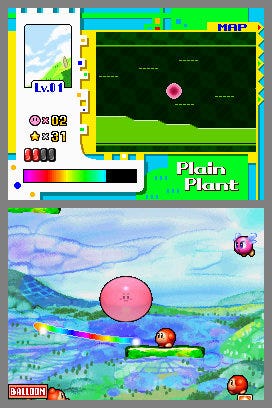
What makes this game so intriguing is the indirect control. You don't play as Kirby. You instead play as you - a sort of omnipotent being watching over the world in which Kirby exists - given a magic paintbrush with which to interact.
It's that same sense of the meta that Another Code offered: you have indeed been handed this magic paintbrush in the form of the DS's stylus. Draw on the screen with it and a rainbow-coloured swoosh appears, then soon evaporates away. It's by this means that you mostly control Kirby, who has by the way been turned into a spherical blob.
In fact, the story setup deserves attention, as it's hilariously silly. Right at the start in a splurge of mad text you're welcomed to peaceful Dreamland, Kirby on a nice stroll. But then the world's colours change, and a witch appears and turns the land into a painting. As you might expect.
Seeing Kirby, the witch flees into the sky, toward a weird vortex. Kirby chases! He's now in a world of paintings. The witch's magic turns Kirby into a ball! The witch escapes. But looking down in shame, our hero sees the magical paintbrush, and then transports it to you in a ray of light. Go!
That's some awesome storytelling. They wanted a round Kirby, levels that look painted, and a reason for bouncing around them, and dammit, they wrote a story that gave them that.
Kirby mostly rolls onward of his own accord. Even uphill. But tapping on him will give him a spin and accelerated movement. That's the extent to which you can directly control him. Everything else comes from the paths you paint him to ride.