Jumpgate: Evolution

NetDevil's Peterscheck on the return of the joystick.

Late last week we got a chance to speak to NetDevil's Hermann Peterscheck about the development of the company's reborn space MMO, Jumpgate Evolution. The project is intriguing: it's essentially a remake of the company's first game, the action-shooter MMO Jumpgate, which was released in 2001 and is still pottering away today. Evolution sees the concept expanded, extended, and pumped up with all the pixel-shader hormones of a brand new current-gen graphics engine. The core concept, however, remains the same: a space combat game where you fly your ship in real time and do damage in real time. It is closer in its genetics to Elite or Freespace than it is to EVE Online, and is one of the most interesting MMO projects currently on our radar. Let's find out more...

Eurogamer: How did all this come about? How did NetDevil end up electing to develop a remake of your original MMO?

Hermann Peterscheck: Well, after Auto Assault we began thinking about the kind of stuff we wanted to do next, and so that led to us thinking about the kind of game we actually like to play. That led to us thinking about Privateer, Freelancer, even going all the way back to Elite. We had already made a game like that, and we still enjoy the gameplay in those kinds of games today.

The other thing is that there are some giant gaps in the MMO options out there, and there's not a space combat MMO of this particular kind. There's EVE Online, which is huge and successful, but if you play that you'll know that it's a very different kind of game. So all this led to the questions "what if we were going to make Jumpgate again?" and "what if were to make it more modern?"

Obviously we would make it quite differently given the lessons we've learned over the past ten years. So we started out with a small team, and we weren't quite sure if we should just update the original game or to start from scratch. We began by updating the graphics and adding things, and over four or five months we realised we could take this more seriously and make a full game out of this. In fact, when you look at really successful games companies you tend to see that they produce various iterations on the same genre. We have an advantage there because we've already made this kind of game before, and now many other people have. We have a baseline to start from.
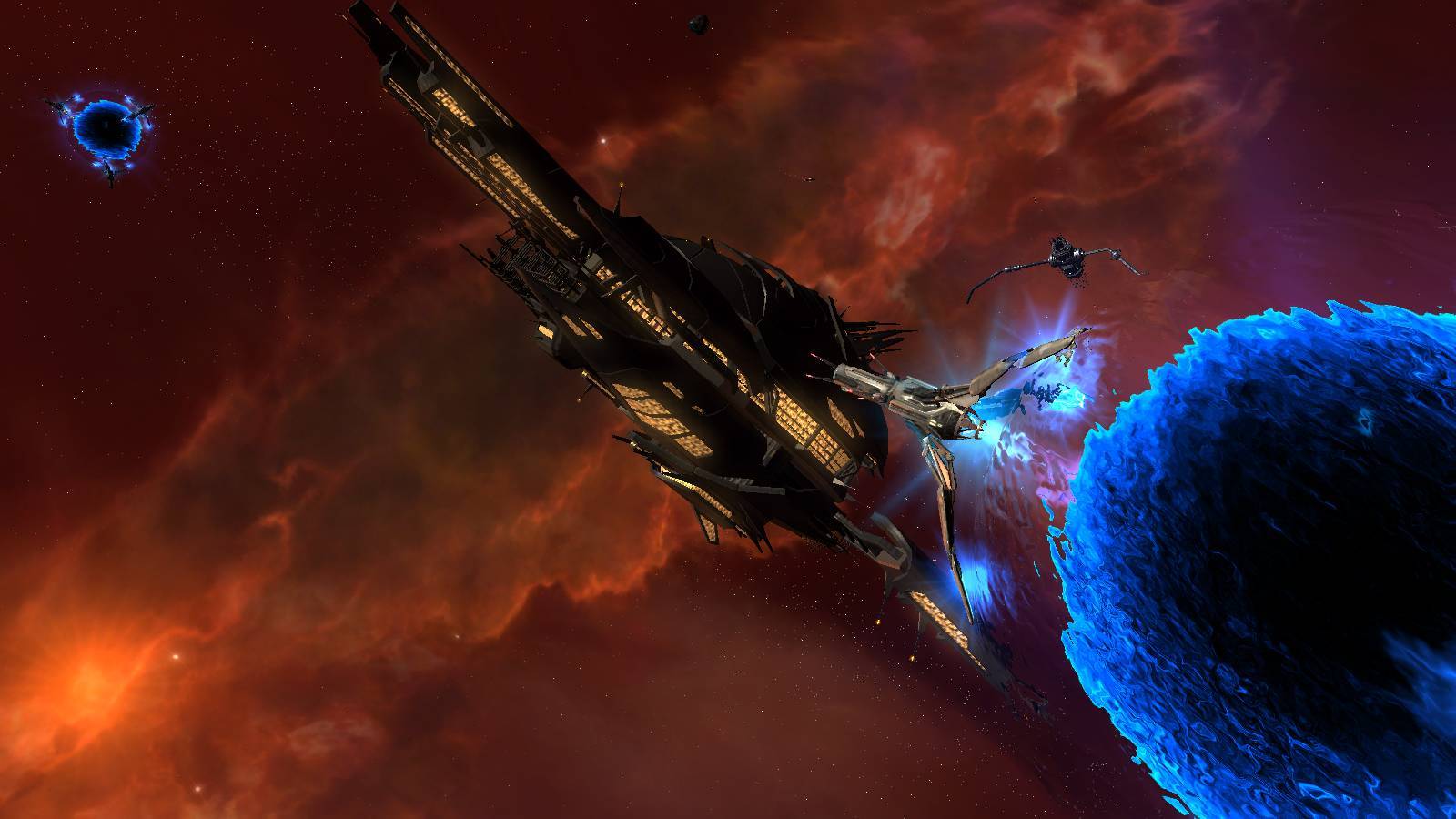
'Jumpgate: Evolution' Screenshot 1

The pretties have been ramped right up from the original game.

Eurogamer: That sounds like quite a luxury: to be able to develop a game just to see if it will work. That comes with having a big team though, I suppose?

Hermann Peterscheck: Yes, we are over a hundred people now in a little town outside of Denver called Louisville. It originally started with Scott [Brown] just working on Jumpgate, the original game, in his basement. I think he started around 1995, and released the game in around 2001. At the time we started helping Scott making Jumpgate, MMOs didn't really exist yet. There were MUDs and stuff like that, but the idea of an action game with hundreds of people in hadn't really appeared. Ultima Online came out around the same time too, and the MMO industry as it is now didn't exist at all. When we explained it to publishers at the time they'd be all, "an online action game - so, like Doom?" And when we said there were thousands of people in the game, they didn't understand.

Eurogamer: OK, let's talk about the initial player experience of Jumpgate Evolution. What should we expect?

Hermann Peterscheck: Well you start off by creating a pilot and then choosing one of three playable nations. One of the things we wanted was to put you straight into the game, rather than there being a long, linear tutorial experience. So you start out right away in a mission and you have to take out some enemy ships. It teaches you to play, but you're in there right away. There's a lot of context-sensitive stuff in there to prompt the player at the start.
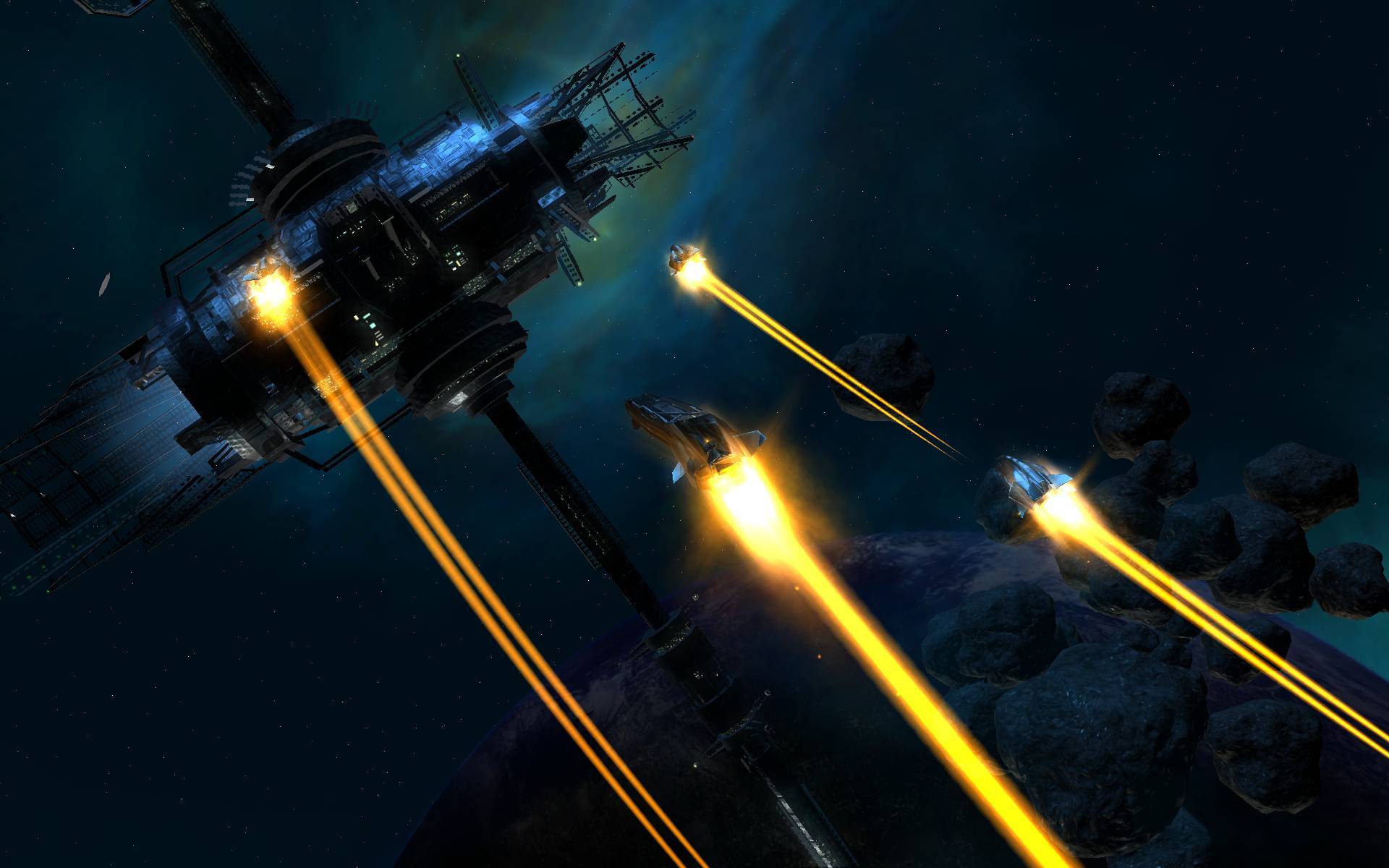
'Jumpgate: Evolution' Screenshot 2

Player-driven economy and real-time shooty? Oh baby.

So you'll start out in that initial combat mission learning the mechanics of the game, and you go land at the station and we start to teach you to do station-type stuff: transactions, NPCs who give out missions to move the story along, things you can buy for your ship, and so on. The station is where the auction house is, and where you get licences - we have these things called licences that allow you to undertake certain activity, so you'll get a mining licence to do mining, and all those kind of things.

So you start out playing a bunch of missions and soon complete that pocket of content, and then the game opens up a little more. After that you enter the wider game, and that's where player-versus-player and the other more advanced experiences begin.

Eurogamer: Is this all level-based? Do you level up over time?

Hermann Peterscheck: Well, it is a continuous-progression game - a pretty standard MMO method - the more you play, the more money you get, so the better equipment you can buy, so the more powerful your ship becomes. And it's an ongoing arc that continues for a long time. It starts out rapidly and slows down as these things tend to do.

The crucial difference is the that the combat is much more like, say, an FPS game. You shoot where you aim, and your bullets hit if you were aiming in the right place. This model makes the range of participation much wider. If I'm level 10 in WOW, and you are level 12, I'd struggle to have a chance against you, if you're level 18, you can forget about it, I can't even hit you. In Jumpgate a guy who is level 7 can go to a high level fight with a guy who is level 20 and actually contribute, it's that kind of game.

Eurogamer: So it's a case of less-experienced pilots simply doing less damage?

Hermann Peterscheck: That's kind of what it boils down to, yeah. You have access to better equipment, therefore you tend to do more damage. We wanted to avoid the narrow grouping experience that levels bring in. We want to widen the range of levels that can participate.

Eurogamer: And this is the case in PVP too? You talked about factions earlier, is it an open PVP war?

Hermann Peterscheck: Well there's friction going on, right? It's not open war. You get to decide if you want to work with these guys, or fight them. We try to keep the conflict in the hands of the players, rather than having it at a top level like "Horde versus Alliance". What the original game had which was cool was a "war-meter" so that if more of one faction's ships had been destroyed then the hostility level would be greater. That meant there was this kind of conflict in the game, but it didn't force that scenario on you. We found that was a cool thing in the original game because players could feel they were shaping the universe with their actions.

Eurogamer: How much will players be able to invest in the actual infrastructure of the world? Any guilds? Player-owned space stations?

'Jumpgate: Evolution' Screenshot 3

See how we carefully ignored Auto Assault? Yeah...

Hermann Peterscheck: Well we've got the guild-level organisation, and advantages for doing those things, certainly. Player-owned stations is something we've talked about a lot, but we won't have that in for launch. I mean it's basically player housing, and when that's done well it's great, but when it's done badly it's really awful. So if we do player-owned stations I want to make sure we have time to implement it in an interesting and elegant way that is meaningful for the players. The danger with housing is that is breaks off people into little pockets and they interact less.

Eurogamer: So let's wrap up with a quick overview of some of your content: what are we going to spend our time doing in Jumpgate Evolution?

Hermann Peterscheck: Well we have all the standard MMO type missions: defeating opponents, collecting things, or delivering things, escort missions... but we're just now implementing something really awesome which are these giant capital ships flying around - huge staged battles - and taking those out is becoming a major part of the game.

We're also working on a fairly advanced PVP system, with mass battles that have clear objectives: take out their battleship before they take down yours, hold this position for a period of time, and so on. There are two things that players have been responding to really well, and that's large groups of ships fighting each other, and taking down really large opponents, and so those are the things we want to develop for launch.

But there's loads of exploration too, we've worked really hard to make areas of space different and interesting. Also there's the player-driven economy that starts out from mining, turning raw materials into commodities, and commodities into equipment, so lots to do.

Eurogamer: So speaking of the launch, when will that be? People have been saying how finished the game looks, and yet we're still not at beta.

Hermann Peterscheck: Well a lot of games go into beta too soon, and players end up testing things that they should not have to test - like basic client stability! We're trying to do as much of that as we can. We had the game playable at the Penny Arcade Expo, and lots of people came up and said it looked pretty complete, and we get that feedback with everyone, but we just want to continue with that mantra. We want players to test the stuff we don't know about, even if that is time-consuming for us. We're right on the cusp of large-scale outside testing, and we intend to launch in the first half of next year.

Comments (19) Latest comment 3 years ago

Comments threads automatically close after 30 days, but please feel free to continue chatting on the forum!