It's hard to think of a more hostile environment for a game's launch than the one Free Radical's Haze faces. On one hand, it's viewed as a flag-bearer for the PlayStation 3, a console whose vocal detractors aren't afraid to come out in force online to criticise any weakness. It's also got the misfortune of being billed (although not by its developers) as a Halo-killer (well, it's a first person shooter where some of the characters wear funny looking helmets, what did they expect?) and it's launching at a time when the world's FPS gamers are still in the midst of a torrid love affair with Call of Duty 4.
In other words, Haze had better be bloody good, or it's going to be crucified - perhaps not in the press, and perhaps not even in stores, but its developers certainly need to be worried about a bloody sacrifice on the altar of public opinion. Don't they?
"Yeah, I can see where you're going with that," sighs Haze's creative director, Derek Littlewood. "I mean... I think you can worry unnecessarily about that kind of thing. At the end of the day, any game you make is going to end up getting judged on a lot of different criteria after launch. To a large degree you just have to say, let's just let it go - let's let the gamers judge for themselves."
"I think there's a lot of talk in the media about titles becoming flag-bearers and stuff," he continues, rather presciently we think, "but when you get down to the level of individual gamers, they just have titles that they love. That's the sort of feedback that I'm looking for, and that's the thing we were looking to deliver, which is a great game that gamers can enjoy. I think all of the other stuff about being a flag-bearer for PlayStation 3, or whatever, that's for somebody else to judge."
Make Haze while the sun shines
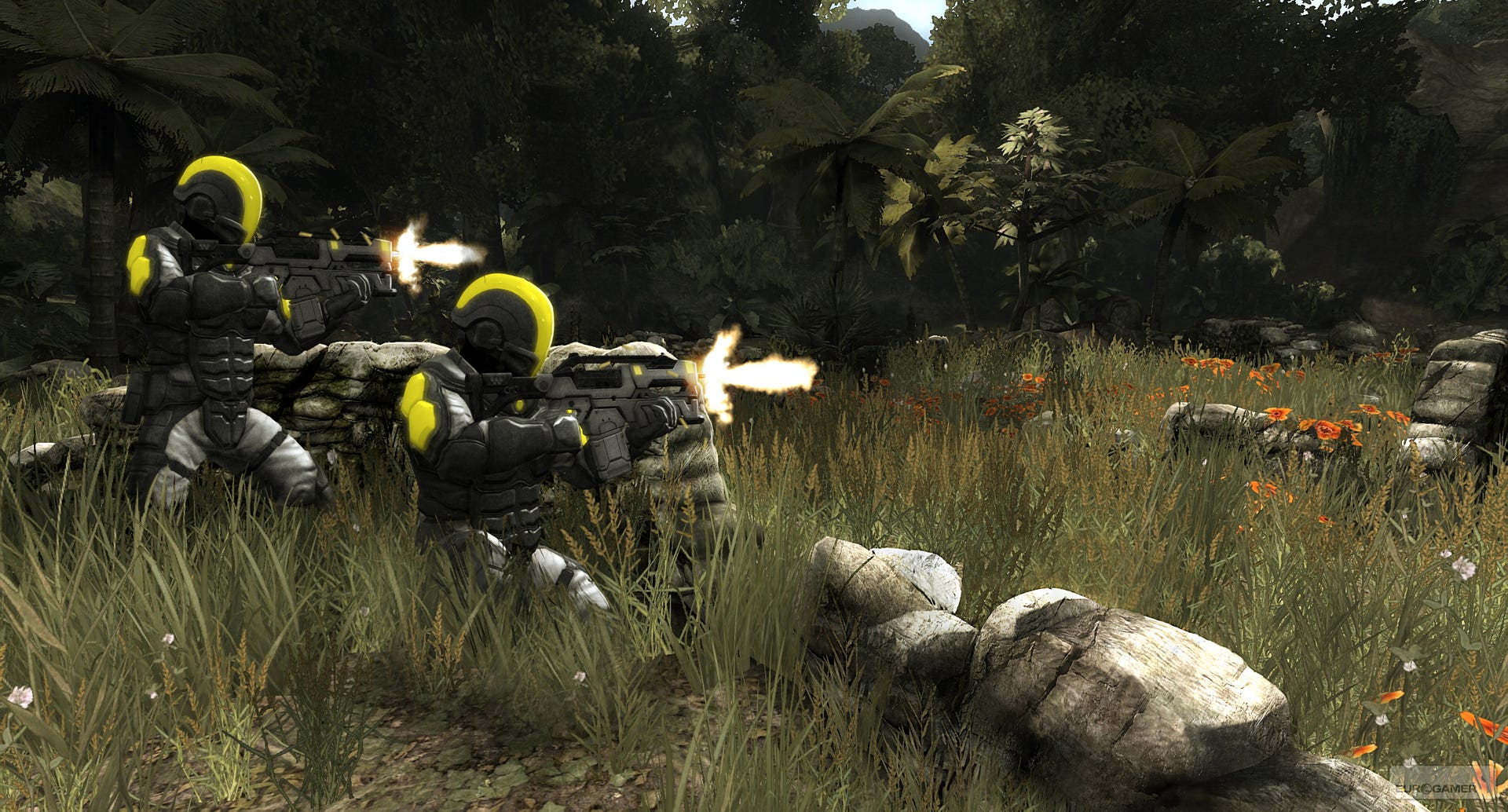
These are your buddies - your whooping, idiotic, annoying buddies. Hopefully their Day-Glo yellow helmets make them into easier targets.
Of course, there is one way in which Haze could have faced an even tougher time - and that would have been to launch before Christmas, which was originally Free Radical's plan, before a delay pushed it back to 2008. "It was a very crowded market before Christmas, and I'm not going to pretend like I'm not glad to have a slightly more quiet window to release into," Littlewood tells us. "Releasing up against games like Halo 3, Call of Duty 4 - that's always going to be brutal. But I don't think it's a case of us looking at those games and thinking that we're going to have to make Haze better."
He pauses for a second, then continues. "I'm glad those games came out and were very strong titles, very good games. We're always looking at other titles to try and improve what we do, but I don't think it was a case of us panicking about the quality of Haze at all."
So, given that Free Radical has had almost six months more to work on Haze, what have it done with the time? According to Littlewood, it's mostly been a case of polishing the game - taking on board mounds of feedback from playtesters, and using it to inform a process that has seen them tweaking everything from the balance of the sides through to the actual design and flow of the levels themselves. "It's not that we've added stuff," he explains. "What you're seeing is the delivery of the game we always wanted to make - it's more robust and more polished. The feature set is identical to what we've always been talking about."
In fact, Littlewood is quite enthusiastic about the delay to the game. "Normally, as a developer, you just don't get the opportunity to do that," he says. "Every game that goes out the door, you always feel like you could have made some things better in it, or that here are things that you could have improved. To get the opportunity to spend three or four months fixing a load of those issues, that was a fantastic chance - and I'm really glad that we got to do it."
The question, of course, is whether gamers will be equally glad that Free Radical invested that extra time in buffing the game to a lustrous shine. Like we said, Haze has a lot to live up to - and our chat with Littlewood left us itching to play the game itself and find out just how well it's going to meet those expectations.
Sweet Nectar
Like many other FPS titles of recent years, Haze is seemingly on a mission to rid itself of the dark, enclosed spaces we saw in the "corridor shooters" of the late '90s. It's bright and sunny, set across the jungles, beaches and mountain slopes of a South American tropical paradise, with only the occasional urban section or military environment breaking up the holiday postcard nature of the levels. Well, that and the relentless bombing, shooting, screaming, dying and so on. Think of it as an adventure holiday.
Actually, that's sort of the point. The central conceit of Haze is that you're playing a soldier who works for a private military company, with your instincts and abilities all boosted by a drug called Nectar. You can dose up on Nectar at any point in the fight by pressing L2, and while it's active, it makes you faster and stronger - and also makes your enemies glow brightly, your health bar more resilient, and other such handy things.
The drug has other effects, too. In a somewhat backhanded comment on videogame violence, the bodies of your foes fade out of your vision - allowing you to ignore the horrors of war and get on with the shooting. We're not sure if it's an effect of the drug, but the other main effect seems to be that it turns every Mantel soldier in the game into an utterly repulsive, whooping, idiotic jock - which is presumably how the senior Mantel characters get away with being so downright suspicious at all times.
These are your new rebel buddies. They wear more sensible clothes, and like all good revolutionaries, talk like they just walked off a Mexican tourist trinket stall.
We were a little surprised when Free Radical started talking openly about the "twist", where you change sides and start shooting for the rebel forces - but having played the game for ourselves, it's clear that this really isn't a spoiler. Anyone who hasn't worked out within five minutes that they'd rather be shooting these odious sacks of testosterone and stupidity rather than fighting alongside them needs their head examined (although admittedly, Gears of War managed to play that one totally straight for the whole game).
Once you switch sides, things are mixed up rather a lot. You no longer have access to Nectar, but you do have lots of interesting tactics to try out. You can rip packs of Nectar from dead Mantel soldiers, for example, and stick them to grenades - or wipe them along throwing knives. Hit a solider with one of those, and they'll overdose on Nectar and go insane, firing wildly at their comrades. In a nice touch, you can also feign death when you're being shot at - and because the Mantel soldiers can't see corpses, you'll be invisible to them until you start moving again.
Both sides have access to a fairly hefty set of weaponry, which ties in with the near-future setting of the game - mostly consisting of pistols, machine-guns and sniper rifles, with the occasional special like a flamethrower thrown in for good measure. Aside from the obviously different ones like the sniper rifles, we had some trouble working out the qualities of the various weapons - we suspect that it'll take players a little while to work out what each one does better than its siblings. The game also boasts vehicle sections, as you'd expect - the handling of those vehicles seems a bit light to us at the moment, although of course, this isn't actually a final build of the game.
Hazy sunshine, scattered showers
As you've probably gathered, the story mode of the game is a fairly heavy focus - although Littlewood thinks that the team might have made a bit too much of the story at the outset. "We focused a lot on the message that we're trying to communicate with it, and in a way, I think this may have distracted people's attention from the ideas that we had to make it a really interesting game to play. Since then we've always been backtracking a bit," he muses.
So, the "message" eh? Well, despite Littlewood's assertion that "the message was never meant to be this overt thing that comes in and whacks you around the head", we did see quite a bit of that going on in the few cut-scenes we got to witness. There's a fair bit of eulogising and a lot of naked anti-war sentiment in the game's script, which can leave the whole thing feeling like the strange offspring of Metal Gear Solid and a John Pilger article. On a tropical island. It's hard to say at this stage whether this is going to grate or not, really, but we can certainly see some gamers making faces at the chest-beating sincerity of it all.
On the plus side, the story seems to provide a fairly good reason for setting up a lot of varied levels - ranging from a running battle around a cargo ship that's running aground, through to an assault on a mountaintop observatory, with plenty of Far Cry-style jungle combat in between. Even better is the fact that the story mode experience isn't necessarily a single-player affair, either.
Nectar makes everything go a bit mental, but definitely makes shooting the bad, er, good guys easier.
Co-op is one of the things Free Radical has focused on very heavily, with the end result being a "drop in, drop out" system that does pretty much what we've wanted a top-flight FPS game to do for years - allows a friend to join in (either online or in split-screen) at any point in the game, and then to leave whenever they like. You always have three AI companions in your squad, so when a player joins, they just replace one of those - and when he leaves, the AI takes over again.
Simple - well, sort of. "To be fair, three AI characters are not the same as three players," says Littlewood, "so the game also auto-balances against that. If you've got two human players, it will start ramping the difficulty up to compensate for that. On lower difficulties, it doesn't get much harder - but on the harder settings, it really ramps up the difficulty as you add extra players. That way we enable all ranges of gamers to get a good experience, from the most casual to the most hardcore."
In graphical terms, Haze looks pretty good, thanks to Free Radical's in-house developed engine - it lacks some of the slickness and graphical detail we've come to expect from modern shooters thanks to the ubiquity of the Unreal Engine, but Littlewood claims that developing its own engine gave the team much finer control over things like lighting, which lend hugely to the atmosphere of the game.
This month's photoshoot for "Idiotic Combat Gear Monthly", we suspect.
We're not sure how that one is going to be judged, in the final analysis - the game certainly looks good, and some of the environments, like the jungle areas, are incredibly lush and packed with foliage. The visuals aren't by any means a leap ahead of what we've seen before in FPS titles, though - if Haze is going to win over hearts and minds among gamers, it's going to be with great gameplay, not with flashy visuals.
As to whether this game can really hold the flag high for the PS3 - we're reserving judgement. We're looking forward to getting our teeth into the multiplayer modes later this month, and our appetites are certainly whetted for the final game. Haze has its fair share of interesting ideas, but we're very conscious that this is expected to be a lot more than just a decent shooter; it's expected to be brilliant. Whether it can reach that lofty goal or not remains to be seen.
Haze is due out exclusively on PS3 (or is it etc etc self-harm) in May.