Grand Slam Tennis
The humble pie edition.


This review replaces our original verdict on Grand Slam Tennis, which was withdrawn last week due to errors affecting the review process. Please see the Editor's blog for an explanation.
In a month that's seen motion-sensing controls rocket to the top of the agenda across the spectrum of consoles, Wii MotionPlus's timing surely couldn't be better: Microsoft and Sony talk about the future in aspirational terms at the start of the month, and a fortnight later Nintendo's dream is reality. Strangely, we'll have to all wait until 24th July to see the first Nintendo game for the new accessory, when Wii Sports Resort is released. In the meantime, Electronic Arts debuts not only the first WMP game, but the publisher's first tennis game in 15 years, Grand Slam Tennis.
But not to worry, right? Because tennis should be an ideal way to demonstrate the precision accuracy of Wii MotionPlus - swinging the Wii Remote around like an imaginary racket, delighting as the new upgraded technology senses our shot-selection with a fair degree of accuracy, strawberries all round, etc. Combined with EA's pedigree in releasing glossy, accessible sports titles, it should be a winning combination.
Without Wii MotionPlus, the game works almost identically to Wii Sports' tennis offering, with running taken care of for you (although you can position your player with the d-pad or nunchuk if you don't mind a wire tethering your Wii Remote), flat shots pulled off with a short swing, a slice performed by swinging high to low and top-spin by going low to high. The harder you hit the shot, the shallower it will land. In addition, pressing A along with your swing produces a lob, while pressing B delivers a drop shot. Aiming is a slightly darker art without WMP, with an early swing making the ball travel left, and a late swing making it travel right.
While it's certainly possible to extract shallow enjoyment out of Grand Slam Tennis without Wii MotionPlus attached, it feels frustratingly imprecise. The moment you add Nintendo's little add-on marvel, you'll never want to play it any other way again. It's that dramatic an improvement.
The game works best when you follow its advice to use "smooth and easy motions" with "follow-through to aim/place the ball". Boot it up and a ball machine immediately puts this process to the test, firing the ball every which way at you until you've had enough, and it's easy to see how well the game reads your movement.
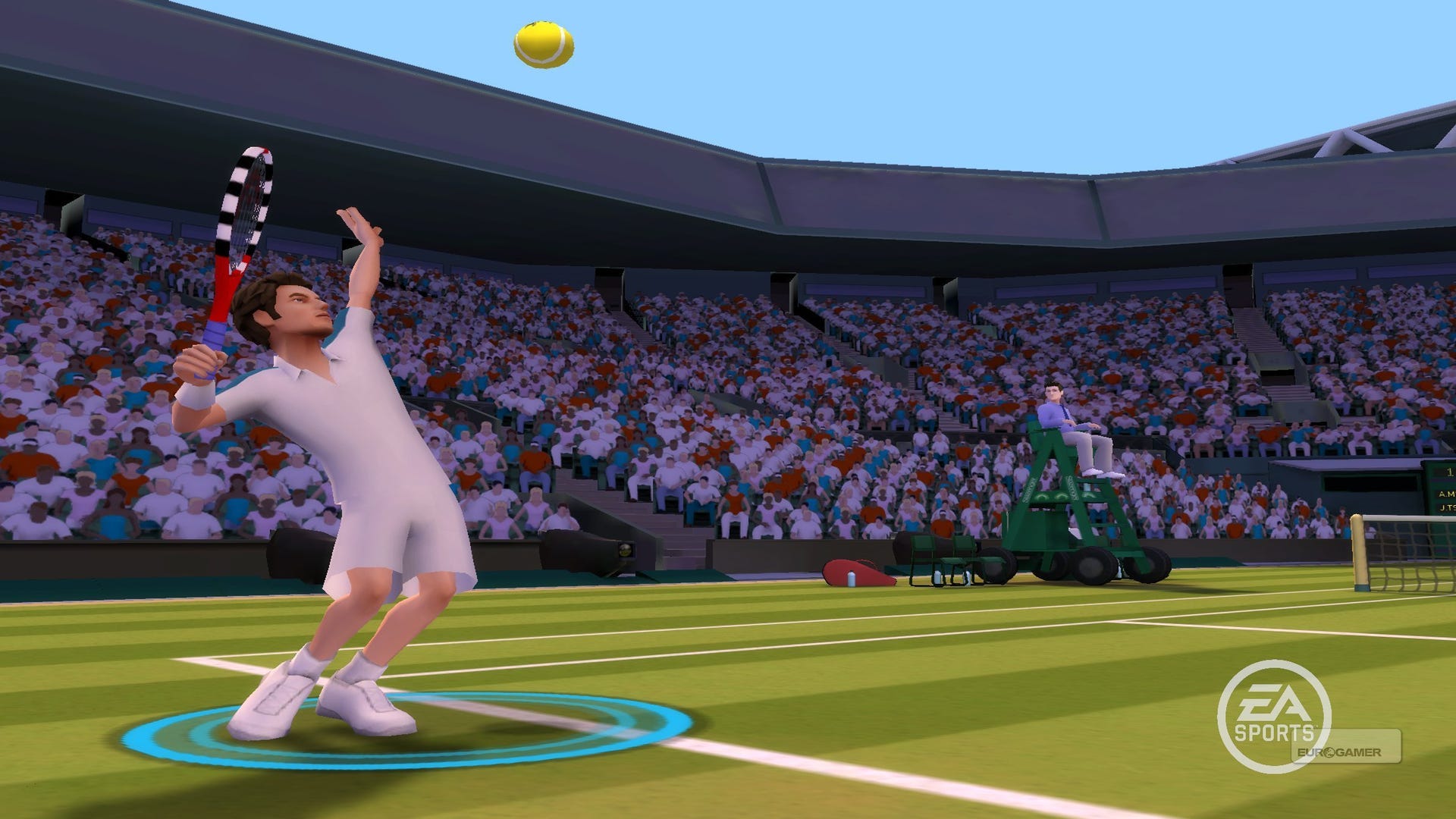
Suddenly, forehand and backhand swings respond intuitively to your actions, and once you nail the timing and velocity, shots go in the direction you want them to more often than not. EA's system has its quirks and certainly isn't infallible, but with practice and a certain amount of patience, it's the most fluid and intuitive motion control system we've come across.
One such quirk is the need to use the A button when you want to lob, and B when you want to dink a drop shot over the net. In addition, if you allow the game to handle running for you, it second-guesses what sort of shot you're going to attempt. If you happen to have decided to attempt a backhand when the game's already put you in a forehand stance, it sometimes confuses matters and you can fluff a perfectly decent shot opportunity as a consequence. Other times, you'll simply miss inexplicably.
The baffling absence of a fully-fledged training mode doesn't help. In every tennis game we can think of going back a decade, the chance to practice different types of shot via court games or an academy is standard issue. For EA to come out with a game with an all-new control system using cutting-edge hardware, and then fail to introduce it properly, is extremely strange. The ball machine helps, but it does nothing to enhance your tactical awareness, and offers little incentive to stand there balefully returning balls to the automaton. You'll want to get stuck in and actually play the game, but options here are a little thin on the ground as well.
If there's no-one around to play against, the path through the game isn't as thrilling as it could be - at least on the surface. You can work your way through a four-tournament Grand Slam (encompassing Wimbledon, as well as the French, Australian and US Opens) over the course of a season, facing a mixture of tennis legends and the current crop of top pros. In between tournaments, you'll engage in mini-challenges, one-off matches and quirky doubles variations, winning new clobber en-route, or sometimes a new special skill.