Ghostbusters: The Video Game
Human sacrifice, dogs and cats living together... good Wii version?

It's said that Activision Blizzard passed on Ghostbusters - as it was rummaging through the contents of Sierra's drawers, post-merger - because it didn't see the potential to develop this vintage, one-off film licence into an annual series, the way it can with, say, James Bond. It's probably for the best: the callous super-spy and the wise-cracking paranormal investigators are very different kinds of icons.
Bond is pure high-concept, and has already survived countless incarnations and decades of heedless prostitution because he boils down to something so simple and inviolable - man drives, shoots, beds, wears suit - that it might always work next time. You churn out the films and the games and the novels for kids and the novels for grown-ups because the next one might always be another Live And Let Die, or GoldenEye 64, or Casino Royale (and this year's Bizarre-made Bond racer just might make that grade). And if it's not, it doesn't matter, because people will forget it instantly.
The Ghostbusters, on the other hand, are more mercurial. Their appeal is about the car and the getup and the theme tune and the logo too, for sure. But it's also about the chemistry between four comedy actors now in late middle-age, a certain style of writing, a particular city in a particular era, a dose of nostalgia, a pinch of PG-rated naughtiness. The fact the legend has been left virtually untouched since the dawn of the 1990s in any form (we don't talk about Extreme Ghostbusters) is telling, and daunting. This one needs handling with extreme care.
That said, the reborn Atari certainly wasn't about to look a gift ghoul in the mouth as it hustled its way back into the game. So we still get Ghostbusters, and developer Terminal Reality gets an extra six months to make sure it lives up to the burden of the "true sequel" hype heaped on its shoulders (and only slightly lifted by the announcement that a third film script is in the works). Just as well; on the evidence of a viewing late last year, the basics were right, but the presentation had some way to go.
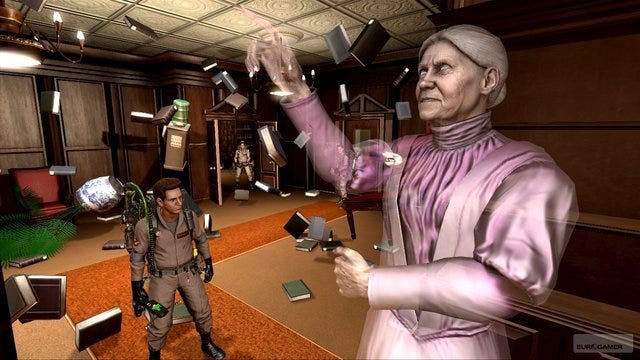
Set two years after Ghostbusters II, in 1991, the game casts the player as a nameless and somewhat faceless fifth Ghostbuster drafted in as an experimental weapons technician - a guinea pig for Ray and Egon's latest gadgets, in other words. Things have moved on; the spectral investigators now operate with the authority of the city of New York, and stuffy bureaucratic foil Walter Peck has ended up their overseer, resulting in a neat running gag where he gets the bill for your collateral damage (which will be copious and encouraged, thanks to Terminal Reality's in-house physics tech).
The Peck set-up is a perfect example of how Ghostbusters: The Video Game is getting it right. So is the focus on the equipment, with the PKE meter a perfect all-in-one device for hints and exposition, the streams serving up the rhythmic push-pull combat - you need to slam ghosts into the environment to weaken them enough to trap - and the new inventions seeming to avoid rote ectoplasmic makeovers of standard videogame weaponry. We liked the Slime Tether, a retractable elastic harpoon you can use to manipulate objects and restrain enemies. Equipment upgrades can be bought with money earned for trapping ghosts, or unlocked as you move through the game.
Half an hour with PS3 code takes us through one third of the Library mission (the full game length is estimated about 10-12 hours "at a good pace") and showcases the game's action side; bizarre equipment and combat mechanics aside, this is very much your third-person buddy shooter, with two or three AI (i.e. famous) Ghostbusters accompanying you and needing to be revived if they take a fall (and vice versa). Golems are summoned from the environment - books, coal - and can be often be defeated by using what conveniently comes to hand (barrels of water for the flaming coal golems, for example).