Version tested: DS
The Final Fantasy series polarises gamers like no other. Believers defend its shortcomings, idiosyncrasies and cynical spin-offs with blind fury while detractors are only too eager to dismiss the entire mythology off-hand. Final Fantasy, as an idea, can do no wrong to those blinded by fond memories of younger days spent dreaming in Midgar or doodling pictures of Aerith, Squall or Tidus just as it can do no right to those who won't see past the random battles, overblown dialogue and kindergarten philosophy.
The problem with these black and white opinions is that they leave no room for nuance and subtlety, those shades of grey in which truth is so often painted. Because, within the Final Fantasy series, quality and ingenuity vary greatly, even when the games appear very similar. Nowhere is this more apparent than when comparing this update of Final Fantasy IV to last year's overhaul of Final Fantasy III.
Both games, developed by Matrix Software, are aesthetically identical. They employ the same fonts, menu screens, squat polygonal characters, washed-out colour palette and world textures as one another; both games reinterpret their source matter in very similar ways and yet, by way of some subtle tweaks and balances, and the benefit of stronger source material, this Final Fantasy manages to be a marked improvement over the previous one in almost every way.
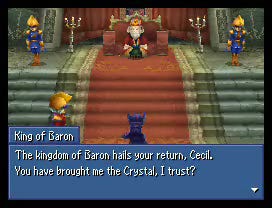
Chief among these improvements is the story itself. Eschewing the stock JRPG zero-to-hero narrative arc, Final Fantasy IV instead focuses on the upper echelons of a medieval-style royal courtroom. You play as a powerful knight, Cecil Harvey, who dares to question the ethics of his beloved king. For this impudence Cecil is thrown out of the courtroom and sent on a final assignment to mark the end of his royal service. Unbeknownst to Cecil, the king's order is a suicide-bombing mission that will result in the deaths of many innocent villagers.
Matrix has managed to eliminate the loading times that plagued the DS version of Final Fantasy III.
Within the first half an hour of play the stage has been charged with a kind of hot tragedy that's unusual to videogames. Rare themes of revenge, loyalty, power and responsibility are investigated and, while this certainly isn't Tolstoy (let's remember, you can summon a fat yellow chicken to help out whenever the going gets tough) it's a story of surprising pace and range, something that will help drive today's players through some of the more archaic game elements.
As with last year's update of Final Fantasy III, this is a difficult and unforgiving game but, thanks to a deeper battle system and some better balancing, its enlivened by the challenge rather than ruined by it. It's not unusual to venture out from the safety of a town into a dark cavern only to run out of healing potions, your whole party wiped out 20 minutes later, with no option but to reload back at the town again. Released 17 years ago, the Japanese original was deemed so tough that Squaresoft created a bespoke 'Easy Type' version for the American release. No such concessions are made to lily-livered Westerners today and this DS version is the full strength original.
Players 'spoiled' by modern day gaming's indulgences may find the challenge too much to bear, but approached with the right mind-set, it can make for very rewarding play. Every encounter, from a lowly bat up through to a hulking Antilon boss is defined by difficulty, and as such the importance of items and their careful management is pushed to the fore. Whereas in most RPGs, health- and magic-restoring potions and ethers soon become redundant, here they are precious commodities to be treasured and used sparingly throughout. Every excursion from the safety of a town's borders is heavy with danger, bringing the game's economy into sharp focus.
This new emphasis is intensified by some new mechanics to the update. For example, whenever you enter a cave or dungeon, the bottom screen switches to a blank canvas. Then, as you explore, lines are drawn onto the screen mapping out the area. Complete a map of the dungeon to 100 per cent and you'll be richly rewarded with new items or money. It's a brilliant idea introducing a neat risk/reward mechanic: should you race through a dungeon, limiting the number of fights your team will encounter but miss treasure chests and lose your map completion bonus or should you painstakingly cover every inch or ground and reap the full benefits?
In contrast to Final Fantasy III, characters are given set classes with unique abilities. To introduce flexibility to the system, Matrix has added the ability to customise characters within their classes with new abilities known as 'Augments'. These can be found throughout the world as items, or stolen from certain enemies and even 'inherited' from characters that join the party for a short period of time before leaving as the plot dictates. With some experimentation it's possible to create some interesting and powerful combinations and this flexibility within the hitherto strict character classes is a welcome success.
Rhydia gains a new eidolon (summon monster) named Whyt who can be visually customised and levelled up by way of some Brain Training-esque mini-games.
There are some petty irritations such as the lack of cursor memory (if you want to keep entering the same attacks during each round of a battle you'll have to manually input them every turn). Likewise, you can't hold down a directional input to scroll through a menu list, rather you have to tap up and down for each and every item in the list; stupid, unnecessary oversights that niggle away. The encounter rate throughout is high and the fact that you can only save on the world map or at designated spots inside dungeons makes the game unsuitable for short-term, on-the-move play.
It's not the best Final fantasy game in the series - even with the new additions to what was already a strong classic JRPG, the inescapable confines of the structure make this literally a lesser game than many of the subsequent releases - but it's a respectful and assured update and that freshens an aged experience for a modern audience. Of course, for those who have made up their minds with regard to the Final Fantasy brand there will be nothing here to convince them that the game is anything other than universally brilliant or universally terrible. But for those who deal in more than mere absolutes, this is a project of mixed excellence that bodes well for the inevitable updates of Final Fantasy V and beyond.
8 / 10
