Enemy Territory: Quake Wars
These are hostile waters.

It's a good week for those who enjoy taking care of Alien Scum. Unless you've been living under an especially soundproof rock, you can't fail to have noticed that the Master Chief has returned to Earth this week to splatter some Covenant types all over the ruins of East Africa - but it's not just Xbox 360 owners who will be finishing the fight this weekend.
There's alien killin' to be done on the PC as well, it seems - with another venerable franchise, Quake, bringing the fight back to Earth for a teamplay-focused rumble between the human forces and everyone's favourite biomechanical horrors, the Strogg.
We shouldn't really imply that there's much correlation between Enemy Territory: Quake Wars and Halo 3, though. In fact, if anything, this pair ably demonstrates just how un-alike two FPS games that are essentially about space marines fighting space aliens can be - and yes, we're saying that without a hint of sarcasm. Honest guv.
For the Makron!
Enemy Territory: Quake Wars is English developer Splash Damage's follow-up to the popular Enemy Territory freeware title, which was based on another id Software game, Return to Castle Wolfenstein. Around four years in the making, this second instalment in the Enemy Territory series has transposed the action to the science fiction universe of Quake II and Quake 4 - and somewhere along the way, seems to have swapped some DNA with Digital Illusions' celebrated Battlefield series.
In fact, it would be fair to say that ET:QW has far more in common with Battlefield's wide open spaces and vehicular focus than it does with Quake's tight corridors and twitchy firefights. Anyone who has played the Wolfenstein version of the game will know that teamwork and mission objectives are the order of the day here, not frags - but Quake Wars takes that ethos a step further.
Each of the game's 12 levels - which are spread across four distinct "Campaigns", each ostensibly highlighting a major battle in the Strogg invasion of Earth - has one defending team and one attacking team. The plot explanations regarding what you're defending and attacking are almost meaningless; once the timer counts down, all you know is that you have to blow something up, hack something or capture something, or prevent the enemy team from doing one of the above.
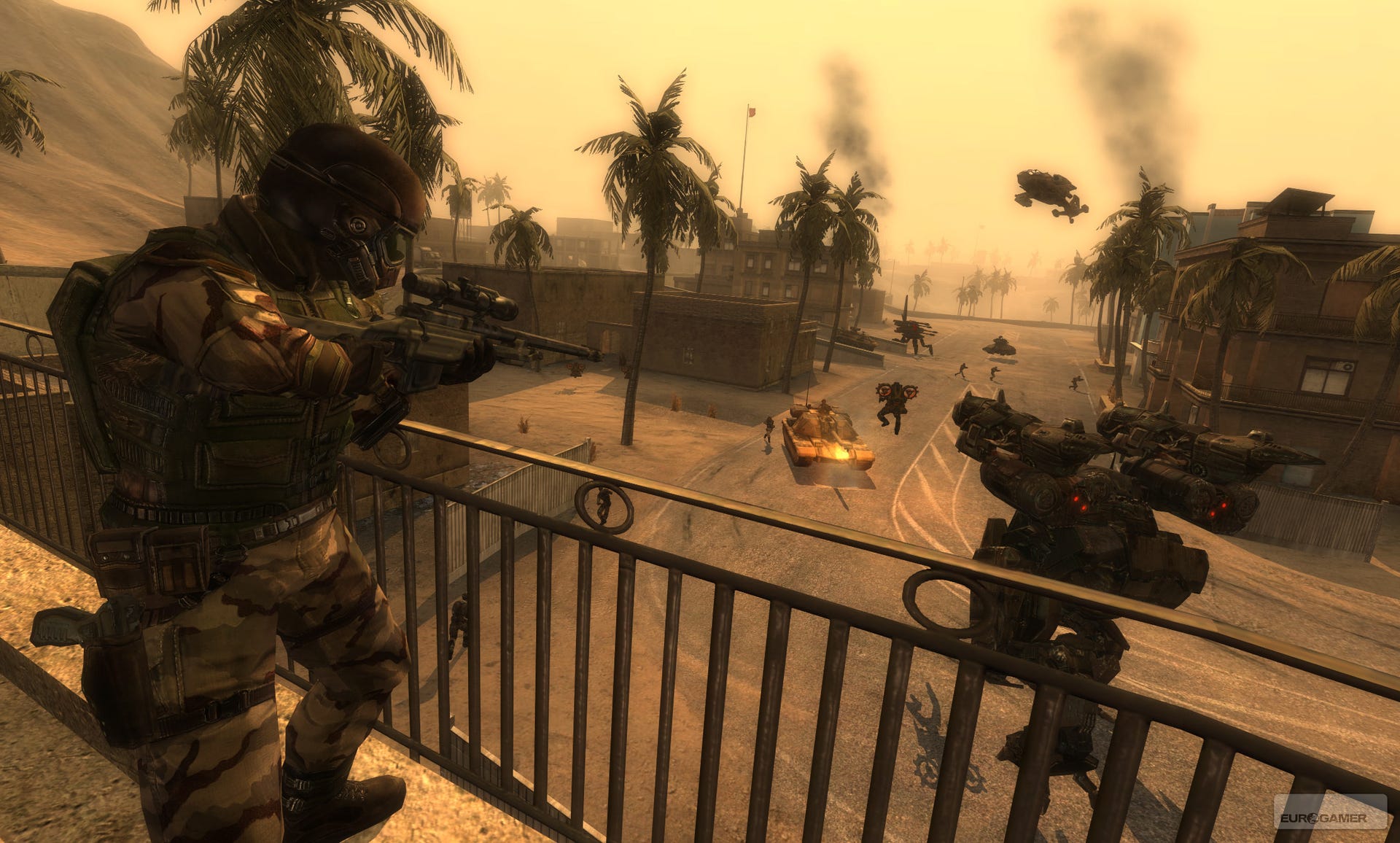
The game progresses according to a lengthy timer; most servers seem to set this at around 20 minutes, although we're writing this on the evening of launch so it's likely that settings will be played with in the coming days. Within that timescale, the attacking team has to achieve a number of objectives - for example, knocking down a barricade so you can bring your mobile command centre through, escorting said command centre to a deployment point, taking out a nearby shield generator, stealing a key object and then making it back to an evacuation point with said object.
The objectives flow in a logical progression from one to the next, and the attacking team can only win by completing the full sequence. On many maps, this actually means that the game gets harder as you near the end; with only one final objective to go, vital seconds are ticking away, and the full enemy squad is defending just one room or one entrance. More than once we've seen an attacking squad make it all the way to the last objective, only to be held there in a bloody stalemate for ten minutes - although that's nothing a bit more coordinated team-work couldn't solve.
Unlike similar games like Team Fortress, though, Quake Wars doesn't allow for an ebb and flow across the battlefield. Certain things - remote points where your reinforcements spawn, say, or various turrets and defensive buildings - can of course be destroyed or recaptured by the enemy, but the major level objectives are one-way only. Once the defending squad is down to its last objective, there's no way to push the attacking squad back or retake the initiative; painted into a corner, it's time to defend or die.
To spice things up, the game also offers a host of smaller "missions", which you can cycle through by pressing M on the keyboard. Some of these are dynamic - such as keeping track of which vehicles and emplacements are damaged, and allowing engineers to select their repair as a mission. Others are static, such as capturing helpful spawn points that aren't included in the main set of objectives. Your present objective is always listed in the top-left corner - although we were a bit miffed that selecting a mission doesn't give you a nice obvious waypoint marker to guide you there.
Covering Fire
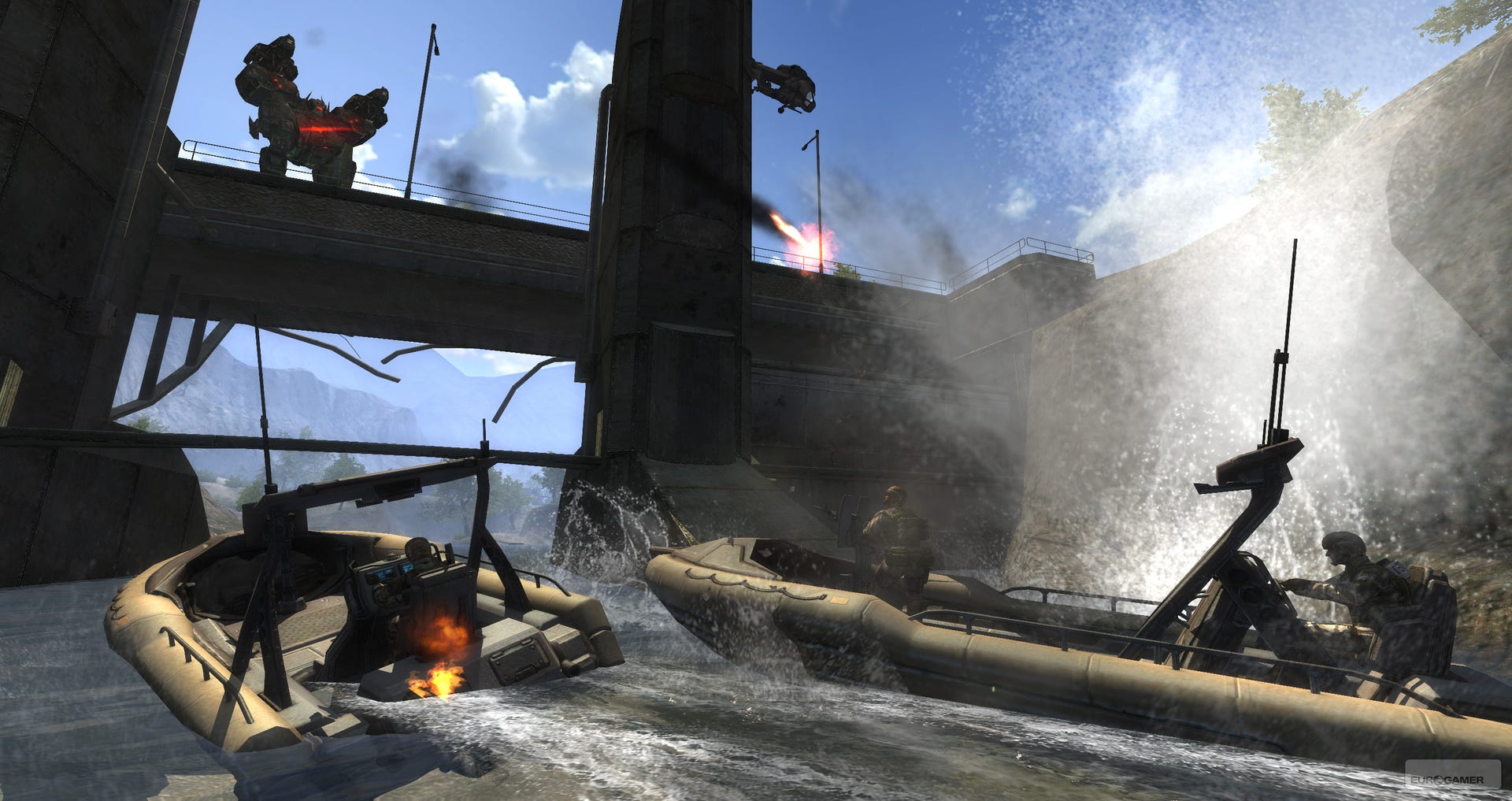
Actually, that's a bit of a problem with the game as a whole; it's got a learning curve reminiscent of the Matterhorn, with only the faintest nod given to the idea of comprehensive in-game information. Information on your map and HUD is densely packed, but only makes sense once you actually know the layout of the level. You'll spend a lot of time wandering around in your first few days playing the game, which a decent and clear objective marking system could have avoided.
The game's determination to cast you as a clueless newbie for your first few matches continues in the equipment load-out. As you select each weapon and tool from your arsenal, you get a brief description in a window at the top of the screen; helpful as this is, it'll still be a long time before you instinctively know which of the bewildering items you need in each given situation. This is especially notable on the Strogg side; the humans, at least, get sensible weapons like shotguns and sniper rifles. The Strogg equivalent items will take quite a bit of experimentation to get your head around.
Once you've stopped wandering around the maps like a tourist looking for a cashpoint in the West End, and have worked out which way around each of the guns goes, Quake Wars seriously starts to come into its own.
The vehicles in the game - both terrestrial and aerial - are great fun, ranging from conventional tanks and choppers to more outlandish types like the Strogg's slow but devastating bipedal Cyclops. As in Battlefield, we expect that aerial combat experts will emerge quickly; there's a steep learning curve to controlling the choppers, but taking out ground targets with them is both a great tactic, and a deeply satisfying experience.