E3 2009 may not have officially kicked off yet, but it's already been a show to remember. After all, it's not every day you get to see the likes of James Cameron, Paul McCartney and Pele chatting about videogames. Nor is it every day you get to have a conversation with a virtual 10 year-old or play Burnout with an imaginary steering wheel.
But today is one of those days, because today Microsoft is revealing Project Natal to the world. Fresh from the E3 conference, we dropped by their posh hotel to go hands-on - or rather, hands-off - with the new technology.
Milo & Kate
First up is Peter Molyneux's new baby. As you'll know if you followed our live text, Milo is the name of the new AI character in development at Lionhead Studios. And as you'll know if you read our interview with Peter Molyneux, or could have predicted if you know anything about Peter Molyneux, Kate is the name of a dog.
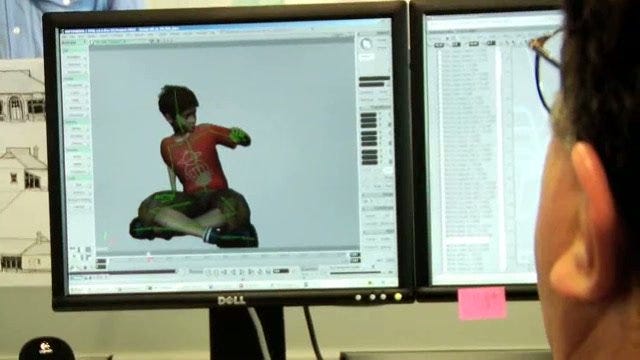
A Lionhead man mucks about with Milo.
But the dog's not on show today - instead we're presented with Milo on his own, sitting on a swing by a river. Molyneux invites me to try interacting with him by standing in front of the screen and moving around the room.
As I move, the camera moves with me. Shift your body left and the camera pans left; tilt your body forwards and it zooms in, and so on. "Normally you'd be using the right thumbstick for this," observes Molyneux. It's a bit disconcerting, but in a good way; looking around to change your viewpoint feels a lot more natural than pushing a stick.
What about those who would rather stay sat on the sofa? The technology works just as well when sitting down, according to Molyneux: "You just move your torso and your head to move around. It can be a very relaxed experience."
Now, he says, we're going to train Milo to recognise me. I'm told to smile and frown to start the process off, and I try to make things easy for Milo by exaggerating my expressions like a gurning champion at a rave. "That's too much," says Molyneux. "You don't smile and frown like that in real life, do you?" He clearly hasn't seen my Facebook page.
I tone it down a bit and sure enough, Milo jumps off his swing and walks towards me. "You OK?" he says.
It's unnerving, there's no doubt about it. Instinctively I reply, "Yes, thank you. How are you?"
Claire again, Milo again. We want the dog. Show us the dog now.
"Wearing black, I see. It suits you." He's not wrong. About the first bit, anyway. But once the shock of Milo noticing this wears off, I realise he hasn't answered my question. Perhaps this is one of the tricks used to make you think he's real; and they are indeed tricks, as Molyneux is happy to admit.
I try another direct question. "Have you had a nice day, Milo?" He smiles and nods, so I go for something more complex. "Did you enjoy Microsoft's E3 conference?" He's non-committal. "Are you looking forward to the rumoured unveiling of the PSP tomorrow?" Milo nods. The truth is though, he doesn't really know what I just asked. He understood I was asking a question by listening to the tone of my voice, but he didn't understand the words. Knowing that doesn't make the whole thing much less unnerving, though.
Molyneux invites me to go and look at the fish in the river, as seen in the E3 press conference. The water effects are stunning anyway, but to see yourself reflected within them is astonishing. "Swish the water about a bit," says Molyneux, so I do. There are one or two odd moments where the water doesn't quite seem to flow naturally, but once again, the overall effect is highly impressive.
The demo's over, and all too soon. I didn't get to try out the work or play activities, or draw a picture for Milo, or meet his female counterpart, Milly. Not to mention the dog. There are still lots of questions about Milo & Kate, particularly with regard to how scripted the conversations are and just how clever your virtual friend really is. Here's hoping we'll get to find out more soon.
Ricochet
In the meantime, let's try out the tech demo titled Ricochet. This is the one Kudo Tsunoda unveiled during the press conference, and he's here to guide us through a playable demo.
The basic concept is that your character, shown as a translucent avatar, is standing in a tunnel. Endless waves of balls get chucked down the tunnel and you use your whole body to deflect them. You can perform kicks, headers and handballs, for example. Or, if you're as co-ordinated and graceful as me, you can flail wildly about, using everything from your elbows to your high heels to try to whack the balls back.
There's no denying there's a bit of lag between your movements and those of your on-screen avatar. However, the discrepancy is so tiny that it never feels like the lag has cost you a hit. In any case, playing Ricochet is immediately instinctive and enormous fun. In fact, I don't realise quite how much I'm getting into it until I hear Tsunoda warning a bloke behind me to stand back.
Punch dinosaurs! No wonder Spielberg likes it. He hates those f***ers.
Tsunoda is keen to point out this is just a tech demo, so don't expect to see Ricochet hitting Xbox Live Arcade any time soon. "But this is representative of all the kinds of things you could work into different games, both retail and Arcade," he says. "It's a creative toolset we provide so designers can build things however they want."
As with Milo & Kate, there are many more elements of the technology that have yet to be demonstrated. The potential for multiplayer games, for example, which Tsunoda assures us is there, and the option to play while sitting down. But the major breakthrough, he says, has been getting the camera to register how the entire skeletal system works. "That's something people have not yet been able to solve yet with this kind of technology," reckons Tsunoda. Eat that, EyeToy.
Burnout With An Invisible Steering Wheel
The other tech demo on show initially looks familiar. It's Burnout - the original Burnout, to be specific, for the original Xbox [Editor's note: it was actually a modified Burnout Paradise - apologies for the error!]. The difference is you can drive around without pressing a single button, or indeed without even touching a controller.
To accelerate, explains Project Natal director Alex Kipman, you just put your right leg forward. Bringing it back to the centre will put your car in neutral. To brake, you put your leg behind you. To steer, you hold up your hands as if holding a real wheel and twist.
Although we haven't got pics of the Burnout demo, the tech demo reel from Microsoft's conference throws up an equivalent.
According to Kipman, the game is running at 30fps. The camera is able to scan your entire body within five frames, so no complicated calibration is required. Within just a few seconds of taking my place in front of the screen, I am playing Burnout with my leg. As promised the car accelerates and brakes depending on whether I'm stepping forwards or backwards. Again, there's only the tiniest bit of lag, and the overall level of responsiveness is highly impressive.
The steering is slightly more complicated. My first instinct is to twist my imaginary steering wheel like a six year-old, but predictably this sends me careering into walls and over cliffs. "Trust in the device," says Kipman, like some kind of Jedi of futuristic invisible technology. He shows how only gentle turns are required to steer the car and soon I'm cruising round corners with ease. It helps that there don't appear to be any other cars on the road, mind.
Would you really want to hold up an imaginary steering wheel for the length of an entire game? It's difficult to know the answer with such a short demo and in such controlled conditions. However, there's no denying this technology works. Twist your imaginary steering wheel left, and the car goes left. Step backwards, and you brake. It's responsive and it's intuitive. And this is just the start, reckons Kipman.
"If I was doing a game from scratch I would have done a wider array of gestures," he says, suggesting you might be able to push the imaginary steering wheel forwards to go faster, for example. "This graph on top of the game, we just did it in a few days. It's very simple and there's not a lot to it as it's just a proof of concept. If I was designing a brand new racing game from scratch, which is what we will be doing with Natal, I could be doing any number of things to control the car."
Even an ancient game seems new and fresh when you graph Project Natal on top. It looks like Burnout, it plays like Burnout, but it doesn't feel like Burnout. Again, it's hard to make final judgments within such a short amount of time, and with only two tech demos and a single game to go on. But I walked away from my first hands-on session with Project Natal wanting to see more, and that has to be a good thing.
