Dragon Age: Origins - Awakening Review

They have a voice. They're going to use it.

Version tested: PC

Let's remove any confusion from the start. Dragon Age: Origins - Awakening is not another piece of crappy DLC following the dismal inclusions we've seen since the BioWare RPG's release last November. This expansion is 25 hours of full-scale new content, essentially an entire new game, that picks up the story however you may have left it. It has a new setting, a (mostly) new crew of companions, new abilities, skills, spells and talents, and most importantly, a re-imagined approach that's appropriate to a shorter format while still achieving the necessary sense of scale.

You've finished Dragon Age, right? By necessity, this review has to mention the events at the end of that game, so consider yourself spoiler-warned. That said, we can all rest easy because the Archdemon has been defeated, the Blight quashed, and now all citizens of Ferelden live in happy bliss, singing songs of praise to the mighty Grey Warden [your name here] who saved the day. Except, of course, that's not the case at all. It's never that easy.

There are a number of ways you could have chosen to end Dragon Age. The consequences of these can be dramatic enough that you might not even have a character to import into the start of Awakenings. My character, Simon, survived, and so I pick things up with the level 21 Grey Warden being attacked on his way to Warden stronghold Vigil's Keep to take up his post as Commander. Attacked by darkspawn.
1

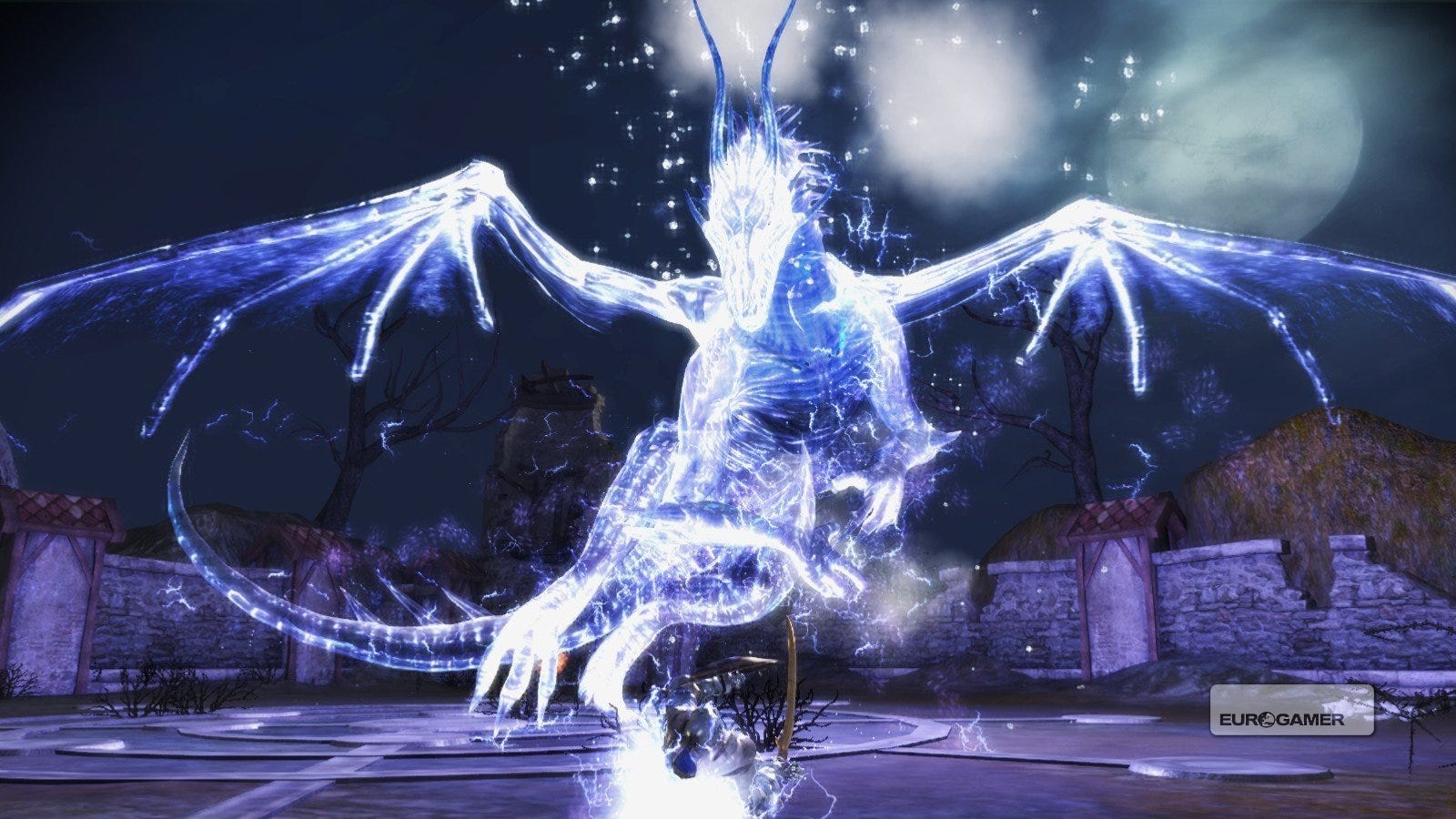
It wouldn't be Dragon Age if you didn't fight a couple of dragons.

That's strange, given that I spent 100 hours playing the main game to put an end to the darkspawn attacks. The reason for this enemy's return is, in fact, the crux of the story, but it doesn't stop it being just a touch galling - as if your enormous efforts have been undermined. Shake that off, and things pick up quickly. Something very strange is going on with the darkspawn. Not only are they not retreating into the Deep Roads, but some of them are speaking. Their attacks seem more coordinated, more deliberate. And most oddly of all, there are hints at two separate factions.

As you might expect from an RPG expansion, a slew of new abilities have been added in and a lot more levels to climb through. There's no scrimping here at all. After you've recovered Vigil's Keep from the invading darkspawn, it's time to regroup (literally, gathering a new team of companions) and prepare for a new battle. To do this you'll find that each class now has two new specialisations available, and a third specialisation slot to stick one of them (or another older one) into once you reach level 22. There's also a third row of four class-specific talents available from the start.
2

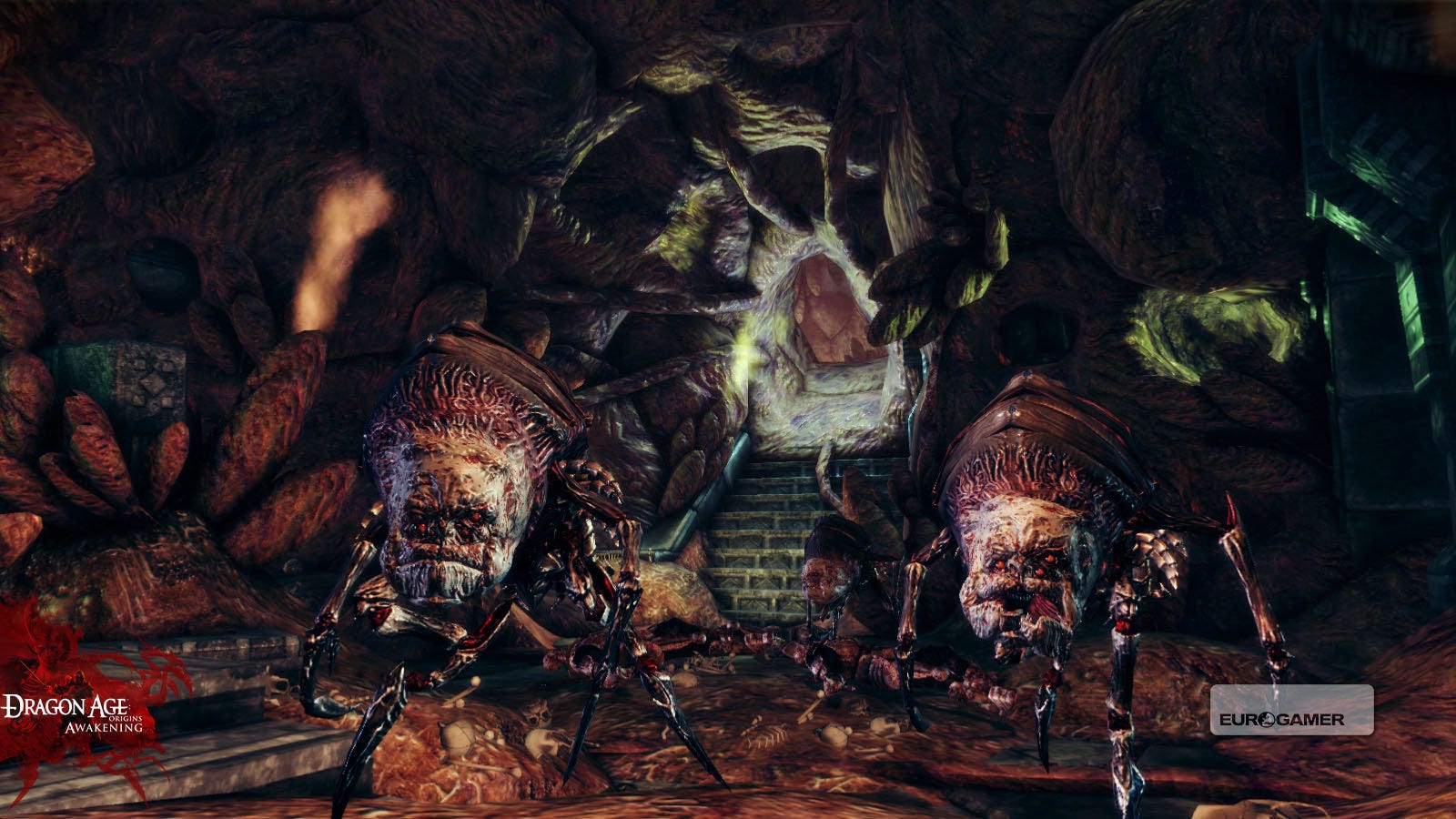
The Children. Someone call Social Services.

These come with four new abilities each, and none feel tacked on at all. In fact, a few are clearly there to address issues that arose in the original game. For instance, you may choose to develop Battlemage skills if you want your mage to live through melee encounters. A rogue specialising in Shadow will be far more effective at staying hidden, using decoys, or performing elaborate backstab manoeuvres. Warriors are given a brush with magic via the Spirit Warrior path, or more complex team buffing as a Guardian.

On top of this, every other ability set has another row of four tip-top new talents. As a heavy-weapon warrior, I was very grateful for a new selection of really meaty two-handed attacks. Combined with the warrior's new Second Wind talent, allowing an instant top-up to the stamina bar, this made for much more involved battles.

There's a new crafting skill too, Runecrafting, and again it feels like it that always belonged. These bonus additions for weapons (and now also for armour) can be created by one trained in the art, although you'll still need to find an Enchanter to get them added. It's well worth it, as the little coloured tiles are a lot harder to come by in this add-on. You can also level up in Vitality (improving health bonuses) and Clarity (giving focus to mana or stamina). Another other smart addition is stamina draughts, allowing the resource to be topped up in the same manner as using a health poultice. To sum up: there's really quite a lot of new stuff.

But for me, the most important new stuff is the characters and the places we're heading. The early revelation that Oghren is the only major companion rejoining you from the first game is something of a shame; my least favourite character was forced to accompany me for the first couple of hours, until I could recruit someone - anyone - else to replace him. That's the odd thing about Oghren: the writers seem to hate him too, making him even more of a vile, irredeemable drunk this time out. However, also joining you from the off is Anders, an apostate magician and thoroughly sarcastic sort. Thank goodness.

It took me a while to warm to Anders, especially in the company of rogue Nathaniel - son of the treacherous Arl Howe - who isn't exactly Mr Positive either. However, I got there, and I got there because of Ser Pounce-a-lot.

I saw a kitten wandering around in Vigil's Keep. Not unusual, but this one could be picked up. Then I forgot about it. A while later I was going through the gifts I had, winning favour with party members, and spotted the cat listed there. So on a whim I offered it to Anders, thinking his refusal might be funny.

3

Anders may look cool here, but try giving him a kitten.

Anders fell in love. Anders fell apart. And from then on, he had a pet cat in his backpack, available as an icon on his taskbar. Any time it seemed inappropriate to do so, I could click on that and hear the furious magician start talking in baby gibberish at his adored pet. Fantastic.

As with the main game, you're free to approach the tasks of the principal quest in the order you choose. There's only one major city in the northern reaches of the Arling of Amaranthine: Amaranthine itself. But surrounding it are sprawling regions to explore, each containing enormous stretches of dungeons, story twists, and new potential companions to recruit, reject, or chop up into bits.

Each region hits on a key note from the main game, and in doing so smartly reflects on its themes. The Knotwood Hills lead to an abandoned Dwarven city, Kal'Hirol, while the Wending Wood is home to a particularly cross Dalish Elf. The relationship between mages and the Chantry is perhaps the most discussed topic, in light of Anders' conflict between being on the run and joining an established order such as the Grey Wardens.

4

The feather in your helmet drives fear into the hearts of the enemy.

In fact, that's the common theme to all those you recruit for the Joining here. Awakening is about reluctant heroes who you might, if things were different, have been fighting against. This darker tone persists throughout.

I'll say nothing of the ending, nor reveal anything that might spoil a surprise. But it's worth noting quite how serious the decisions you're making are. There's one choice you're asked to make very near the start of the game: where do you want to focus the very limited supply of soldiers for the Keep. Defending the city, protecting the surrounding farmlands (and therefore the civilian population), or defending the trade routes? Or perhaps spread thinly between all three? Really, seriously, choose carefully.

There are further quests from the Chantry board in Amaranthine, personal tasks asked of you by someone who I suppose is best described as your secretary, a merchants' board to take quests from, and best of all, in a pub in the city, challenges given to you by the "Blight Orfans". This group of cheeky children has a series of fantastically silly requests, poorly spelt and thinly disguised as virtuous. Choose to join in and you're quickly putting itching powder in people's beds, stealing books from the church, and scaring the neighbours.

However, the Orfans' series of quests also reveals Awakening's biggest problem: a tendency to fizzle out. Finishing their list of challenges ends in, well, nothing. No consequences at all. A much worse example was a nice set-up in Amaranthine, where you're asked to choose between helping the city guard or the smugglers they're fighting. It gives the impression that it's all going somewhere significant, but ended with a bug allowing me to complete it for both sides. This seems to be a perennial issue with RPGs, but it's so unsatisfying. Then the overall ending to Awakening, while certainly dramatic and enormous, comes to a close too quickly, lacking the after-show party that made Dragon Age's finale so rewarding.

On the other hand, Awakening redeems itself with by far the best prison break I've played. It's a hoary old set-up - your party gets captured, its equipment removed, and locked in a cell - but it's handled with real finesse. It offers you the satisfaction of making good your escape using the scraps of equipment you can find, but then quite brilliantly returns all your stuff to you in such a way that there's never that awful moment of having to figure out what was whose. It even has a shop at the end so you don't get over-full inventory syndrome. Standing ovation.

5

One angry Dalish Elf. Check!

Most importantly, Awakening is a refined beast. Dragon Age's rougher edges have been smoothed, including the difficulty levels. Pre-patch, the original was a real mess of spikes; that's absolutely not the case here. Normal provides a sensible challenge for those wanting to combine real-time attacks with judicious use of turn-based pausing, and Easy is a cakewalk. Then scale it to Hard or Nightmare depending on how hardcore you are; just as it always should have been.

The new sets of attacks, buffs, spells and talents make combat much more interesting, letting you choose from a vast array of abilities rather than spamming the two or three that get you through. And of course, there's the satisfaction of being a high-powered crew capable of some really splendid tactics.

While a quarter of the size of Dragon Age, Awakening is still absolutely enormous. At 25 hours, your £20 is buying you a game three times as long as some things twice the price, and it's every bit as rich and involved as the original. Sure, you'll bristle at being forced to work with new characters, but that quickly passes and you're consumed once more.

6

They've got a gob on them, and they're going to use it.

Nothing feels tacked-on or cursory. Even the one-shot, one-scene locations are elaborately designed. Each new companion has a detailed, nuanced background, and brilliant banter to share as you go about your business. (A favourite line from Anders: "That ballista is conveniently placed. Well, I'm always up for a spot of iconoclasm.") You don't just help out a village in trouble: you learn about that village, its place in history, the reason it's in trouble, and you experience the consequences of helping it.

Awakening is a mighty fine addition to the Dragon Age canon, and a rewarding continuation of its story. Perhaps most interestingly, the volume of choices you make leads to what might be an even more variable ending than the previous one. There are some incredibly tough choices to be made, some peculiar allegiances to form, and a region to save from the darkspawn. You're a Grey Warden, it's your duty.

9 / 10

Read the Eurogamer.net scoring policy

Comments (93)

Comments for this article are now closed, but please feel free to continue chatting on the forum!

  • Loading...hold tight!