Perhaps the best way to define your more violent kind of game is by whether it gives you tools or props. Uncharted 2, dynamic and enthralling as it is, gives you props. Even its guns seem to have been designed specifically to get you through the next bottleneck of set-pieces, before the developer flings you in another direction. Crackdown, however, provides tools - items and ideas that are good for all manner of experimentation or chaos. Or perhaps that should be toys rather than tools - its developers, after all, insist on calling Crackdown 2 a toybox, rather than a sandbox.
So what should messing around in a toybox feel like? In the original game, it always goes the same way with me. First, rocket out of the Shai Gen underpass in the fully-levelled SUV, hit the ramp truck and narrowly miss that first glowing stunt marker, landing real soft-style, thankfully, in the passing lap of a nice old lady. Then screech to a halt in skyscraper plaza, with the nice old lady now harpooned to the back bumper, kill the engine and decide who to run over. Then it's into the Shai Gen elevator (with the car, obviously) and all the way to the top floor before a run-up, followed by that perfect squishy moon-rover boost jump, carrying me out the window and into the bright blue sky. Then it's back to transcribing some endless interview about Bulgarian middleware.
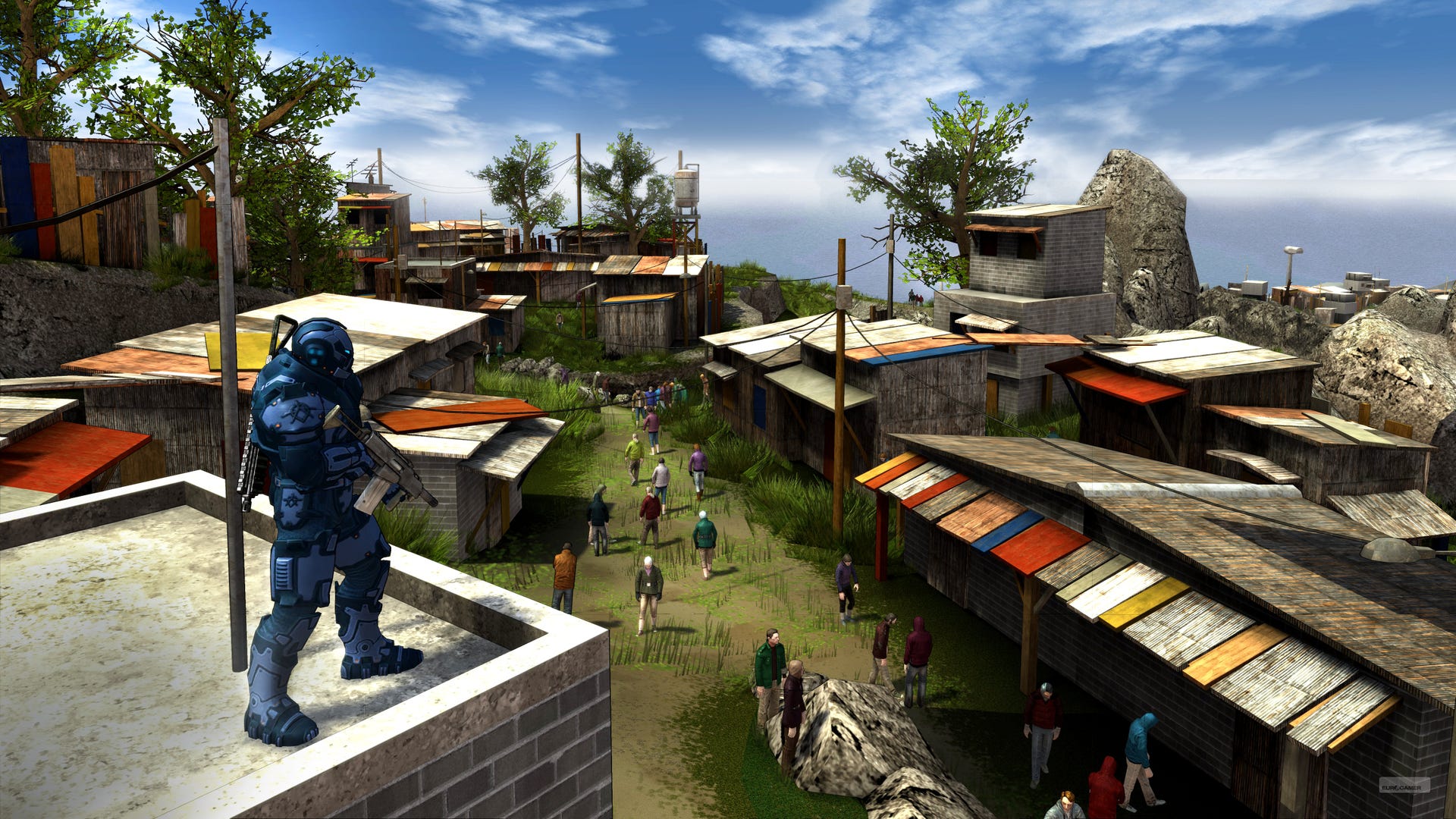
Four-player co-op is promised throughout the main campaign, and Ruffian suggests you might all enjoy doing different missions at once instead of teaming up.
Realtime Worlds' original deranged masterpiece was a testament to idiotic free will, where every 15 minutes was an entire action movie's worth of stunts and explosive mishap - and by "action movie" I mean one of the proper, unintentionally hilarious eighties action movies where cameramen still got crushed under lorries and they used real bullets to save on costs. Crackdown was a marvel of mucking about that had very clear rules but almost no restrictions, and with a sequel on the way, it's going to be fascinating - nail biting - to see if Ruffian Games, a studio filled with key personnel from the original development team, can strike the same magical balance.
An afternoon in Ruffian's new, rather unfinished office suggests that, yes, they probably can. The first outing was always at its chaotic best played with a friend, of course, but bespoke multiplayer game-types are a considerable focus of Ruffian's sequel. The two the team reveal aren't that inventive - Deathmatch and Rocket Tag, a Halo 3 Ninja Ball variant which tasks you with keeping hold of an elusive orb while everyone else chases you with rocket launchers - but that lack of obvious gimmickry is the point: Ruffian's allowing the game to speak for itself, and the strategy works.
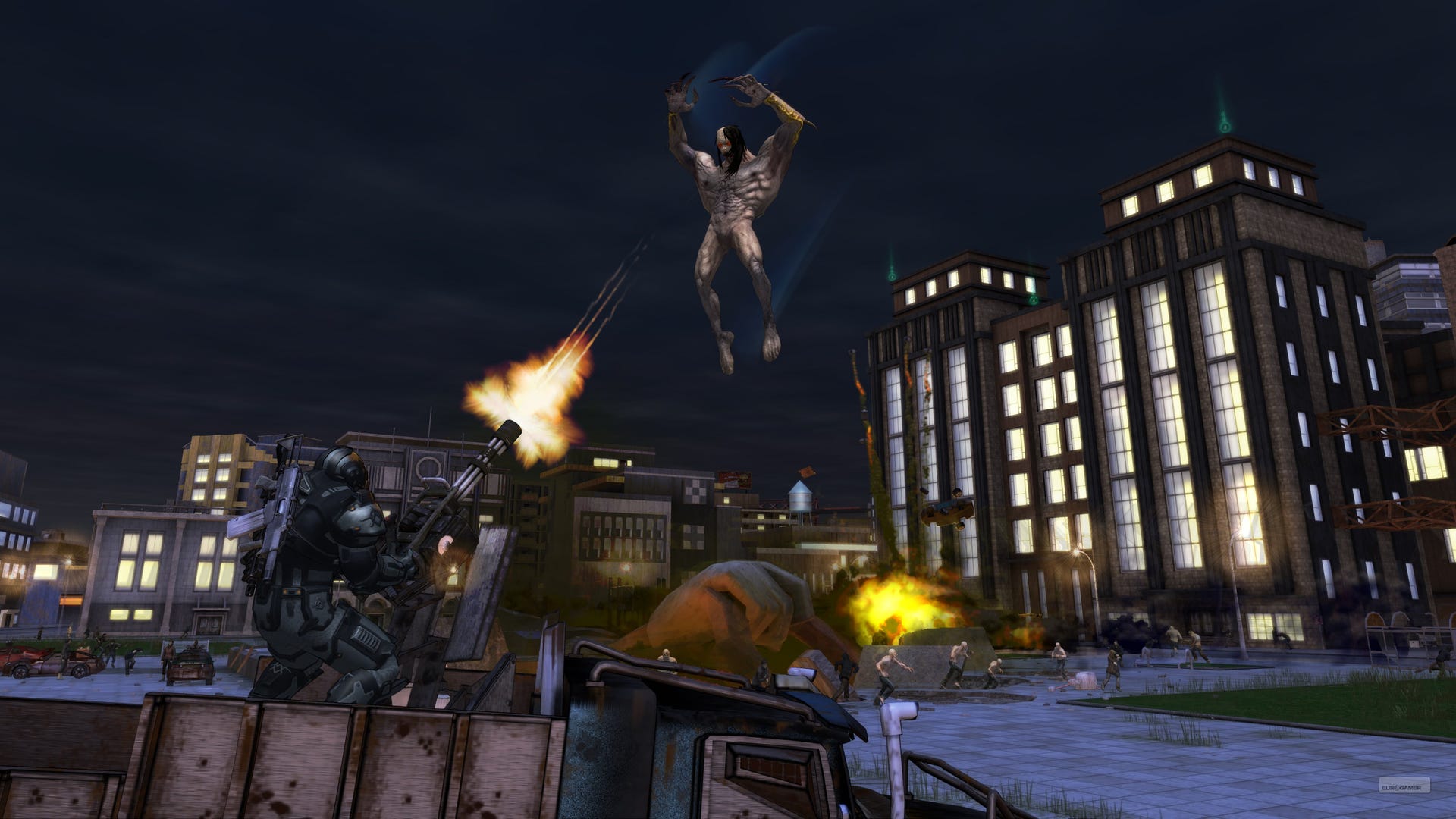
Vehicle-mounted weapons will be available for this outing.
Multiplayer divides Crackdown's city into districts to create separate maps. They've got a nice bunch going so far, all of which remind you how subtly the original managed to turn its distinct neighbourhoods into the equivalents of actual game levels, each with its own twist, its own focus. Turnback Lane is a warren of skywalks and narrow balconies set around a rundown motel complex, while High Rise, as the name suggests, is an intensely vertical map with plenty of opportunity to get right up above some fairly nasty street-fighting. Docks is the original game's brilliant shipping container paradise exploded outwards with the addition of some truly gigantic cranes, while Refinery is the old Volk industrial plant, made even more complex, multi-levelled and treacherous than before.
As one match turns into two, then five, then a dozen, it becomes obvious that Ruffian has zeroed in on something rather special with multiplayer: while it would be pointless to try and take on the CODs and Halos at their own game, there's simply nothing else like 16-player Crackdown available at the moment. The matches move at a crazy pace akin, perhaps, to Quake III, but they also feature that frightening degree of mobility the Agency has given you - an arm-flailing leap that seems to last forever and terminate just where you want it to, and a targeting system that allows you to pop people's heads off from the other side of an island.
Glowing jump pads, although initially seeming rather artificial, actually slot really well into Crackdown's simple genome - regular air boosts for this most sky-minded of titles - and Ruffian chains them into elaborate tangles at times, ping-ponging you around an entire map in the space of 30 seconds, or simply chucking you mischievously high into the air, where you can pick out a range of different scurrying targets, or, more likely, become the ultimate target yourself.
16 players means there's always a chance to find somewhere to catch your breath for a few seconds or build up a nice lingering rivalry with a handful of other people, but such is the speed of movement and the relentless pace of respawns that it can feel like you're playing against hundreds, and there's a smart scoring system that sees you rewarded with different points depending on the quality of each kill. The concrete-splintering ground-strikes seem to be most worthwhile. Throw in power-ups like extra shields, invisibility, and regular chances to change your weapons, and multiplayer becomes hard to put aside.
Eventually, however, it's into one of the flimsy-walled meeting rooms and onto a closer look at the single-player game. "Let's get cracking," says Ruffian producer James Cope (regularly namechecks Robotron 2084/is generally awesome), firing up the game before instantly looking rather embarrassed.
I have a horrible - unconfirmed - feeling that they may have changed the voice of Crackdown Announcer Man. 2/10.
Crackdown is unlikely to go down in history for its plot alone - there were some dodgy people knocking around, and you killed a lot of them while jumping very high in the air and bravely driving over pedestrians - but it's nice to know that it had enough ticking away under the hood to kick off this sequel. Towards the steeper end of the original game's missions came an opportunity to put one Dr Baltazar Czernenko off the Open University grant application list for good. Czernenko was Shai Gen's head of dubious genetic research - although I doubt that was the exact job title on his business card - and in the course of ridding Pacific City of this deadly menace, you probably let a lot of his snaggle-faced, zombie-like Freaks loose.
That, it transpires, was probably an error. Once the Agency regained control of Pacific City at the end of the first Crackdown, it then lost it again quickly to the hordes of delightful infected mutants rolling around in its streets and alleyways. 10 years passed, in which the three islands were comprehensively trashed, and the population either fled or joined The Cell, a terrorist network dressed in the same foxy knitwear patterns beloved of City 17's resistance. The Cell hate the Freaks, but hate the Agency a little bit more, and they're totally rocking this season's thick rustic threads and cable knits.
Crackdown 2 starts out with the re-emergence of the Agency as a force in Pacific City. With a crippled infrastructure and only one active officer back online, it's up to you to fight off The Cell and take down the Freaks, or just spend your time donuting your car mindlessly in the streets before backflipping into a laundrette.
Hopefully, it will be easier to get a new Agency car after lobbing your first one into a river this time.
Promisingly, although Ruffian is eager to tell a deeper story this time around, this set-up is little more than a way of getting three factions into opposition, while also creating an environment in which the only people left on the streets are The Cell or the Freaks - i.e., people you can legitimately back over in an SUV, meaning you won't be impeding the progression of your driving skills. "People love running other people over," smiles Cope, before adding quickly: "in Crackdown. But too often we made that something that punished you at the same time. This time, we're making sure that doesn't happen."
Meanwhile the streets themselves will be familiar, but not entirely so. "It's not exactly the same city this time," Cope continues. "There's lots of new geometry in there: we wanted people to see familiar bits, but also wanted them to come back and see how it's all changed."
Mission accomplished: Pacific City was a wonderfully memorable playground, and for a lot of players it would be something of a shame to say goodbye entirely. Ruffian appears to have achieved a remarkable balancing act: retaining the very basic layout of the city and its three islands, keeping all the neighbourhoods and districts in roughly the same place, but then swooping in close to extensively redesign each of the individual areas. The docks, as deathmatch hinted at, are now gigantic and far more vertical, while the refinery is more elaborate, filled with new dead-ends, gantries and shortcuts to discover.
Given the backstory, dereliction is a bit of a theme throughout: that smart little observatory nestled in the armpit of the mountains where you once found that big golden globe you then ran about lamping people with, is now burning wreckage filled with dozens of hazards, while the three tall cooling towers stuck rather incongruously in the middle of town are partially shattered in Crackdown 2. Citizens move about the emptier streets in patched-together vehicles reinforced with corrugated iron, or barricade themselves in skyscrapers where the Freaks can't get them.
Trashing the place appears to have been done partly to create a different kind of playground, but also to allow for an eruption of content from below. Crackdown 2 will feature numerous large underground cavernous areas where the Freaks live in picturesque squalor. Cope loads one up and zips around a bit - entering into the subterranean chamber through a hole at the bottom of one of the cooling towers. Inside, it magically manages to feel both huge and claustrophobic, as if the whole thing is a complex raid area pulled from some kind of Fraggle Rock MMO. Such close-up skirmishes are a tantalising prospect in such a traditionally open game, particularly when the area's filled with lumbering mutants.
And even above ground, the Freaks are causing trouble: Freak Breaches are impromptu mini-missions which, when triggered, lead to monsters suddenly pouring up out of the earth in a set location until a timer runs down. They provide a snappy little rush of intense action in a gameworld that generally has a nice background level of chaos, but not much in the way of sudden spikes.
I'm totally hot for this Fraggle Rock MMO, by the way. I'm rolling a Wembley right now.
Wading into a breach, Cope displays a handful of new combat options - picking up a large cotton bud-shaped chunk of metal and concrete, which originally formed a natural piece of cover, before meleeing freaks into wet chunks of splatter, or switching to the new UV-blast gun, which looks like a radioactive short-burst hairdryer, capable of blowing any surrounding enemies - and light vehicles - back a good distance to kill, injure, and generally create breathing space. "It's not a few people in a fight any more," as Cope points out. "This time around, you're always fighting hordes."
And the horde is rarely as stupid as it looks. Freaks come in a variety of different flavours, from the common scroungers at the bottom of the food chain, to slinger scroungers, with fairly unpleasant acid-lobbing ranged attacks, all the way up to creepers, the real Agency adversaries who can take the battle to the rooftops if you try to escape, and will have the brains to put up a real fight. "Creepers solve another of our problems with the original game," admits Cope. "We had this great open world, but whenever you got up high, you were safe. No one could really touch you up there. That's not the case anymore."
There's a handful of other things to be seen - night and day will pass very differently in the new Pacific City, with both the Freaks and the Cell thronging the streets in force after dark, while elsewhere Ruffian's hard at work on a more varied mission structure, mixing up the familiar baddies who need a truck parked on them with tasks that tell a little bit of story (the one I'm shown involves an assault on the Volk refinery to reconnect the Agency to the power grid).
We're still lobbying for a 'kicked Kristan off the Agency Tower' Achievement.
There's also - whisper it - going to be a new strain of orb potentially joining the party, although at the moment there's only the Pavlovian green glow of the agility variety scattered, temptingly, on every rooftop and ledge (Ruffian reveals, rather shockingly, that the originals were put there simply because most testers ignored the game's verticality without them). But there's no word yet on new vehicles or new powers or tweaks to the levelling system, and the Agency Tower - one of the most beloved gaming landmarks of this hardware generation - is still being redesigned, even though the team does hint that it's not necessarily the tallest building in town anymore.
It was easy to feel a little worried about Crackdown 2 originally, what with the long delays, the prolonged radio silence, and Realtime World's understandable irritation at seeing its cherished IP head off down the road. But the more that's revealed, the more it starts to seem that the game Ruffian's working hard to finish really feels like classic Crackdown. It's still an explosive stunt course, and it's still a vertical perpetual-hilarity machine, but most importantly it's still a toybox rather than a sandbox.
Crackdown 2 is due out for Xbox 360 in 2010.