Clive Barker's Jericho Review

Knee deep in the dead.

Version tested: Xbox 360

Pity the poor publisher which tries to sell a first-person shooter right now. At a time when gamers are positively drowning in 10/10 games in the shape of Bioshock, Halo 3, the five-pronged Orange Box (and another half dozen highly impressive also-rans), anything that's scoring less than a 9 is likely to get short shrift from anyone with a wallet. Either Codemasters is supremely confident about Clive Barker's Jericho, or someone forgot to look at the release schedule.

And you know what? If Jericho sinks without trace, it won't be because the game didn't offer something new and inventive. Spanish developer Mercury Steam has evidently put a huge effort into differentiating the game from the tired masses of done-to-death sci-fi and military-themed titles, and deserves a lot of credit for that - even if sometimes the actual execution leaves a little to be desired.

The core premise for this squad-based horror title is to see off an ancient evil that has "broken through into our world". As with all ancient evils, it's, mwhahaha, determined to "spread its taint across the whole of the earth". Sent into 'ground zero' in a Middle Eastern city is a secret seven-man strike force called Jericho, which "protects government interests from paranormal threats". Schooled in arcane arts and military savvy, each member of the team has his or her own para-psychological speciality, and carries their own specific weaponry with which to take out the dark denizens that await.

Halls of the damned
1

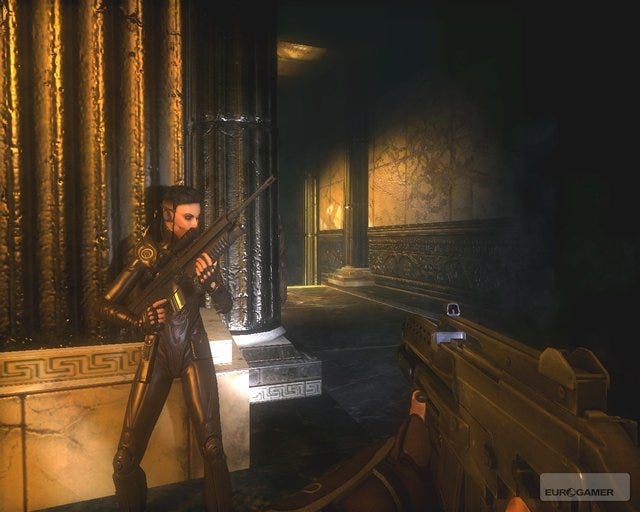
Even paranormal soldiers have eating disorders.

To begin with, you control generic grizzled squad leader Captain Devin Ross through the ruined streets of Al-Khali - a city destroyed by a massive sandstorm. With suspicions running high that a former Department of Occult Warfare agent known as Arnold Leach is behind the storm, you spend the first few hours of the game trudging through the doomed city in search of evidence of paranormal activity. Certainly, for the first six chapters or so, it's hard to find anything special about Jericho apart from a decent game engine. It really struggles to get into its stride, coming across as little more than a gory, overly linear fantasy shooter with gruesome enemies and the novelty value of fighting alongside six squad-mates.

But if you stick with it beyond the dreadfully tiresome early levels, something entirely unexpected happens in the plot (which we won't reveal here), and the game goes from boring, linear trudge through predictable encounters armed with an assault rifle, to gradually giving you an assortment of toys which freshen up the gameplay no end. The main change that we don't mind spoiling for you is how the game suddenly turns into a proper squad-based shooter, as opposed to a game where you and a bunch of other guys in black coats and American accents run around shooting scary monsters.

Okay, so that's still true when the game suddenly gives you the ability to play as the squad member of your choosing at any given moment (by cycling through a menu via the d-pad), but what soon becomes apparent is the dramatic impact each member's special abilities have on the amount of fun you'll have with the game.

Slough of despair
2

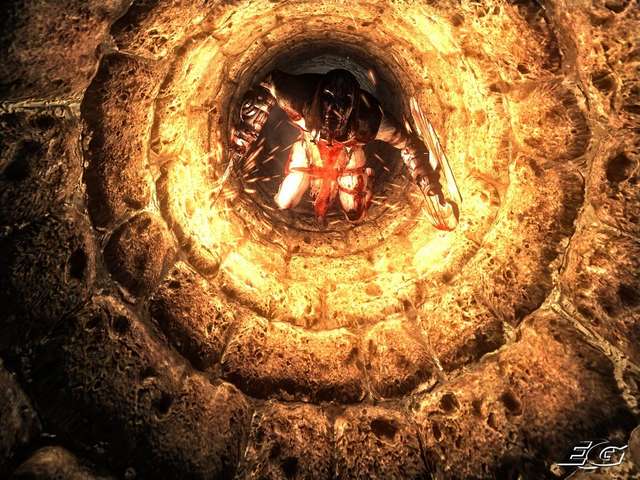
The arse end of nowhere.

Take Lt. Black, for example. Armed with a sniper rifle, she boasts the rather nifty ability to telekinetically steer her bullets in slow-motion to their destination, and - better still - strike up to three targets with a single shot. Admittedly, games like Stranglehold have already allowed you to steer a bullet to its target, but Jericho manages to make the sickening process of popping demon skulls that little bit more satisfying. And then there's 'reality hacker' Corporal Cole, with her terrifically useful ability to slow down everything around her for a brief period - allowing her to get the jump on enemies and either pump them full of lead before they get a chance to attack, or throw a few well-placed grenades and leg it before time returns to normal speed.

Elsewhere, you can call on Sgt. Church with her blood magic abilities, which not only allow her to drain energy from any enemies in the vicinity by slicing into her own hands, but also set up a 'fire ward', which effectively sets any enemy on fire for a few crucial seconds. Not only does this help drain the energy of any incoming hordes, you can finish them off easily with your sword, which is nice. And while we're talking about fire, Sgt. Delgado's usefulness as a heavy weapons specialist is aided no end by the ability to unleash "creatures of living flame" - effectively parasites that reside in his arm, while he can also shield himself from fire and, you know, burning hot lava, because he's that hard. Cool wet grass cool wet grass...

And for the sake of completion, Captain Jones' ability to project himself into another host's body offers a new neat moments later in the game - even if, in general he's the least useful character alongside Father Rawlings - a 67-year-old pistol-wielding man of the cloth whose main talent is healing the rest of the squad en masse, as well as being able to inflict an energy-draining curse on enemies.

The shores of hell
3

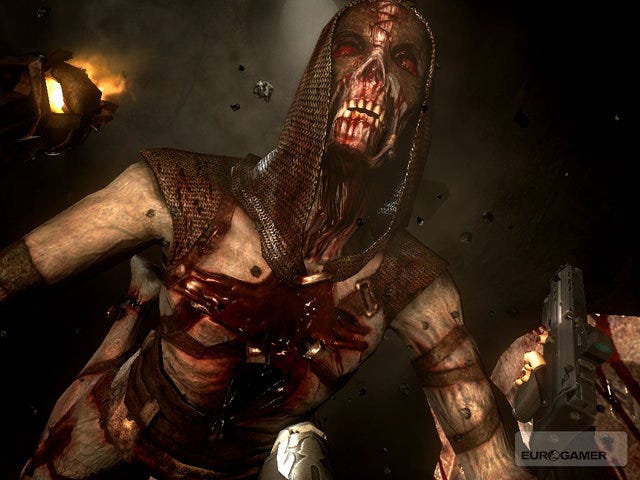
Ian Brown's looking a bit rough these days.

So, at the risk of sounding like the game manual, these abilities go some way towards making the gameplay very different from your average run and gun. The difficulty you might have to begin with is realising the importance of utilising these abilities as often as possible. Played as a standard shooter, it's quite likely you'll find yourself utterly overwhelmed by the speed and ferocity of the enemies that pour towards you. Merely emptying clip after clip into their fleshy innards isn't good enough to see off the odd one or two enemies - and backing away all-guns blazing only works if you're vigilant enough to remember to have reloaded, while also lucky enough not to have something else chasing you down.

One thing Jericho is absolutely rubbish at is giving you any kind of useful advice, and with no tutorial included, and no expectation of the kind of gameplay scenarios you're going to face, it's one of those games where you'll very much learn about as you go along. In a sense, this becomes part of its charm in retrospect, but while you're repeatedly being slaughtered and cursing the rather inconsiderate checkpointing, all you can think about is 'why am I so rubbish at this game?'. Admittedly, playing it on hard was partially the reason for so many deaths, but the way the Achievement points are distributed, Jericho doesn't give you much choice but to do so.

While it might seem as if all your problems are down to being some kind of gaming masochism, the truth is that you just have to get good at knowing when best to use everyone's speciality, and get good at making the most of them. In particular, Black's 'Ghost Bullet' ability became our staple tactic for most of the game, continually popping heads three at a time and cutting a swathe through what would have otherwise been difficulty and protracted encounters.

As if pre-empting gamers' tendencies to rely on doing the same thing over and over, a few plot twists here and there ensure that your numbers are reduced, forcing you into using dramatically different tactics to survive, and, better still, forcing you to go it alone and really fight for your life. Not only does this give you a much broader impression of what the game has to offer, by forcing you to learn each character's hidden depths it helps encourage you to change your approach as and when it's required. The chances are, by the time you really need to use a specific character, you'll already be proficient in how they operate, and how best to utilise their speciality.

Firstborn, last to die

4

"Help! Can someone show me the way back to Quake, please?"

But as admirable as this constant need to adjust your playing style is, it can't quite paper over the cracks in some of the weaker elements of the game design. For a start, your team-mates aren't anywhere near as savvy as you are when it comes to utilising your special abilities, and tend to get incapacitated an awful lot. To make up for this rather annoying habit, the developers basically 'fixed' this tendency by giving you the ability to just walk up to anyone out for the count and heal them. Likewise, when your currently selected character dies, you end up switching to someone else, running over to your prostrate body, healing, then switching back. It might make sense in terms of the 'rules' of the character's abilities, but in gameplay terms it becomes a bit of a clumsy way of making sure you're not heading back to the load screen too much. At its most frantic, you end up running around like a headless chicken healing, healing, healing with so many of your AI buddies getting killed literally seconds after being revived it's a bit of a joke. So many times, you'll scrape by, not actually fighting, but just making damn sure that there are other people in the scene so that if you end up getting cornered by an enemy, it won't result in a restart.

And it bears repeating that even when you've mastered the game, and even when you're enjoying it, some of the checkpointing is absolutely awful, forcing you back ages for no good reason. Not only is it annoying to find yourself repeating large sections over and over again, it pads out an eight to ten hour game by about 50 per cent, so there's a mark knocked-off right there.

Technically, Jericho veers between being extremely impressive to being merely average. You can tell that certain sections of the game had a lot more love than others, with some incredibly elaborate geometry demonstrating Mercury Steam's artistic flair and eye for detail when it feels like it. Elsewhere, though, the game's reliance on ridiculous colour saturation as an atmospheric design decision starts to irritate, as does some of the game's cut and paste level design, and over-reliance on basic corridor linearity. On a few notable occasions, too, some basic signposting wouldn't have gone amiss - such as the game's repeat failure to acknowledge that it's asking you to do something it has never asked you to do before (and often, never will again), and proceeds to waste the player's time barking vague, patronising hints at them, when what was actually required was possibly as simple as walking one specific character up to one specific item of scenery. Such minor niggles, individually, aren't a big deal, but over the course of a game they chip away at your overall impression, and make it feel like a game that could have done with a little bit of extra polish to smooth over such kinks.

Over and done with

5

I wonder what Freud would have made of Clive Barker?

Another criticism, albeit minor, is the game's utter lack of replayability. Once you're done (especially if you've played it on Hard from the start), there's sod-all reason to go back and do it again, and with no multiplayer options to speak of whatsoever, you won't even be able to try out these interesting weapons and abilities against one another, or in co-op, say. Admittedly, the very nature of the gameplay would throw up all manner of technical headaches, but nevertheless, set against some stiff competition, Jericho needs all the selling points it can get.

On the whole, Jericho is an intriguing experiment that almost comes off for Codemasters. Clive Barker's contribution to the concept and narrative direction of the game will certainly help get the attention of horror fans, and few who put the time into exploring Jericho's intricacies will come away disappointed. With its unique squad-based focus and the huge combat variety on offer, it breaks plenty of new ground for the genre - and were it not for a few rough edges would have been bordering on essential. As it stands, Jericho is definitely one that all horror fans should check out - if your bank balance can cope.

7 / 10

Read the Eurogamer.net scoring policy

Comments (92)

Comments for this article are now closed, but please feel free to continue chatting on the forum!

  • Loading...hold tight!