You're a Big Daddy, and you're right, that doesn't sound very ambitious. As Take Two admits during our tour of 2K Marin, a lot of people bought the first BioShock because they thought you were a Big Daddy anyway. He's the guy on the box. He's got eight glowing eyes, JCB hips and a drillbit the size of a fridge stuck to his arm. And the fact is, by the time you got to the end of BioShock, you were so powered up that you practically and to some extent literally were a Big Daddy as well.
Except, there's also something wrong with the idea of being a Big Daddy in BioShock 2. BioShock was a first-person shooter with RPG elements and a brilliant story, laid out next to Randian extremism in a smotheringly coherent waterlogged coffin at the bottom of the Atlantic Ocean. But its sucker punch was an interrogation of free will in videogames, landed in a dizzying monologue by Andrew Ryan at the end of its second act. The Big Daddy may be a kickass monster, but he's also BioShock's supreme embodiment of what writer Ken Levine - speaking through Ryan - was attacking: he is conditioned to do one thing, and knows no better.
If 2K Marin, led by creative director Jordan Thomas (Fort Frolic, The Cradle), is committed to overcoming that paradox, BioShock 2 might actually be the more ambitious of the two games after all.
However, it's also clear that the Big Daddy is the wrong emphasis at this point, as senior character designer Colin Fix explains when he talks about the Big Daddy's probable replacement on this year's front cover: "It was my very first day, and Jordan took me into an office and was like, 'Alright, so, pretty much the premiere character of the entire game you'll start designing now.'" He wasn't talking about the Big Daddy. He was talking about the Big Sister.
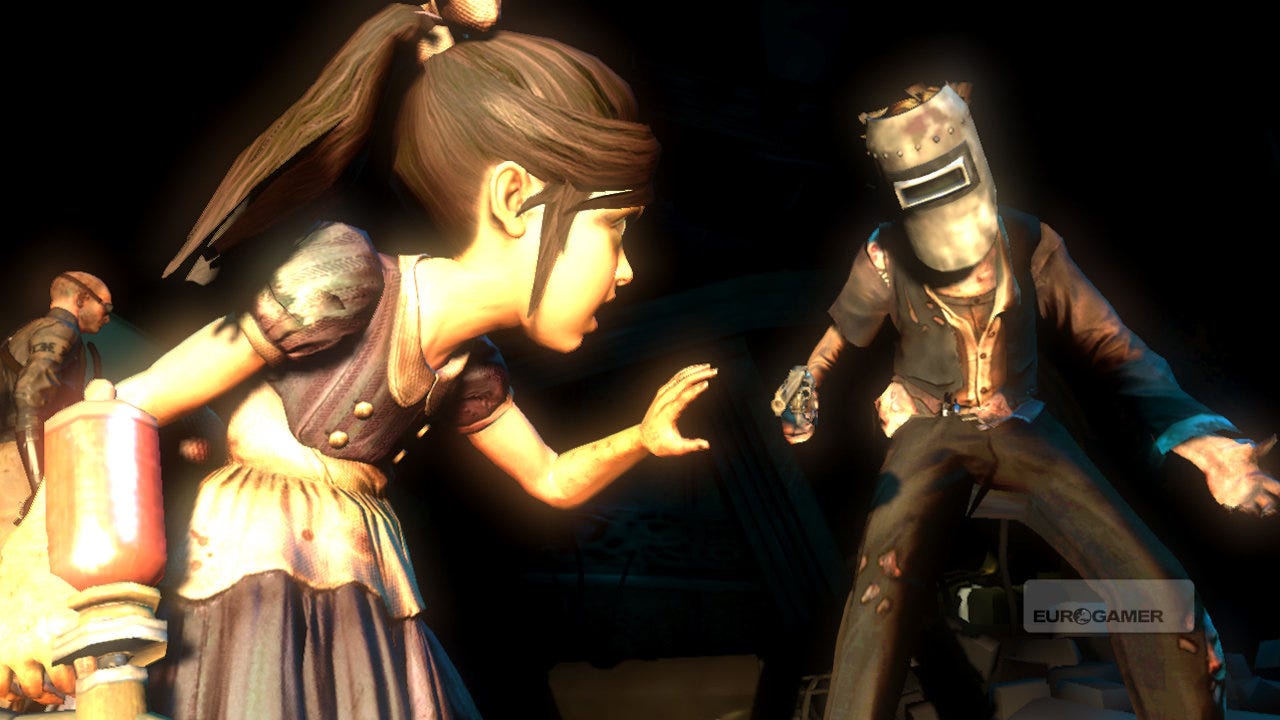
The Little Sisters in BioShock 2 have more advanced facial modelling, so they can frown, and smile, but like most of the characters they're stylised.
BioShock 2 is set in Rapture around a decade after the first game. The star of the first trailer
, the little girl standing in the sand, is one of the Little Sisters liberated by the player's actions. But she couldn't assimilate into life on the surface. So she went back to Rapture, and put herself through a process that transformed her into the Big Sister. "This literal hybrid of a Big Daddy and a Little Sister", as Jordan Thomas - the new Ken Levine, if you like - puts it.
"She begins abducting young girls from all over the Atlantic coast and turning them into Little Sisters in an attempt to kind of jumpstart Rapture from the decayed hulk that it had become into the city of her memories," he explains. "And to her the status quo is very much Big Daddies and Little Sisters in perfect harmony. Even though that's a horribly conditioned nightmare, to her that is home." With new Little Sisters roaming around Rapture, she reboots the ADAM ecology, and the splicers - raging former inhabitants of the underwater city driven mad by their addiction to the substance that powers their genetic enhancements - are restored to a food chain that the Big Sister dominates.
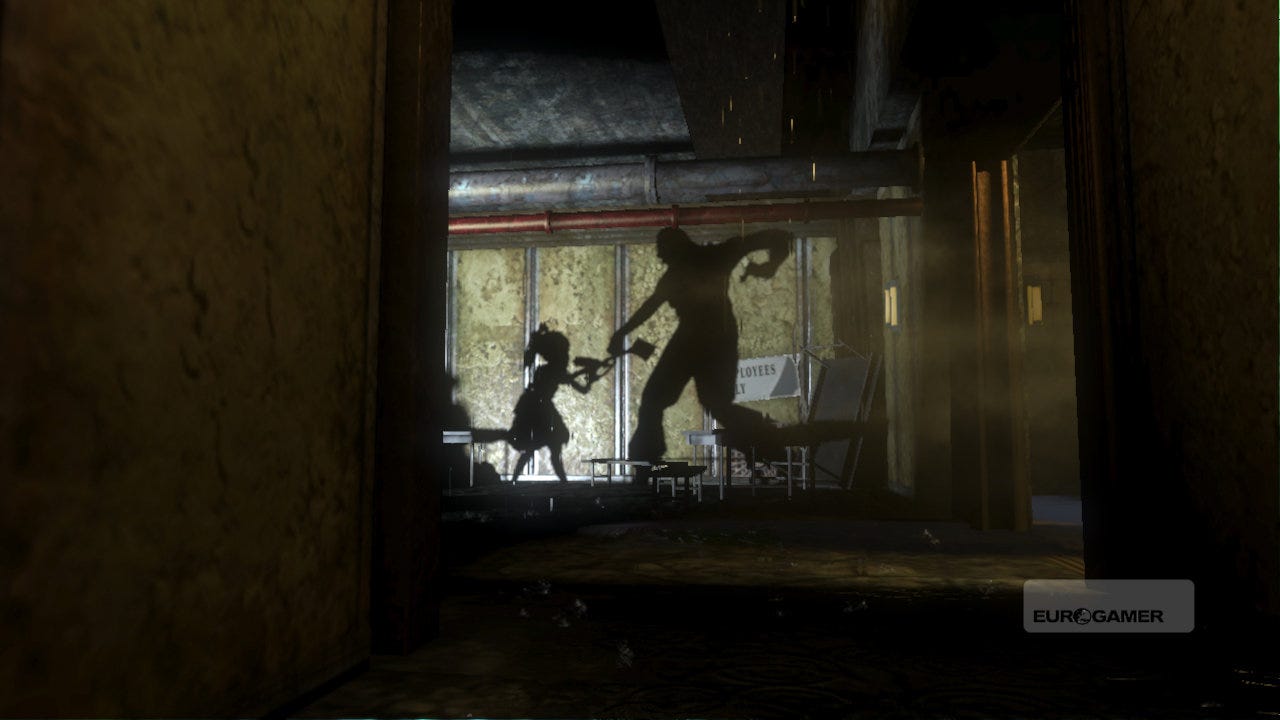
"One of the things that sold BioShock 1 was visual storytelling in a scene, " says Jeff Weir, "like a spilled glass of wine and maybe some bullets, and it illustrates the story of a guy there who maybe committed suicide. Visually we're doing the same thing with our characters - you'll see the storytelling, like the drawings and the bows."
The Big Sister is slender compared to the original Bouncers, with an ominous red glow burning through the single porthole of her diving suit headpiece, and a spider's-web cage on her back to carry Little Sisters, and she cuts a mournful figure in stills - hunched, closeted in tight strapping, with Polio braces on her legs and little bows tied to her back. In motion though, she is imperious. "What Jordan wanted was unstable grace, which are two very distinct visual qualities," says Jeff Weir, who supervises the animation. We see this in action during an attack on the player, where she scores a crescent gash across a broad glass wall, releasing thousands of tons of water into your path. She leaps and scrambles across the transparent surface with balletic composure before dropping into an arthritic landing.
The reason she wants you dead - and the way 2K Marin dodges the conditioning issue - is that you are not really a Big Daddy: you are a prototype whose conditioning has been broken, and you are being guided by the familiar voice of Dr Tenenbaum, who once again implores you to help her liberate the Little Sisters. But rather than reducing your options to simply "saving" them and then helping them to a nearby escape vent, BioShock 2 gives you two options: you can still "harvest" the girls' ADAM and use it to unlock new plasmids and tonics to enhance your abilities, but you can also choose to adopt them.
At some stage, this will allow you to spirit the Little Sisters out of Rapture, but in the meantime you can help them do their job: harvesting ADAM from the corpses of dead splicers. When you discover a glowing body, your Little Sister can go to work extracting ADAM with her oversized syringe gun, and while this goes on, Rapture takes notice, and puts you in the firing line.
The section 2K Marin shows off brings everything we've seen before to bear: thuggish splicers, leadheads, nitros, spiders and Houdinis, who attack in mixed waves. The Big Daddy may have little trouble deflecting a few with his interchangeable drill dash and rivet gun, but when they confront you in numbers, they're a serious threat, and dealing with them is a full-time job complicated by the Little Sister's exposure. If she is killed, you lose all that ADAM, so you need to control the crowd, making use of whatever weapons and plasmids you have, including whirlwinds, fire and electricity.
There are other Big Daddies to worry about too, including some "surprising variations you haven't seen before". What's more, "There definitely will be enemies we introduce over the course of the game that feel a little more like they could go toe to toe with a Big Daddy," according to lead designer Zak McClendon. Splicer combat is described as "popcorn between meals". And worse is to come, as Jordan Thomas explains: "[The Big Sister] is incited to attack the player by his interactions with the Little Sisters."
"The first Big Daddy is missing in action during BioShock 1," says creative director Jordan Thomas. "I can't really tell you how, but the timeline does not intersect during Jack's stay. He is elsewhere."
"You take a certain number of them out of the world, and she gets angry, and hunts you down anywhere in a level. And there's a countdown, which gives you a chance to prepare, so you can rush over and hurriedly punch the clown until it gives you goodies, and hack every turret in the room, and blanket it with trapbolts and so on before she comes. Because when she does, you are going to have the fight of your life." It's at this stage that the demo ends, because the player is simply no match for the Big Sister, who terrorises him, just as surely as the Bouncers ripped Jack back to the last Vitachamber when you dared to provoke one in the Medical Pavilion.
Rapture's cultural isolation means that the city itself has evolved ecologically but not stylistically, which 2K Marin combats by creating new locations, rather than returning you to Neptune's Bounty or Fort Frolic. "There will be links to stuff you've seen," says Jeff Weir, "but all the primary environments are totally new places that you've never been to before. Rapture is a huge city. The first game was only a small part." Thanks to your permanent diving suit, BioShock 2 also takes you outside onto the ocean floor, through floral corridors of reefs and vegetation. And you do go back to Fontaine Futuristics.
"It takes a long time to understand the vernacular of BioShock," says Weir. "It's not steampunk. There's more things that it's not. It's a unique combination of Deco, horror and whimsy that's really quirky and earnest."
And thanks to that sucker punch, Rapture has also had to evolve philosophically, although Thomas is adamant that BioShock 2 must reinforce the original's objectivist foundations - and Andrew Ryan himself. "How can I possibly return you to Rapture without having Ryan be a presence?" he asks. "Without objectivism, without the influences both literary and philosophical that gave birth to Rapture, it wouldn't be BioShock. Taking you back to Rapture and showing you how Rapture changes has to begin with the ideas that setting was built out of.
"From there, however, to add a new mystery to Rapture, there has to be a contrast. One of my buzz-phrases for this brand is 'an indictment of extremism', that the interesting thing about BioShock 1 was whether you agree with Ayn Rand or burn her books regularly, you can see it exaggerated massively in the form of Andrew Ryan in the form of Rapture, and you watch how the attempt to bend reality to a fairly rigid set of abstract principles fails and succumbs to this yowl of entropy."
It raises an obvious question. Given what Ayn Rand's novel Atlas Shrugged meant to BioShock, what's the equivalent here? Thomas deflects. "If I told you what the influences to the motives of our characters are right now, it would spoil a lot about the plot," he says. "This isn't time for that yet. I will say that I find characters, whether they're heroes or villains, as ideologues very compelling, and you have to kind of know the material before you can write somebody like that and have it resonate in any way, and everyone on BioShock 1 had a bellyful of Rand... There was a lot of, 'Oh my god, if she mentions another sharp angular face again I'm going to strangle myself.' Well, in BioShock 2, we are doing similar research, I just can't say on what yet."
With Thomas's background in horror - designing The Cradle in Thief 3, and Fort Frolic in the first BioShock - that side of the game is also amplified. "Because you play this sort of armoured prototype who's pretty much designed to survive, I kind of have to strike the player obliquely on the fear front," he says. "I have to wage psychological warfare against the player."
"I think BioShock 1 was very much a tragedy - the horror of loss, and of exposure to the dysmorphic effects of these characters who have been distorted by ADAM - and in BioShock 2, I hope there will be a horror of emotional context as well, that I can cause you to experience massive cognitive dissonance from time to time and keep you guessing. That's at the very least my goal. I think fear is very important to BioShock, as is tragedy, and it's toeing the line between those two that is both what makes the challenge compelling and BioShock unique."
Thomas says that BioShock 2 "validates all possible choices the player could have made" at the end of its predecessor, and there's a consensus about choice within the game. "The kind of levels that we want to put you in are more about the old Warren Spector/Looking Glass dichotomy of problems rather than puzzles," says lead level designer JP LeBreton. "Puzzles have an explicit hard-wired number of designer-intended solutions, and for the most part we want to put a lot of different tools in the environment and the player's hands."
"One of the things we are really driving for is getting more sane people in front of the player more often," Zak McClendon says with a smile.
On a purely mechanical and structural level, this will mean a return to the mixture of map-based exploration and genetic augmentation, although the team will only discuss the way the game plays out in generalities, promising stronger FPS fundamentals and things like that. You will get to splice yourself silly again, for example, but we aren't told much about how the combat has changed, except to say you can now dual-wield weapons and plasmids. We're also promised online multiplayer, but nobody will say what that entails.
Throughout the time I spend in Marin, the narrow parameters of the discussion are a stumbling block. But in a sense this is also encouraging: it was the nature of BioShock that every answer generated a dozen more questions. Even months after the game was released, the debate surged back and forth about the significance of details and design choices. The fact that fifteen minutes of BioShock 2 gameplay and two hours of interviews leave so much open to interpretation (the butterfly in the trailer, for instance) is the game's most important, and promising, characteristic.
Does the Big Sister speak? "In a game about ideas, it would be a damned shame if you never heard any of the ideas of any of your antagonists," says Thomas.
"I am very interested in systems of play as kind of gardens in which you can plant the seed of a question and allow the player to shape how the thing grows," says Jordan Thomas, explaining his ambitions. "And specifically, that doesn't really work unless your mechanics are very unified with the kind of story you're telling, and so I am striving, shall we say [he grins], to generate a similar resonance from the sort of the high themes all the way down to the base mechanics.
"I can't really say how, because it would be a giant ass spoiler, but it is important to me that BioShock 2 is worthy of the name - not just as narrative, and not just as a kind of series of meaningful player decisions, but also particularly as a videogame that asks interesting questions, and from which players can derive meaningful statements."
In other words, you may be a Big Daddy, but they get what that means.
BioShock 2 is due out for Xbox 360, PS3 and PC this autumn. Check out the Editor's blog to see what else the developers had to say.
