Version tested: Wii
Animal Crossing is a world without death, but that doesn't mean it's a world without loss, something that's never more keenly felt in this virtual life sim than when your in-game neighbours up and leave. As the name suggests, Animal Crossing houses a transient population, something we're not used to in games that ask us to invest in relationships, so when Tiffany, the cute cat you've been flirting with and running errands for, leaves the village on the next bus out with only a scribbled note by way of goodbye, you're actually sad.
The feeling in past Animal Crossings was heightened because while most of the residents were free to head off to new lives on a whim, you could only go to your friends' towns, and only on the DS. A town of one sort or other was where you had to stay until you grew tired of it and stopped visiting, leaving the weeds to sprout and your relationships with the other villagers to wane. Until that point you were the local constant - the hick who never left its borders - and there was some comfort in the knowledge that the places the other animals went would never be known by you.
Until now, anyway, because Let's Go To The City, the third western Animal Crossing game and first for Nintendo's Wii, punches a hole through the series' previous boundaries. Now you're free to toddle along to the bus stop at any point and catch a ride to the big smoke. Sure, all you can do when you get there is a bit of shopping and character-customisation before your inevitable ride home, but with the exception of multiplayer on the DS it's the first time players have been allowed outside the confines of a village, and it's a rare new feature in a game that otherwise exactly apes its forebears.
Indeed, for players familiar with the Animal Crossing series, much of Let's Go To The City is like watching a favourite film for the hundredth time. You smile at the right places, giggle at the worn jokes, whoop when a much-loved character pops onto screen, celebrate the triumphs and feign sadness at the micro-tragedies. It can be a joyful experience but this is joy from familiarity and not discovery. Despite the game-box promises of "new events to celebrate!" and "new items to collect!", despite the extended development time, and the community features facilitated by the Wii, and the option to play as your Mii character and, of course, the titular promise of a whole "city" to visit, there are few innovations beneath the topsoil.
Pop along to the recycling bin in town and you'll be able to nab some neat unwanted items before they go off to the dump. Likewise, every day you can claim items that aren't yours from the lost property.
Your adventure begins in the same way it always has, with a journey into a new beginning, a bus ride to a fresh start. There's no background given, no great trauma that you're fleeing from and no overarching mission driving you forward. Instead you ride in the back of a rickety bus answering the questions of a friendly co-passenger, spoken in the cutesy burbling half-tongue language of the game's inhabitants. 'Are you a boy?', 'When is your birthday?', 'Have you arranged accommodation for when you arrive in town?' The answers you give here determine your character's features, which are finally revealed when you step off the bus into your new hometown.
Moments later an officious raccoon, the local shop owner, landlord and general furry Godfather, Tom Nook, offers you one of four properties to call your own. From there in you have neighbours to get to know, letters to write, festivals to attend, fish to collect, bugs to net, fossils to excavate, clothes to buy and, of course, a mortgage to service. The game follows the Wii's internal clock and calendar, meaning that when it's night in your world it's night in Animal Crossing, while the shops open at nine and close at six, and Christmas falls on 25th December.
Let's Go To The City has all of this. It is, in format and progression, a cookie cutter copy of the other Animal Crossing games, especially the first GameCube one. There are seasonal festivities, like daily fishing competitions to see who can catch the largest Black Bass and challenges to see who can best match their home's furnishings to the month's theme. The lines of (brilliant) dialogue may have been rewritten, the visuals are sharper and brighter, and your choice of four homesteads are now scattered around the town rather than in a cluster near the bus station, but it's best to view Wii Animal Crossing as an expansion pack.
There have been changes to the interface and these are without exception an improvement. Moving around the town is as simple as pointing and clicking with the Wiimote and, thanks to the accelerometer, activities such as fishing are more slick and enjoyable then ever: a flick of the wrist to cast and another to reel. The d-pad allows you to instantly bring up your spade, fishing rod, net and watering can and the menu shortcuts are triggered by moving the Wii pointer to the base of the screen. If you're online then visiting friends' towns is much easier than it was in the Cube version and there's even the option to import and synch your whole town from the DS title Wild World. These are all tweaks of convenience, for sure, but positive ones nonetheless.
The city is where almost all of the game's new ideas come from, although, when you first step off the bus on a day-trip and it turns out to be little more than a cul-de-sac of six or seven boutique shops, it's easy to feel short-changed. The disappointment grows when you discover that at least half of these shops have been in previous games, albeit as travelling merchants who visited your town on certain days of the month. Katrina the fortuneteller, who arrived in her caravan to read palms, is now stationed in a rather underwhelming, dingy terraced store, a peek at the lifestyle behind the mystical curtain we maybe didn't need.
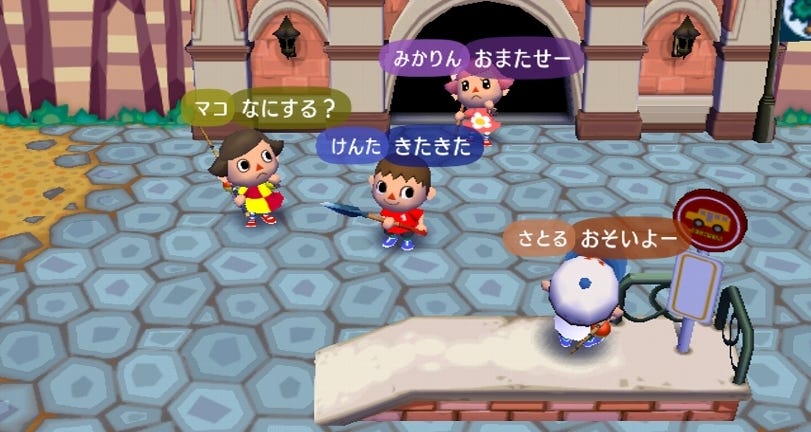
Up to four players can live and play in your town. Your neighbours can also move into your Wii friends list, taking with them any letters you might have written them to show and tell.
That said, the few additions are welcome. The up-market Gracie Grace department store sells expensive tailoring and items for your home and it's a joy to walk around. Harriet at Shampoodle will give you a shampoo, cut and style for 3000 bells or, if you prefer, will apply a Mii's head to your character. For 500 bells you can have your shoes shined, a cute way of choosing their colour. You can now actually visit the Happy Room Academy, its chairman Lyle a delightful Glengarry Glen Ross-style failed real-estate salesman who speaks in machine-gun staccato when setting each month's home-decorating theme. There's also a comedy club where you can watch an awkward stand-up routine, an 800-bell investment that grants you a new emoticon for conversing with friends, while a useful MMO-esque auction house rounds off the city's attractions. The extra space these shops have received is welcome but it won't take long for the novelty to wear off and after the first few visits there's not much reason to return.
This is the best execution of Animal Crossing so far, but it is difficult to view it as anything other than a lazy remake of what's gone before. With Wild World the adherence to template was forgivable: the original's framework was robust and interesting enough to warrant a rebuild. But for this Wii game there was no need for more polish, especially not in lieu of new ideas, fresh takes on core concepts and happy invention. In broadening Animal Crossing's borders, Nintendo has done nothing to add to its depth, and as such this is arguably still the best cutesy Japanese life-sim on the market and a solid buy for newcomers, but for series fans it's in no way a life worth reliving.
6 / 10
Animal Crossing: Let's Go To The City is due out for Nintendo Wii on 5th December.
