I think a mark of quality in a game is whether you can return to a room you've previously been in, and know you were there earlier by the destruction you wrought. Amnesia, the new first-person adventure from Penumbra developers Frictional, does not paint rooms in the blood of your enemies, but rather in strewn desk drawers, boxes and broken glass.
And light.
Amnesia is looking to be an extremely dark game, but rather than offering you the opportunity to sneak silently in the welcoming shadows, here darkness is your enemy. It is the path to insanity.
Your character, Daniel, is fighting to maintain the few memories he has left. Trapped in a mysterious, massive building, he is slowly slipping into madness. So is the building. As Daniel's memories swarm in and out, his vision throbbing, twisting and distorting, walls grow fleshy, pulsating membranes. They sweat grotesquely along the floor, walls and ceilings. Everything seems to be crunching. Chomp chomp.
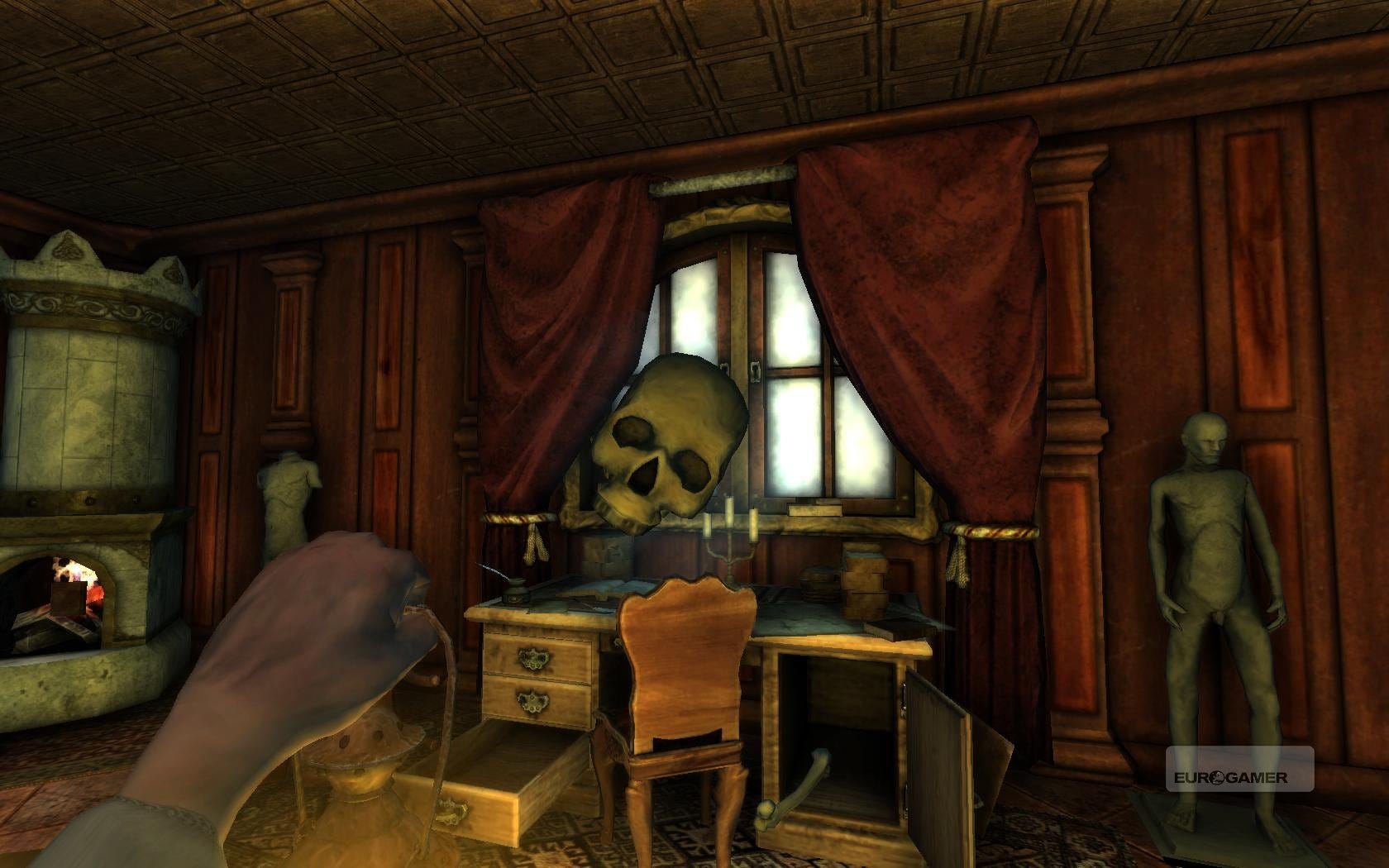
This is probably the lightest room in the first third of the game.
If you're familiar with the Penumbra series you'll understand immediately how Amnesia works. It's first-person, but at walking speed. There's no weapon bobbing at the bottom of the screen, but most objects in the world can be picked up, thrown or piled into maniac sculptures in the middle of rooms. Most crucially of all, you interact with the world in a remarkably tangible way.
To open a draw you don't click on it and wait for the animation. You aim your reticule at it, and click the left mouse, then deliberately pull it in the correct direction. The same for doors, cupboards and anything else manipulated. It's a tactile, powerful form of interaction, and it's mystifying that every other developer hasn't copied it. Running and hiding from an enemy is so much more evocative if you have to slam the wardrobe doors shut by hand so you're not spotted.
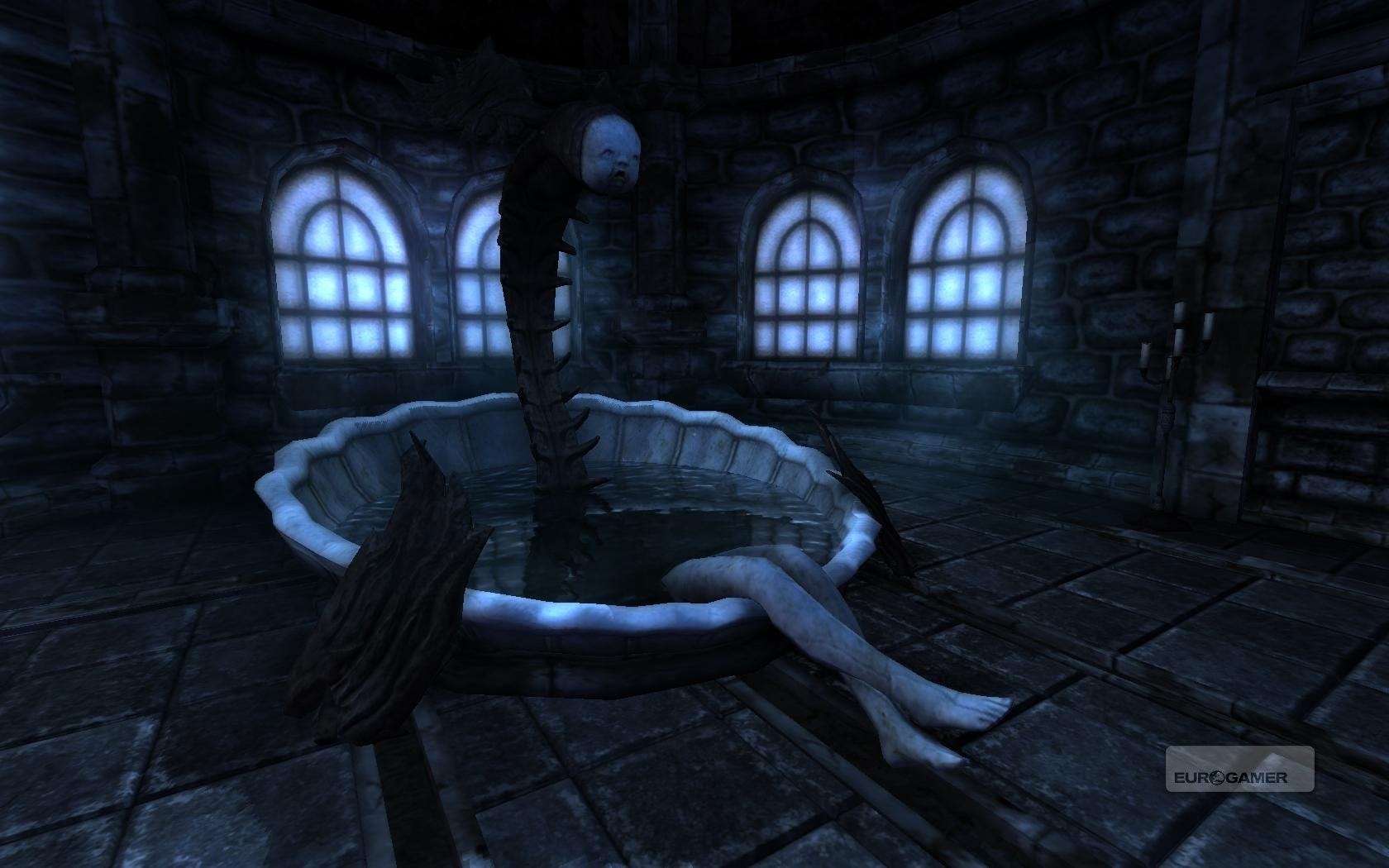
Oh Lord, oh come on. That's just hideous.
Amnesia is designed to frighten you not just with wobbly camera work, but with some remarkably ghoulish enemies. However, there are no weapons at all. Penumbra's great weakness was its terrible combat, and Frictional has been very open to accept that. So Amnesia intends to contain no combat at all. You see something bad? You run.
But the far more common enemy looks to be the darkness. Each room, corridor or chamber contains scant few sources of light, most of them not illuminated. There's tinder boxes, but not an enormous amount. And you have a lamp, but oil burns quickly, and is extremely scarce. In other words, light is a resource to be managed throughout. Without it, you go slowly insane, but how little can you cope with?
Perhaps the best way to explain the experience of playing a preview version of the game is recounting one particular incident which occurred while I was making my way through some flooded underground tunnels.
I'd previously seen something terrible. The ghastly, stretched face of a wretched creature. I'd turned from a rockfall and it evaporated in front of me before I could get a good look. So I knew there was badness out there. But stood in the tunnel, the threat wasn't visible. Its foot-splashes in the water were. But it could only get me if I was in the water too.
So it became a case of leaping from crate to barrel, attempting to clear gaps without making any splash at all. Hit the water and the invisible beast would crash its way towards me, claws slashing. Then inspiration struck. Pick up a crate, throw it down the tunnel. Yes! The creature stalked after it, offering a brief chance to run for the next safe surface. Or better, the fetid flesh of a discarded human arm. That kept him distracted for just long enough to turn the crank handle to open the next door.
The terror this sequence evokes is remarkable. Jumping onto crates in time because a moment of panic, the noise of the monstrous footsteps splashing ever nearer. It uses the game's omnipresent physics to impressive effect.
That's Frictional's other trademark. Where most FPS games will now have Havok or similar providing reasonably accurate physics, few use it for much beyond looking nice. Amnesia looks likely to rely heavily on it. Reaching a hole in a ceiling doesn't require finding the correct ladder, or pressing the right button. It involves gathering detritus from the surrounding area and fashioning a crude staircase.
OH GOOD GRIEF! What IS that? Run!
Machinery that must be manipulated is also dependent upon real-world rules. Raising a trapdoor using a pulley makes a great deal more sense here than gaming's usual invisible mechanisms. Cogs fit together and work accurately. Objects move appropriately, and while Daniel seems to be able to throw unrealistically far, things crash down satisfyingly - or even better, if breakable, will smash. It's peculiar how special it feels to pick up a bottle with a key inside, and deliberately slam it against a wall to get it out.
Of more concern at this point is the story. From the few hours I've played, whatever was going on remains a mystery, and not the good sort where you're pulling threads together. The sort where you just don't have much of a clue what's going on around you, despite multiple letters, notes and that gaming peculiarity of the widely scattered diary. The motivation is progression, but why is less clear.
Also, while the sanity idea is interesting, it does seem to be somewhat mechanical. You will go slowly insane, but taking the rather literally named Sanity Potions makes you better. It will be interesting to see if that makes more sense in the context of the whole game.
For now, the awful biting, crunching sound that seems to follow you so often seems to be sticking with me long after I've played. The impression so far is of a game that while extremely similar to Penumbra in style, is looking much neater, and managing to be far more sinister. Crunch crunch crunch.
Amnesia: The Dark Descent is due out for PC on 8th September.