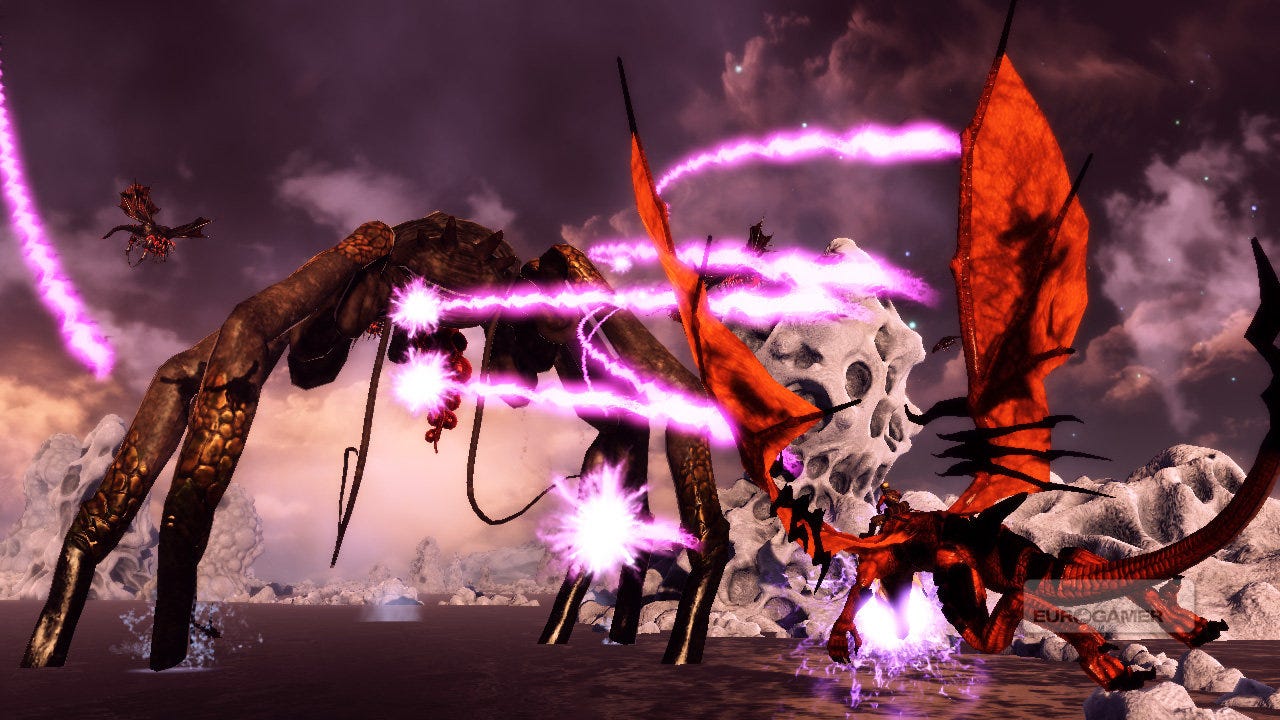
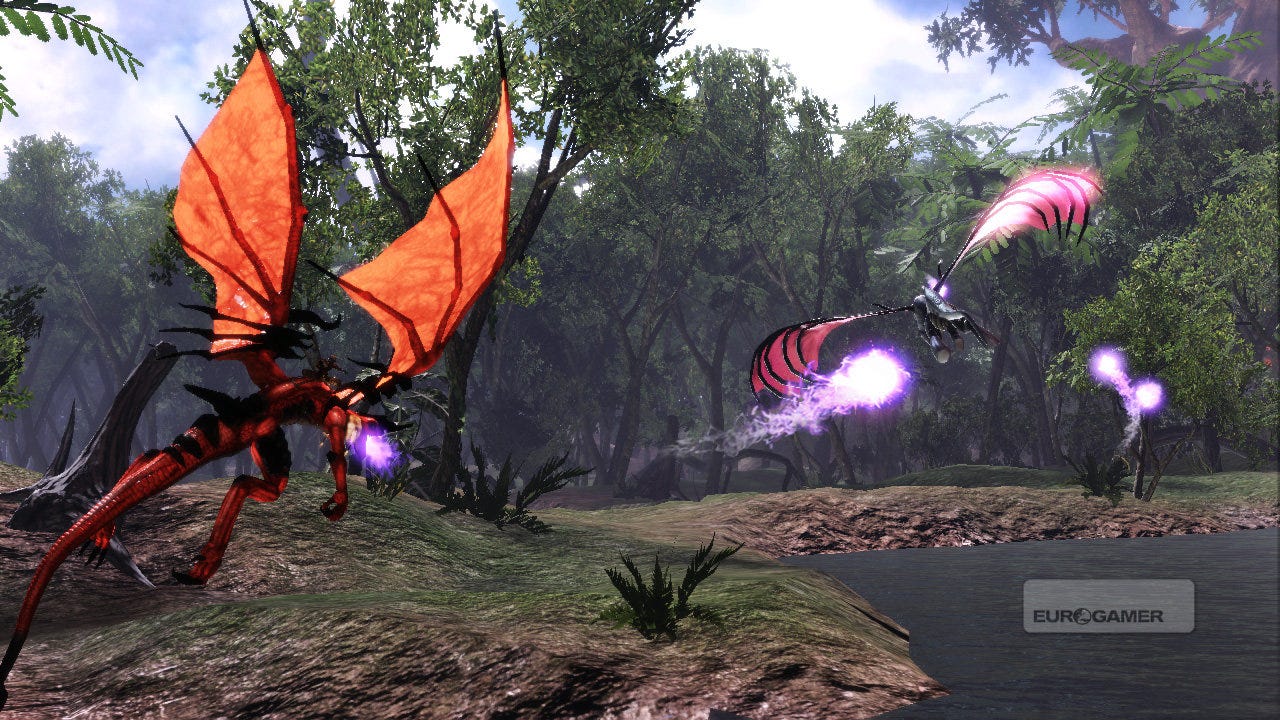
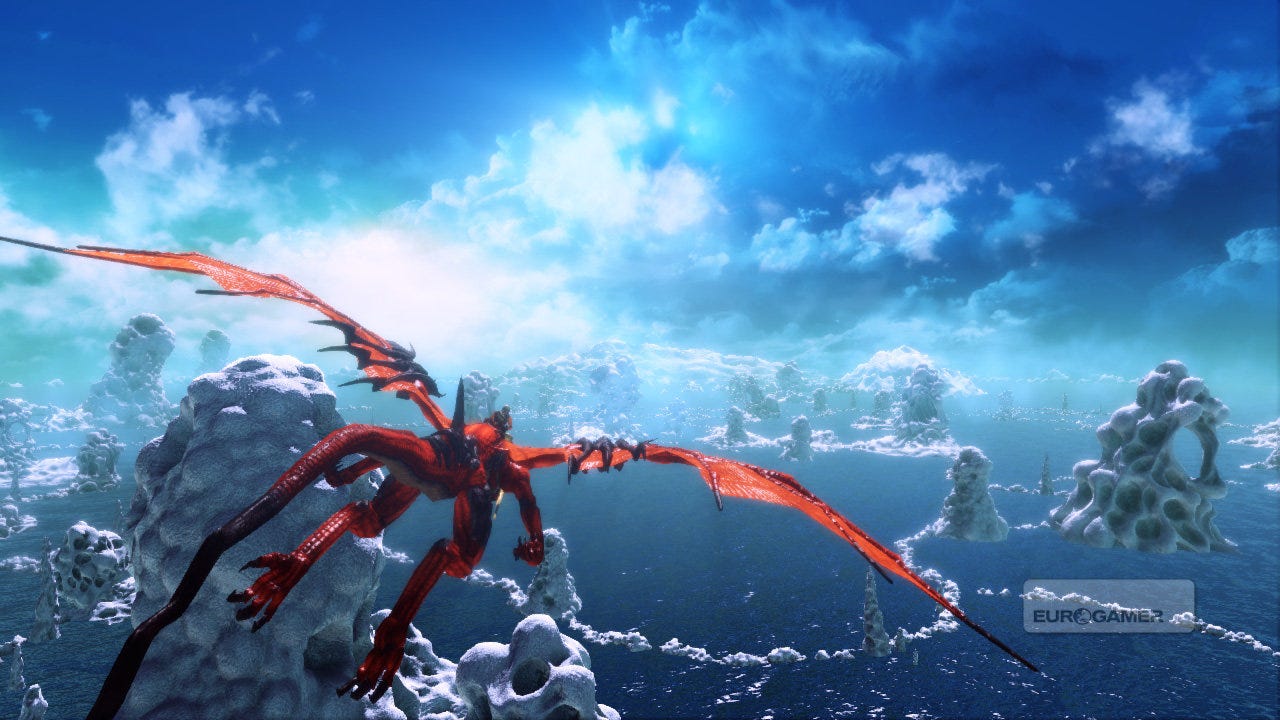
A cherry-red dragon swoops low in a green-topped canyon, its wings skimming against still blue waters as formations of flying insects attack, all disposed of with a sweeping lock-on. Despite the familiarities, this isn't Panzer Dragoon - but the download-only Project Draco flies as close as is possible to Sega's much-loved on-rails series.
Take one look at Project Draco producer Yukio Futatsugi's CV and it's obvious where that particular influence has crept in from. When working at Sega's Team Andromeda in the Saturn era, Futasagi created Panzer Dragoon, helping oversee its sequel and the cherished but all-too-rare RPG spin-off Panzer Dragoon Saga.
But Project Draco's resemblance to Panzer Dragoon isn't born from one man's obsession with flying reptiles or a sign of a designer falling back on past success - it is, its creator claims, born from the possibilities and limitations thrown up when designing a shooting game that's exclusively for Kinect. "We tried to make a 3D shooter with Kinect, and following the logical steps of that we ended up with an on-rails shooter," admits Futasagi, a cheery, talkative man who's surprisingly forthcoming about the genesis of this game for his upstart outfit Grounding.
"When you try to make a shooter on Kinect, you have to think about movement, and I don't think there's a very good paradigm in terms of controlling movement back and forth and left and right. So we thought for Kinect let's make the action come to you, and the player has to deal with it by shifting their weight."
That explains one part of the puzzle - Project Draco is an on-rails shooter, swooping you into the screen on a pre-defined path with a small window of movement, shooting down patterns of enemies that dance extravagantly towards you.
Explaining how its aesthetic, a wholesale steal from the Panzer Dragoon series, made its way across is a different matter altogether - but the smiling Futasagi's got an answer to hand.
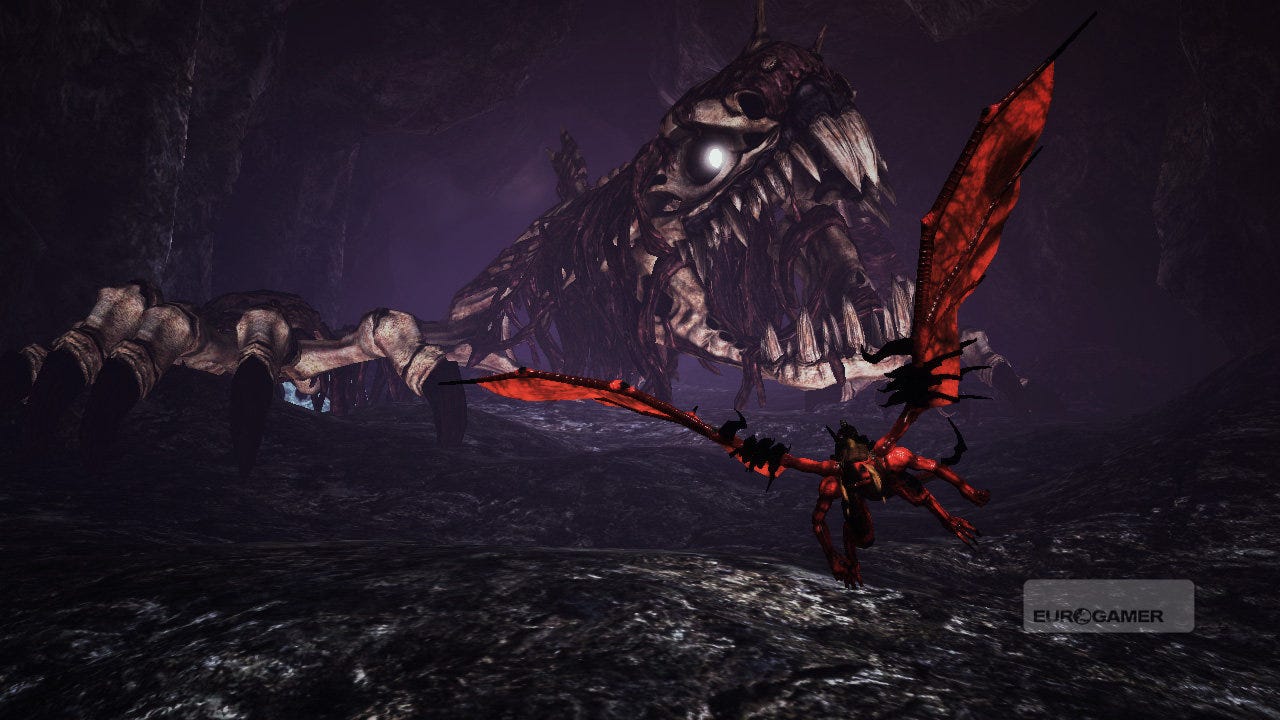
"I thought it's an on-rails shooter, that's great," he says, "But what are we going to be in the game?" An airplane was one early solution, leading to hazy dreams of a motion-controlled Afterburner clone, allowing you to recreate a jet fighter's gymnastics in the comfort of your own living room.
But that was deemed an awkward fit, the soft edges of motion control needing something a little less precise. "You think what do you control by shifting your weight," Futasagi says while hypnotically jiggling from side to side, "and you think about rideable animals."
"And then with animals," he says, his smile broadening, "you think dragon - yay!"
There are, of course, worse visual styles to revive, and the fantastical world conjured by Futasagi is as bewitching now as it was in 1995. Project Draco's world is seasoned with a quiet melancholy, a feeling rooted in its backstory, backed up by its wistful landscapes, and as powerful as ever on more powerful hardware.
Set in the far future ("it's sci-fi, not fantasy," the PR says, though she's drowned out by the soundtrack's pan pipes), Project Draco sees humans colonising a distant planet as they flee an unspecified apocalyptic event, and it's here that they chance across the dragons and harness them for transport.
Riding these beasts, it turns out, requires the kind of loose, broad movements that are perfect for Kinect. Moving your centre of gravity directs the dragon around the screen - and in having you play the rider rather than the dragon, Project Draco's got the perfect excuse for any lag that may occur.
For the business of targeting and shooting, Project Draco's control scheme is as familiar as many of its other elements, although this time the inspiration's a little more contemporary. Your right hand controls an onscreen reticule, your left a slottable skill, and raising both hands in the air fires off a special move that's unlocked by collecting blue orbs from fallen foes. Essentially, it's the same 'grasp and splay' lock-on mechanic that Child of Eden, another Kinect shooter of a similar mindset, recently introduced.
It's another area that Futasagi's disarmingly happy to discuss. "It's unfair to say, 'Do you like shooters? Well, you're going to have to learn a completely different control scheme now,'" he says, with a logic that can't be faulted but is sadly so often absent.
"Child of Eden came out first, so a lot people played that game - and I thought it would be a bad idea if people who played that game are presented with a completely different control scheme. They might get confused.
"I like the Child of Eden control scheme, and I think there's nothing wrong with it. Since we have conceptual similarities, we came up with a similar scheme and we decided not to change it. It's like how Super Mario did it - A button is jump, and every game that followed Mario did the same thing because you don't want to confuse the player."
Indeed, there's a pleasing symmetry to how both Child of Eden and Project Draco are at the frontline of Kinect's core offerings, given the entwined history of the studios behind both games. Team Andromeda, the Panzer Dragoon team, went on to become United Game Artists, who then created Rez - the spiritual predecessor to Child of Eden.
Project Draco is choosing to differentiate itself in other ways. Beneath the shooting there's an RPG backbone that, in a superficial manner, recalls Panzer Dragoon Saga. Between each level you return to a base camp where your dragon can be fed and nurtured with food that's rewarded at a mission's end. Weapons, too, can be levelled up, and there are plenty to grind through, with 150 different flavours available.
Choosing the right weapons is a skill in itself, with some challenges tailor-made to specific loadouts. It lends the game a strategic edge that, Futasagi says, is essential to making a compelling Kinect shooter.
"It's hard to make a high-difficulty game on Kinect," he admits. "If you go over the threshold it becomes impossible and just unfair. On the game pad it's scalable, and you can do a lot of things with difficulty. When you're doing Kinect, if it's too difficult it's impossible and if it's too easy you're falling asleep."
"So that's why we added the strategic layer of being able to choose the right skill for the mission. If you choose the right skill it's easy, but if you choose the wrong skill it gets more difficult. That way we scale it so it's not tied to the control scheme."
As a Kinect-exclusive game, Project Draco is smart as well as compelling, a game that's as aware of the controller's limitations as it is of its potential. The only disappointment comes when it's revealed that this will be a Kinect-exclusive experience, with no option to play with a controller. But that's a slight gripe that's balanced out by how in tune Project Draco is with Kinect, and how overdue a return is to Futasagi's mystical world.