I'm calling a moratorium on boss fights. I've even looked up the word to check what it means, to be sure about that. We need them to be stopped for a while so everyone can gather together and discuss what's going on. I'm not banning them - you can relax. I'm just calling for a hiatus during which some sensible consideration can take place.
My goodness, Metroid Prime is a good game. It's an exquisite game, in fact. A vast, intricate, multilayered world, woven together so expertly that I suspect developers Retro Studios might be nanorobots from the future.
And what an undertaking. Until Metroid Prime in 2002, amazingly there hadn't been a Metroid game for eight years. And this was to be developed by an American studio, rather than in-house by Nintendo. But the reality of how the game came to be developed by this team was not a pleasant one.
Retro, created in 1998, established a co-operation between former Iguana Entertainment (Turok) developers and Nintendo of America. Come 2001 all four games the studio had been working on were scrapped, meaning over a hundred of the team lost their jobs, and the remainder were focused on making a new first-person entry for the Metroid series, the license for which had been bequeathed by Nintendo. And it was not a happy time at all.
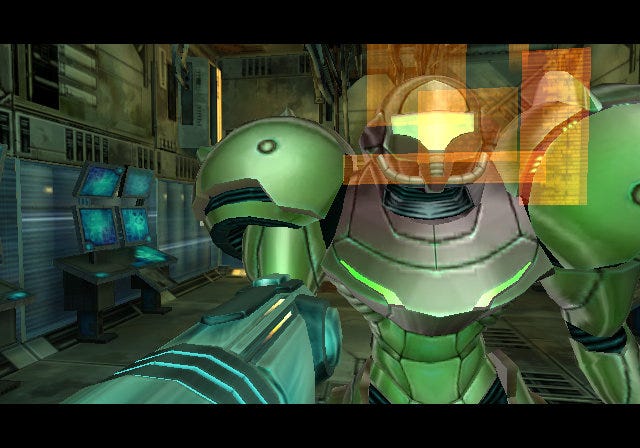
I definitely don't think it's wrong that I fancy Samus and her giant shoulder pads.
That they were able to create such a magnificent game, in the conditions described in N-Sider's definitive article on the time, is perhaps even more impressive than the final result. Allegations of embezzlement and corruption amongst unnamed higher-ups, and increasingly intolerable working conditions for employees, seemed to come to an end when Nintendo gained a controlling interest in the company in 2002 for only $1m and replaced the top management. Not that Nintendo had made the process easy before then, with Miyamoto himself having poured scorn on most of their pre-Metroid work.
But despite all this, the result is so very, very good. Bringing Samus into 3D, and shifting to a first-person perspective was clearly going to mean things weren't going to be quite the same as the series previous 2D side-scrolling releases. And yet it remains remarkably true to the source. The game is still about exploration, the world becoming increasingly accessible the more abilities that are gained and revisiting the same areas with new eyes.
And of course it begins with that oh-so-infuriating way of starting you off with so many of Samus's skills and then robbing them from you. I can never make my mind up how I feel about this; it's at once maddening and brilliant. It causes you to feel handicapped for such a huge stretch of the game, but then liberated when you eventually recover the ability. It's something to lament, but something to aim for. And perhaps most importantly, it gives you an understanding of what you can't do yet, so dead ends are understood as somewhere to return to later.
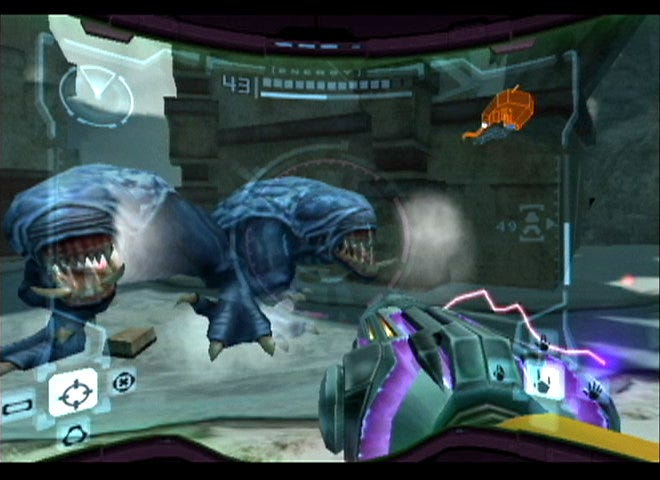
You need a lot of visor to handle so many add-ons.
This is what the game does so incredibly well. Seeing a blocked morph ball passage is a goal to keep in mind, because you know that morph ball bomb is coming soon. Those Spider Ball tracks tease you for so long, before providing both shortcuts and access to new areas when you've persisted long enough. And keeping this all in balance is a remarkable feat. It's not to be underestimated. So let's list every ability and add-on Samus gains over this game:
Weapons: Power Beam, Ice Beam; Wave Beam, Plasma Beam, Phazon Beam; Morph Ball: Boost Ball, Spider Ball, Morph Ball Bomb, Power Bomb; Suits: Power Suit, Varia Suit, Gravity Suit, Phazon Suit; Visors: Combat Visor, Scan Visor, X-Ray Visor, Thermal Visor; Skills: Space Jump Boots, Grapple Beam, Missile Launcher, Charge Beam, Charge Combo.
Every one of these abilities and add-ons changes which areas of the game can be accessed. It's mindblowing that it's all held in balance, and that it's balanced so extraordinarily well. Just to have the guts to include so very many augmentations in one game, all of which are gained by the player as they progress, is a feat itself. And it never feels overwhelming or muddled. It's the reason why Metroid Prime, as loved as it is, is still not loved nearly enough.
And then come the boss fights. Just why? What are they for?
Of course you may be someone who lives for boss fights. You may think they're the greatest thing to have ever happened in gaming. And I'm both jealous and pleased for you. But for some, including those as handsome as me, they're a monolith of idiocy in the middle of so much fun.
I love playing Metroid Prime. I adore gathering abilities, re-exploring previous areas to reach all those greyed out areas on the map, scanning absolutely everything in existence even though I don't care about the scan percentage score. So oddly enough I don't want that inhibited by sudden difficulty spikes so tall they're poking the Sun. They're not in keeping with the experience, not relevant to the game I was playing. And worst, so much the worst, they can stop you from carrying on with the fun you were having. It's not like everything the other side of the latest boss is going to be equally as difficult - it's going to drop back down to the casually challenging combat and puzzles that you were being entertained by before.
Bosses, like in real life, are rubbish in games.
This isn't made easier by the GameCube's controls. That you're holding a controller that offers a stick for each thumb but can't assign the camera to the right stick is like having a hand tied behind your back and dipped in acid. Holding down the right trigger to 'look', meaning you can no longer move back and forward, is - in hindsight - so very aggravating. And never more so than when trying to battle some massively over-powered boss that's killing you before you can even turn to look at it.
I just want a "skip boss" button. Yes, boss lovers find this disgusting. But oddly enough, when I've paid for a game, I want to be able to play that game. I've yet to buy a film that won't let me watch it until the end unless I complete some algebra, nor read a book that midway through refuses to let me turn the pages until I've memorised all the capital cities in Asia. So why am I not allowed to see the rest of a game just because the developers decided to put in a massive obstacle?
This is the reason I've never seen the end of Metroid Prime. You may think me a pathetic weakling, and that's fine, but I absolutely cannot defeat Meta Ridley. That's the penultimate boss! I've no idea how I'd stand against the Metroid Prime itself. So despite having invested so many hours into this, I don't know how it ends. Sure, I could look at YouTube now, but I certainly couldn't in 2002 when I first played it.
Poor Samus - no one has their skills stolen so frequently.
(This gets far, far worse for Metroid Prime 2: Echoes, which I've only seen the first half of thanks to a boss fight I can't even complete the first of four stages for. Give me a mouse and keyboard and I'd be fine - but not with a cack-handed GC controller.)
This isn't helped by Metroid Prime's ghastly lack of checkpoints. Relying entirely on visiting save stations, any boss that isn't located near one (see: most of them) means retracing such enormous stretches of the game to find them again. How is that fun for anyone? It's not! Stop it!
See! It's so sad that my retrospective of such a magnificent game has become so bitter, and it's all because of stupid bosses. So we're putting them on hold until we can find some sort of compromise.
