In an ideal world, gamers wouldn't discriminate. We'd have the time and money to play all manner of titles from a wide range of genres, and to pontificate about them at length on internet forums and at dinner parties. All right, LAN parties.
But it's all too easy to stay in your comfort zone. Who hasn't wavered over trying something new - only to pick up yet another futuristic third-person shooter or arcade racer, confident it'll fit like a cosy old pair of slippers?
Perhaps you've always fancied giving a particular genre a go, but aren't sure where to start with such a wide range of so-called classics to choose from. Or perhaps you just want to sound well-informed and hardcore, without actually bothering to play all those games.
Whatever the case, Eurogamer's new Beginner's Guide series is for you. These articles are designed to provide comprehensive overviews of particular genres - where they came from, where they're going and what you should play if you want to sound knowledgeable about them.
Kicking things off is horror expert Tristan Donovan with his guide to all things spooky, gory and liable to make anyone unnerved by things with no face feel a bit sick.
Introduction
Game genres are slippery beasts at the best of times, but few are as tricky as the greased eel that is horror.
The definition of most genres boils down to how they play. You know where you are with a first-person shooter, a platformer or a dancing title. But a horror game? That's a can of festering worms if there ever was one.
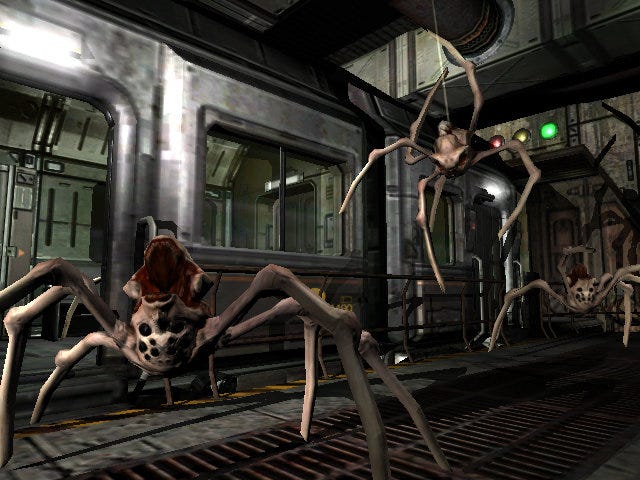
Doom 3: Horror or not? Either way those things are damn ugly.
A horror setting isn't enough. If it was we'd be putting Castlevania in the same box as Silent Hill, when it's really a platform game dressed up for Halloween. And even though the likes of Silent Hill are obvious fits for the genre, there are always offerings like Doom 3 to confuse matters. Is it a first-person shooter? A sci-fi horror? Or both?
For Thomas Grip, the co-designer of Frictional Games' disturbing Amnesia: The Dark Descent, horror games are defined not by play but by emotion.
"There's nothing to say a strategy game cannot be a horror game – that's not really the issue," he says. "It's not the play style, it's the emotion the game invokes that is the genre."
In effect horror is a meta-genre, an aesthetic capable of absorbing the mechanics of any genre as part of its dastardly plan to turn us all into nervous wrecks.
Since making players uncomfortable is the raison d'être of horror games, they aren't always fun to play.
"I hate the word fun," says Grip. "I'm all for non-fun gameplay. I hate it when people say games must be fun. I prefer to say they need to be engaging."
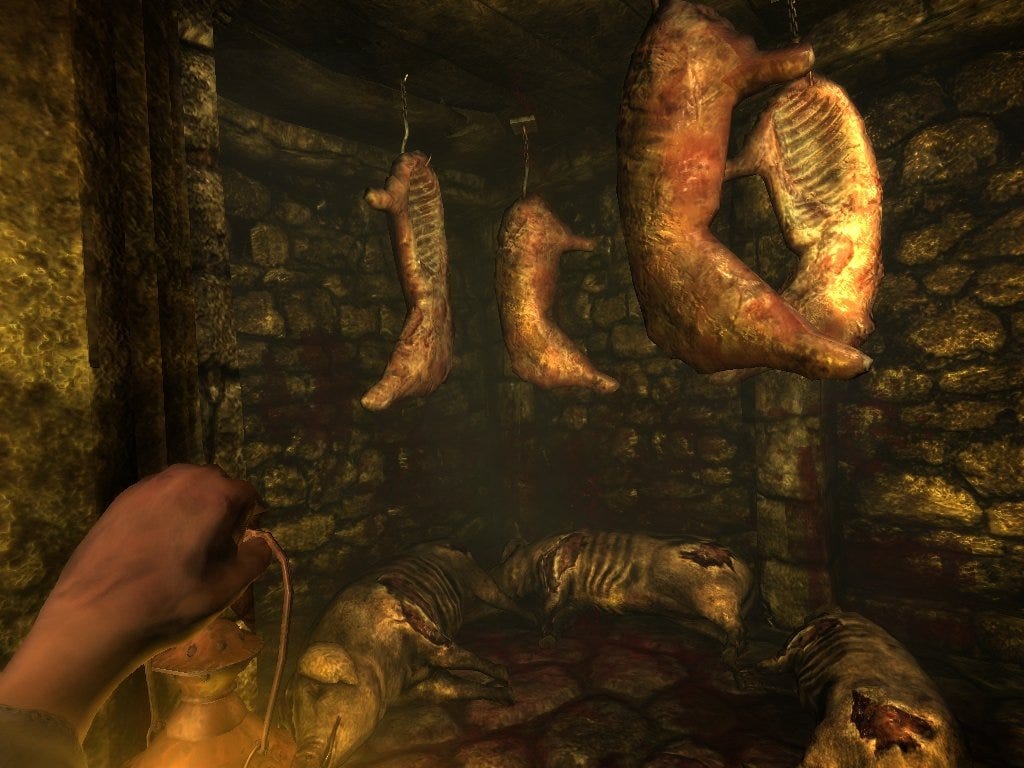
All set for a hog roast.
Climax Studios' Sam Barlow, the designer of Silent Hill: Shattered Memories, agrees that horror games don't have to be slaves to entertainment. "What's cool about horror games is that they are not out to reward players, and that's why some of the more arty games fall into the horror category," he says.
"By definition they are out to make players uncomfortable. When you make most other types of game you reach a point where you ask if it's fun. But horror doesn't have to be fun."
As such, horror games often seek to disempower rather than empower players in order to make them feel vulnerable and uneasy - be that through using fixed camera angles that hide lurking horrors or a worrying lack of ammunition.
A Brief History
So how did this anti-fun, arty, meta-genre come to be? The first experiments in horror gaming emerged in the eighties. They took the form of isolated one-offs which tapped into the potential of games to terrify before fading into obscurity.
Some point to Atari's 1982 VCS game Haunted House as the starting point but this claim is tenuous at best. The player might be defenceless against the monsters within the house, but if vulnerability alone was enough, we should be hailing Pac-Man as the original horror game.
A far more credible starting point is Five Ways Software's 1985 adaption of James Herbert's horror novel The Rats, where London is terrorised by man-eating rodents. Promoted as 'software terror', The Rats featured text adventure sequences that put players into the shoes of hapless Londoners about to encounter the killer rodents.
But instead of sedate turn-based adventuring, these encounters took place in real time. Players had to live with the unsettling knowledge that the razor-teethed, scaly tailed beasts would be coming for them at any moment.
"The fact that you were often working against an undisclosed timer was there to develop the anxiety," says Andy Halliday, the co-designer of the ZX Spectrum game.
But The Rats' efforts to scare didn't catch on and the same was true of the smattering of horror games that followed in the late eighties. Titles such as 1987's Japanese action-RPG War of the Dead, with its creepy atmosphere, and 1989's Project Firestart (a remarkably prescient sci-fi horror that nailed most of the ideas which would become commonplace in later horror games), came and went almost unnoticed.
After that decade of false starts came Frédérick Raynal's Alone in the Dark. Released in 1992, Alone in the Dark challenged players to help its vulnerable hero escape a mansion filled with unspeakable horrors.
First blood.
Aware that the 3D visuals of the time couldn't deliver the frights, Raynal played with players' expectations to instil a sense of fear, using tricks such as collapsing floors to make players worry about even walking around the mansion.
Alone in the Dark established the template but it took the b-movie zombie scares of 1996's Resident Evil to finally establish horror as a genre in its own right. While it was inspired by Capcom's 1989 horror-themed role-playing game Sweet Home, Resident Evil didn't stray far from Raynal's approach. But its execution, superior visuals and embrace of zombie movie clichés took horror games into the mainstream.
Soon 'survival horror' games, as Capcom's marketing people pitched Resident Evil, were everywhere. And with many of them originating in Japan it didn't take long before the psychological terror created by Japanese horror movies seeped into the genre, with Konami's fog-shrouded Silent Hill leading the way.
But as the 21st century got going the excitement about horror games was on the wane. Players were growing tired of the cumbersome controls and restrictions that had come to define the genre. In short, their expectations of how games should play changed.
Resident Evil's GameCube makeover. That guy could do with a makeover too.
"Players today expect fluidity and responsiveness," says Steve Papoutsis, the executive producer of Dead Space 2.
"Some of the older horror games really relied on their controls to infuse more tension and therefore felt clunky and restrictive. I think today's gamer wants to have familiar controls that respond in the way they expect. They don't want to feel like they are fighting the controls."
Capcom's response was 2004's Resident Evil 4, which took the series in a more action-orientated direction. The game placed a greater emphasis on fast reflexes and trigger-happy gunplay than the fight or flight encounters of its predecessors.
Resident Evil 4 marked a turning point not just for the Capcom's series, but for horror games as a whole. It cleaved the genre into two camps: those which embraced a more action-orientated approach and those which preferred to focus on the emotional side of horror.
State of Play
Resident Evil 4: The horror revolution started here.
Which brings us to now. Action-orientated horror has staged a successful coup and is the focus for major league publishers. Today games such as the thrill-a-minute rollercoaster ride that is Dead Space 2 and the panicked shootouts of Left 4 Dead dominate. These titles liberate players from sadistic developers who spent years torturing them with cumbersome controls, lopsided camera angles and distant save points.
Much of it comes down to money. "The costs of making a video game are so high, stuff like Dead Space and Resident Evil has to reach beyond the horror niche," says Barlow. "It's too risky for them not to."
But while action is now more prominent it doesn't mean the horror element has been lost, says Papoutsis.
"I think the term survival horror is still valid for a game like Dead Space 2," he argues. "Issac is trying to survive a horrific situation, so it makes sense for us. Survival in horror games is critical, it should be the driving force."
But while the bigger players in the industry have followed Resident Evil 4's lead, the traditional horror game - with its emphasis on scares over fun - is far from dead and buried. At least when it comes to the indie scene.
Amnesia: The Dark Descent may be uncompromising in its adherence to disturbing players, but it's already sold around 300,000 copies since its September 2010 release.
"It goes to show that those who think it is impossible to sell these kind of games are wrong, because we had zero marketing," says Grip. "If we were to release it on a big budget and on consoles, I'm sure it would have sold 10-fold."
Reading List
So now you've got the lowdown on horror, here are some suggestions for where to begin your descent into gaming's dark side.
Project Firestart (Commodore 64) - The Rats may have come first, but Dynamix's sci-fi chiller is much closer to the horror games that we know and love today.
Resident Evil (GameCube) - The PlayStation original fixed the idea of horror as a distinct genre in our minds, but the GameCube remake is better in every way.
Don't look! It'll drive you insane. Arrggh.
Silent Hill 2 (PlayStation 2) - This, the high point for the psychological horror series, takes us on a unsettling journey into the mind of its troubled protagonist and introduces us to the iconic embodiment of rage that is Pyramid Head.
Resident Evil 4 (Wii) - Not just an important game but also a major influence on games in general. If you play just one of the games on this list, make it this one.
Left 4 Dead (Xbox 360) - Multiplayer might seem at odds with the lonely atmosphere most horror games seek to create, but Left 4 Dead's desperate scrambles through zombie-filled wastelands deliver some of the most terrifying experiences in video game horror.
It's got to be safer in the light, hasn't it?
Silent Hill: Shattered Memories (Wii) - Silent Hill always traded in psychological fear but with this game it reaches out of the TV and into our minds, building a psychological profile of the player then using it to adjust the experience and get under your skin.
Amnesia: The Dark Descent (PC) - One of the purest examples of horror gaming. The monsters are so horrific that even looking at them causes your defenceless character to go insane. Possibly gaming's most frightening creation to date.
Dead Space 2 (PC, PlayStation 3, Xbox 360) - It might sit at the action-orientated end of the horror game spectrum, but this sci-fi offering remains a terrifying experience.
What's Next?
It's not just about the classics - plenty of promising horror titles are set to appear on shelves over the next few months. Here's our pick of the bunch.
Amy (PlayStation Network) – June
From the man who created Flashback, way back in the day, comes this intriguing survival horror offering. Set in a small town where the inhabitants have been turned into killers by a strange infection, Amy casts you as an infected woman hoping to escape and find a cure. Her only hope is an eight-year-old girl with strange powers who the player has to protect and win the trust of.
Shadows of the Damned (PlayStation 3, Xbox 360) - June
Japan's most unpredictable game designer, Suda51, teams up the creator of the Resident Evil series to make "a punk-rock horror from hell". What more could you want?
The barbecue sounded like a good idea at the time.
Dead Island (PS3, X360, PC) – August
Following thatvideo, Dead Island can't be ignored. Thankfully its open-world RPG take on zombie horror seems different enough to suggest this game might not be fated to live in the shadow of its own trailer.
Silent Hill: Downpour (PS3, X360) – Autumn 2011
Fog, rain and a car crash are pretty much guaranteed, but it's the hints that Downpour will seek to build on the psychological profiling tried out in Shattered Memories that could make this something special.
Asylum (PC) – 'Sometime' in 2011
Argentine developers Senscape haven't revealed much about their creepy horror adventure. However, its purist horror approach and early videos smack of a game that is going to deliver some suitably disturbing play.
