Anomaly: Warzone Earth Review

Clothes make the commander.

Version tested: PC

There's this famous scene in the movie Patton. No, not the one where he stands in front of the American flag and talks about shooting the Hun in the belly. I'm talking about the scene where two tanks get stuck in mud during the Third Army's march across France, and General Patton hops out of his Jeep to direct traffic. The image switches to a close shot of Patton, and he's beaming. He revels in his conception of a great commander: one who's willing to put his own boots in the muck.

In Anomaly: Warzone Earth, you play a traffic cop in the Patton mould. When an alien invasion sets down in Baghdad, you're the commander on the ground, scampering around the battlefield in an exhausting effort to will your convoy of tanks and missile launchers into victory. Your character never fires a weapon; in fact, you're the tiniest thing on the screen – a mere mortal dancing through massive weaponry. Yet at the end of a battle, the smoking earth seems to bear your outsized thumbprint. Now I see what Patton enjoyed so much.

Anomaly is a reversal of the standard tower defence format: the evil, faceless aliens place towers along a path, and your troops attempt to survive their gauntlet. The switcheroo could be considered a gimmick if the developers at 11 bit studios weren't so clever about it. They haven't simply swapped roles; they've re-engineered the form.

1

OK, so we hang a right at Horrific Death-Ray Lane, and then a left onto There Is No God Boulevard.

Most tower defence games play out the same way: You construct a defence and then brace yourself as the marauding hordes approach. Since you can only make minor adjustments on the fly, the formula is 80 per cent preparation, 20 per cent improvisation. The makers of Anomaly asked, what if you switched that balance? And so they've produced a game where strategy still matters, but it's beholden to the second-by-second reality on the ground.

Each stage opens with the wide view, a map of the urban grid that you have to traverse. The setting is Baghdad in the first half of the game and Tokyo for most of the latter half. You view the cityscapes from directly overhead, with images seemingly based on satellite imagery. It's a look reminiscent of The Last Guy, albeit with more of a shiny Michael Bay sensibility.

As you scan the map, a man on the radio gives you some vaguely military-sounding reason you're about to plunge into hell – like, say, gaining control of a radar complex. OK, fine. You plot a path through a section of the alien-occupied city by drawing a dotted line on the map that will serve as marching orders. You choose your units, creating a balanced fighting force. Then you say "go." At this point, you start throwing out your stupid plan that was never going to work anyway.
2

Is it hot out here, or is it just me, or is it just the three alien invaders shooting me with unimaginably powerful lasers? Must be me.

The dotted line is a farce. You'll adjust and redraw it countless times over the course of a level, for myriad reasons. Maybe a bridge gets knocked out, or your need to backtrack and pick up some loot you missed. Often, the aliens spawn new turrets in a formerly peaceful-looking corner of the map – those smooth stretches of this pockmarked landscape are always tempting, and as such they ought to arouse suspicion. Thus you take a new tack, and another, and another. If you were working with pencil and paper, the map would be a mess of smudges and sweat by the time you reached the finish line.

Your army is a work in progress, too, thanks to your penny-pinching masters back at Anonymous Military Entity HQ. Before launching an assault, you receive a bit of pocket change with which to purchase a skeleton crew: maybe a couple of rolling gun turrets. Knocking out a few towers with this sorry platoon earns more money, and you add units so that you can take on the bigger targets. The new units drop from the sky, and into perfect parade formation, the instant you buy them. It's best not to question the logistics here.

The game offers a typical array of unit types, which will offer no surprises to anyone who has ever played a video game. For those who haven't, though, allow me to present Anomaly's catalog of wonder. There are tanks that go boom every two seconds and missile launchers that go whoosh every four. The whoosh hurts the bad guys more than the boom, but there's the extra waiting, you see! Hence, strategy.

There are other familiar choices, like shield-boosting units and the obligatory flamethrowers. But yes, the unit selection takes a page from The Book About Games Like This. Except for the ultimate unit: the commander. You're different. While your troops dutifully march down the dotted line, you can wander wherever you want, and you travel at a faster clip.

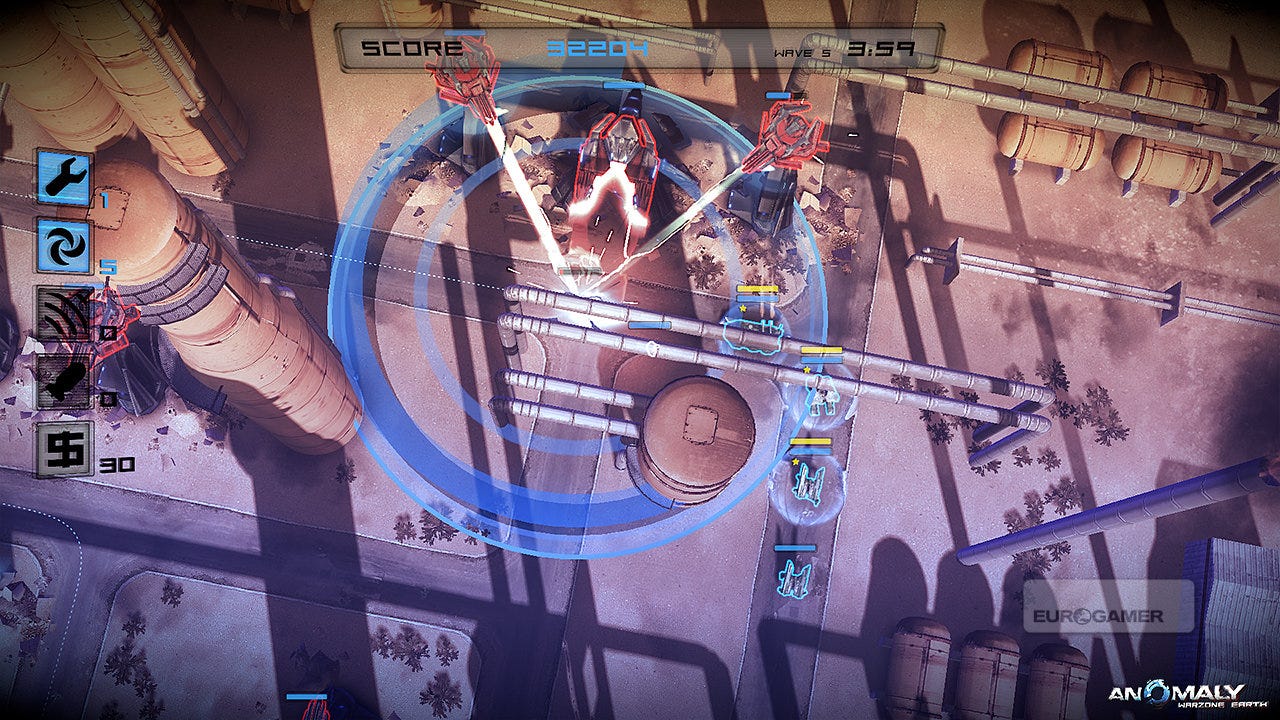
That's handy, as you're wearing this outfit called, somewhat underwhelmingly, the Combat Suit. With the suit, you can drop time-limited power-ups on the field to support your troops. Repair kits replenish your units' shields within its range of influence, smoke screens throws off the enemies' aim, and decoys distract nearby towers. The fourth Combat Suit power, calling in an air strike, doesn't become available until relatively late in the game. (That's fine, as Anomaly is plenty engrossing with just the first three.)

3

Hey, zoom in, I think that dude about to be enveloped by the enormous red alien dome of certain doom is scratching his butt! Man, Google Street View is hilarious.

Without the suit, your units would be screwed, like Patton's tanks in the mud. The puny tanks and whatnot are overmatched by the enemies' towers, which feature lasers, rippling bolts of electricity, and holy-crap-even-scarier lasers. So to keep the troops rolling, you have to support them almost constantly, throwing down repair kits in the midst of a firefight, and desperately scrambling to distract the enemy towers for a moment or two. The opponent has such a strength advantage that by the halfway point of the game, you're almost always on the precipice of death.

This makes it sound like Anomaly is a frenzy of action, and it often is, but not to the exclusion of strategy. Frenzy can be calculated, to a degree. It's not only possible to gain a long-term strategic advantage in a given stage of Anomaly, it's essential. Poor planning will always sink you; even if you survive one enemy enclave, a reckless approach will mean your supply of power-ups is too drained to conquer the next.

4

It's like my mom always said, if someone builds a giant mechanical volcano to fire missiles at you, that person is probably not your friend.

However, you can only build a strategic edge in Anomaly by understanding how you'll respond in the moment. Can your energy-shield truck hold the force together while you dart away to distract the energy-gobbling juggernaut to the east? Will you be able to lead the convoy around that turret-laden corner with your meagre supply of smoke screens? The fun is in finding out.

In that way, the game is a gradual reconnaissance into your capabilities as a leader. The smaller battles hone your self-awareness and prepare you for those glorious life-or-death crucibles – there's at least one per stage – where the screen bursts into a Technicolor fog of war, with glowing power-ups layered on top of energy bars on top of exploding missiles. And amid the madness, there's your happy little commander, directing traffic.

8 / 10

Read the Eurogamer.net scoring policy

Comments (14)

Comments for this article are now closed, but please feel free to continue chatting on the forum!

  • Loading...hold tight!