Version tested: Xbox 360
There's a popular misconception that the LEGO series never changes; that every game is a shameless repeat of the first with different LEGO versions of licensed characters swapped around for each money-grabbing iteration.
If you're just glancing at the games from afar, it's easy to make this assumption. Tiny figures run and jump around brightly coloured maps, smashing everything in sight and slurping up hundreds of tinkling LEGO studs.
That's the heart of the series, the comforting familiar centre that kids respond to. It's as much a part of this game as the timeworn cliches of headshots, drifting and combo-punching are to other console lineages. That part, certainly, has changed very little.
Yet any parent who has sat down with their kids over the last five years or so and spent hours tracking down every last minikit (indeed, any parent who knows what a minikit is) will know that each LEGO title has its own flavour.
Features come and go from title to title, old ideas giving way to new before returning in improved forms - but the series has arguably shown more willingness to evolve over the years than many hardcore-approved titles.
When it comes to LEGO Star Wars III, even the most vehement detractor won't fail to notice the changes made to the formula. With the Clone Wars as its backdrop, LEGO has suddenly turned RTS.
Well, almost.
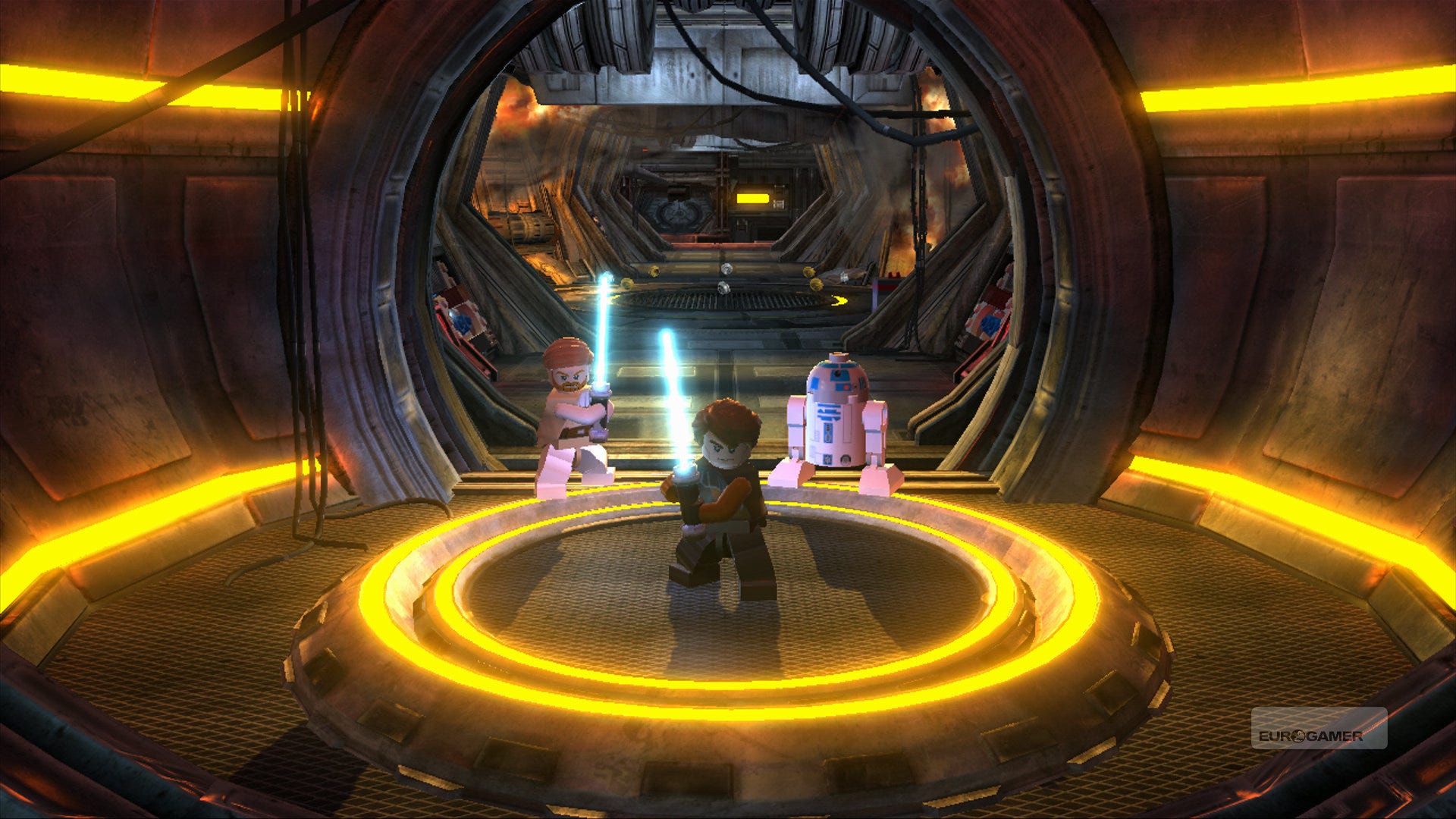
Worst new Star Wars character name? Whorm Loathsom. Come on, George, why not just call him Nasty McEvilguy?
It's not as if the old explore-and-smash template has been abandoned completely. You still work your way through story levels using multiple characters, their complementary skills allowing you to solve gentle environmental puzzles and destroy anything that looks fragile to harvest the game's stud currency.
And you still come back later, once you've unlocked more characters, to find even more areas and extras that were inaccessible first time around. The vehicle sections remain too; you swoop around in a variety of spacecraft, blasting targets.
Red power bricks still unlock cheats and silly features. Each level still contains ten hidden minikit pieces which combine to form a collectible model. It's as familiar and exciting as a childhood Christmas morning.
Yet even here, in the meat and potatoes LEGO game material, changes have been made. The story levels can now actually tell a story, rather than plonking popular characters in recognisable locations and funnelling them to the end.
Events are more fluid, with the established gameplay styles free to flow into one another instead of being segregated into standalone levels. You can start in a deep space combat situation, then land your ship and switch instantly to controlling the characters on the ground. Those characters might then get separated, and you're able to swap between the two groups as they tackle different objectives.
Then you might switch to an entirely new character as they enter the fray. At one point you can alternate between a character trapped underground and another character circling in a dropship, using a mounted turret to clear the debris from above.
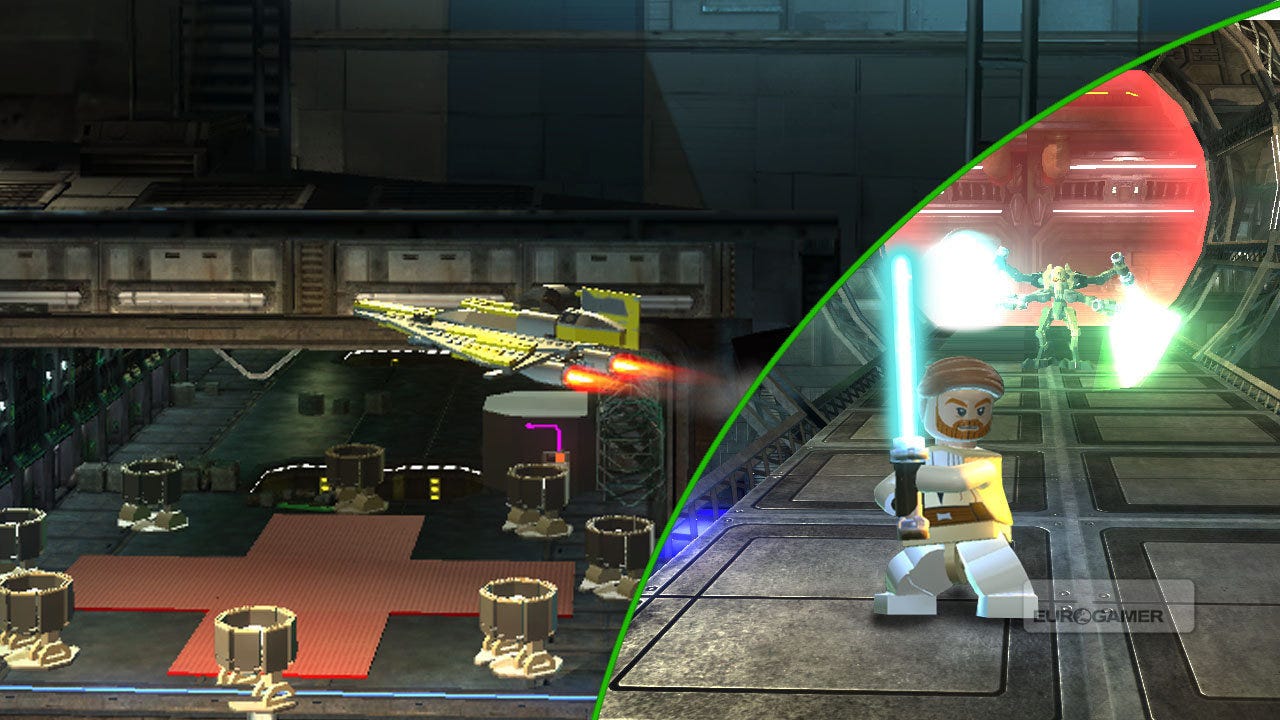
Even the sweeping dissolve effect between different scenes is authentically Star Wars.
It's a shrewd decision, and one that keeps even these traditional stages feeling fresh and unpredictable. A sprinkling of new abilities and features also helps in this regard.
Jedi can use their lightsabers to carve holes in walls and doors or clear space with a Force Push. Clone Commanders can take charge of squads of troopers and direct them to attack a target.
Weaponry, too, has been given a makeover. Chainguns join rocket launchers at the heavy end of the arsenal, used to overheat golden LEGO objects until they explode. There are even sniper rifles, wielded by bounty hunters. Using these calls up a floating zoomed crosshair which depicts distant details in a pleasingly chunky 8-bit style.
Firing up the charming but basic original LEGO Star Wars as a comparison, the difference is immense. The sheer range of interactions now on offer is intoxicating to eager young brains.
When it comes to the visuals, things have taken another step forward. This is, by far, the best looking LEGO game yet. The game finally looks like it belongs in the HD era, abandoning the flat plastic look of old in favour of convincingly lit figures in more realistic locations.
One stage, which takes you into a dusty tomb illuminated only by Clone Trooper helmet lights and the glow of a lightsaber, is as atmospheric as any survival horror game.
Elsewhere, scale and spectacle are on the menu. Swarms of enemies can now roam the screen, and there's genuine tactile pleasure to be taken in the way they scatter after being hit with a Force Push, a rocket blast or just a well-aimed step from a mechanical walker.
It's the ground battles that deviate furthest from what the majority of people will expect from a LEGO title, however.
These frequent diversions into large scale warfare set you down in an open plan battlefield. Dotted about are energy outlets around which bases can be built. The enemy almost always has a head start and has taken control of most of these vital objectives.
Your overall goal varies depending on the story, but success boils down to wresting control away from the Separatists by destroying all structures around each outlet and building something of your own.
The stud currency comes into play here, as everything you build has a price attached, and increasingly expensive options are unlocked the further you progress into the battle.
Giant cannons are a key early component, allowing you to bombard enemy positions from afar. Barracks will spawn platoons of Clone Troopers, air support towers can summon small infantry walkers or tanks, and further up the scale shields and arc energy weapons come into play.
At the same time your enemies are churning out their own forces, so the stage quickly becomes well populated - creating the sort of large scale engagements that were previously restricted to cut-scenes.

It's not going to impress Supreme Commander veterans, but the ground battles are a good strategy taster for kids.
You're free to roam the battlefield, hopping into any vehicle you fancy or taking the helm of a cannon to take down a specific target. The explosions and smoke are something of a red herring. Your forces won't win the battle if left to their own devices, and nor do your enemies make any concerted attempt to capture your bases or retake control of one's they've lost.
The illusion of chaos is compelling, but it won't fool adult players. This is strategy gaming at its most immediate and lenient. It accommodates any mucking about that a youngster might attempt without penalty, but only allows forward progression when attacks are focused and directed by the player.
The downside is that battles can appear aimless. Without much in the way explanation as to what needs to be done or how to do it, kids may hit something of a brick wall here without a game-savvy parent on hand.
The laissez faire approach also brings both pros and cons to the over-arcing structure of the game. Your gameworld hub is the Resolute, Anakin Skywalker's command ship. Story missions are selected from a command deck console, and stages spread out along three winding paths from planet to planet.
Each storyline finds you on the trail of one or more Separatist villains and you're free to hop between plot threads as you go. The consoles also allow you to swap characters, play the two-player Jedi Arena mini-game and access the various bonus modes.
As in previous games, success in achieving the various goals of each level – complete the story, earn all the minikits, pick up enough studs – nets you a gold brick. The more gold bricks you have, the more of the hub world opens up as you're able to build more doorways to new sections of the ship.
The game's first 15 minutes.
It's the same sense of an unfurling gameworld that has been part of all the LEGO games, a constant state of discovery that feels like the best children's museum ever, where everything is interactive, everything does something and leads you on to somewhere else.
Clone Wars is, however, rather more opaque in its construction than its predecessors. There were several moments where I had absolutely no idea what I should do next to unlock more content.
The LEGO games excel at revealing their depths in tantalising layers, but this time it often feels like the goods are perhaps too well hidden. When dealing with younger gamers, especially those whose skills are still embryonic, a little more signposting would help keep the game flowing more smoothly.
Occasionally clunky structure aside, Clone Wars is still easy to recommend. There's ambition here that you wouldn't expect from a series on its eighth iteration. While stretching those boundaries has meant that the game loses some of its structural shape, the moment-by-moment experience is as enchanting and engaging as any previous entry.
Although this game is perhaps better suited to older children who grew up on the originals rather than youngsters taking their first gaming steps, the LEGO track record remains as solid as ever.
8 / 10
