Yakuza 4 Review

Sleeping with the sushi.

Version tested: PlayStation 3

For the video game sightseer drawn to urban breadth and spectacle, nothing yet beats Grand Theft Auto's Liberty City. It's a sprawling virtual capital with distinct districts, diverse architectural influences and landmarks that imprint the memory.

But if you want authenticity and depth, Yakuza 4's grimy Kamurocho is the go-to destination. The geography may be more limited than in Rockstar's city, but its ambition is no shorter. And it's in the details that Kamurocho – a semi-fictional location based closely on Kabukicho, Japan's notorious red light district – beguiles.

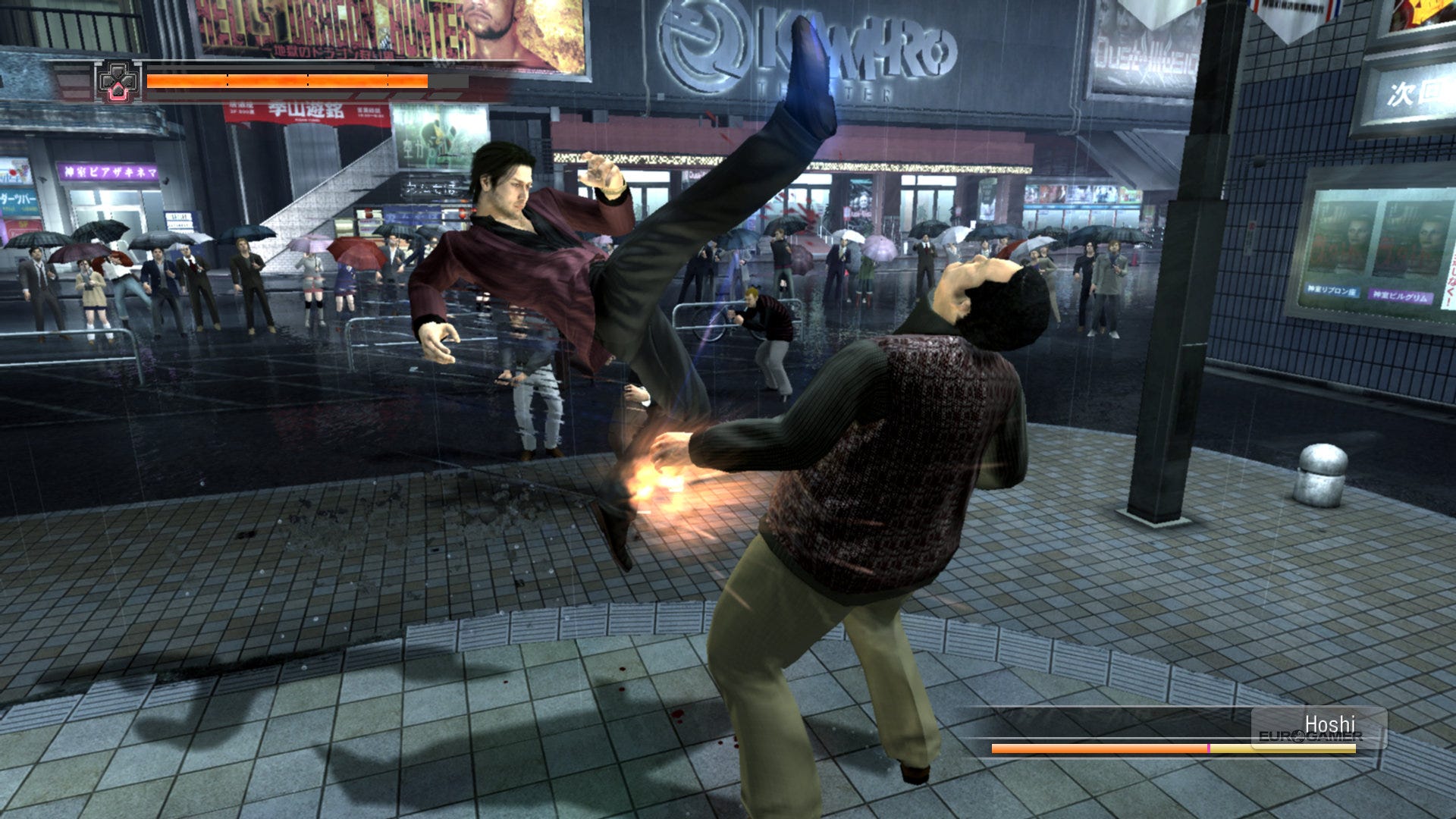
In the daytime, the higgledy-piggledy mess of a Tokyo district is in plain view. Tangles of overhead electrical wires bunch like bird nests in a forest of neon and concrete. Buildings hunch shoulder-to-shoulder next to one another, one tall, another squat, their almost-embrace forming tight alleyways all around - narrow tributaries darting off from the main street inviting snug exploration.

Red neon Ka-Ra-O-Ke signs try to out-glare the dreamy eyes of mousse-haired idols on billboards opposite, while every shopfront screams for attention with blasts of bold lettering, and the irrepressible shouts of a staff member, loudspeaker pressed to lips, boasting of its wares.

At night the distant clanging of a construction site gives way to the Babylonian jangling of a city seeking thrills. Young men in medium-priced suits hover at the shoulders of pretty girls, inviting them to sign up to become hostesses at nearby establishments, while professionals loiter with impatient tuts and foot taps awaiting their tardy dates.
The furious rattle of ball bearings can be heard muffled behind the sliding doors of a pachinko parlour, while schoolgirls squeal as their teen suitors try to win them a cuddly toy at the Club SEGA arcade.

Kamurocho has a weighty sense of verisimilitude, not only in its architecture – which can be viewed on high from the rooftops, or at the roots level from underground malls and carparks – but also in its people. Beggars scratch sleepily in shop doorways, while salarymen march purposefully towards their next appointment.

For anyone familiar with contemporary Tokyo, the sights and sounds are pitch-perfect, the main difference being that, dressed as a virtual native Japanese, you now have access to many of the establishments that, as a real-life gaijin, are usually off limits.

We're still some way from being allowed to enter every building in the city, but around 35 per cent of Kamurocho's establishments have doors that open and bellies that can be explored, a fact that moves this video game city away from the dolls house façade of Liberty City and contributes to a new sense of depth.

Who might be behind this door? What adventure lurks at the end of that alleyway? Persuasive questions. And, for once, they regularly come with satisfactory answers.

Because in the main, having set the stage with such care and attention, Yakuza 4 manages to deliver an absorbing story upon it. Four absorbing stories, in fact, as producer Toshihiro Nagoshi chooses to more fully embrace the soap opera structure the series has always enjoyed, shining the spotlight onto an ensemble cast into whose shoes you are invited to step one by one.

Each of the core characters has a slew of side quests to be completed, all of which are recorded in the game's copious stat screens.

The first of these protagonists, with whom you share the first five hours of the game, is arguably the most interesting. A 32-year-old former homeless man, Shun Akiyama runs Sky Finance, loaning money to those who cannot find credit elsewhere. He charges no interest on the loan, but instead requires his clients to engage in volunteer working to demonstrate their trustworthiness prior to receiving the cash.

Akiyama, working so closely with Kamurocho's most needy denizens, also enjoys close contact with the Yakuza, so his philanthropy is tempered by his mean right hook, a tension between moral uprightness and physical depravity that runs through the very centre of the game.

Later you work as Masayoshi Tanimura, a corrupt policeman, Taiga Saejima, a former Yakuza knucklehead on death row, and series stalwart Kazuma Kiryu, the moralising owner of an orphanage. Their stories are separate but intertwined, drawing together for the final portion of the game. As such, the four characters offer variety, but at the expense of complete investment from the player asked to switch between them.

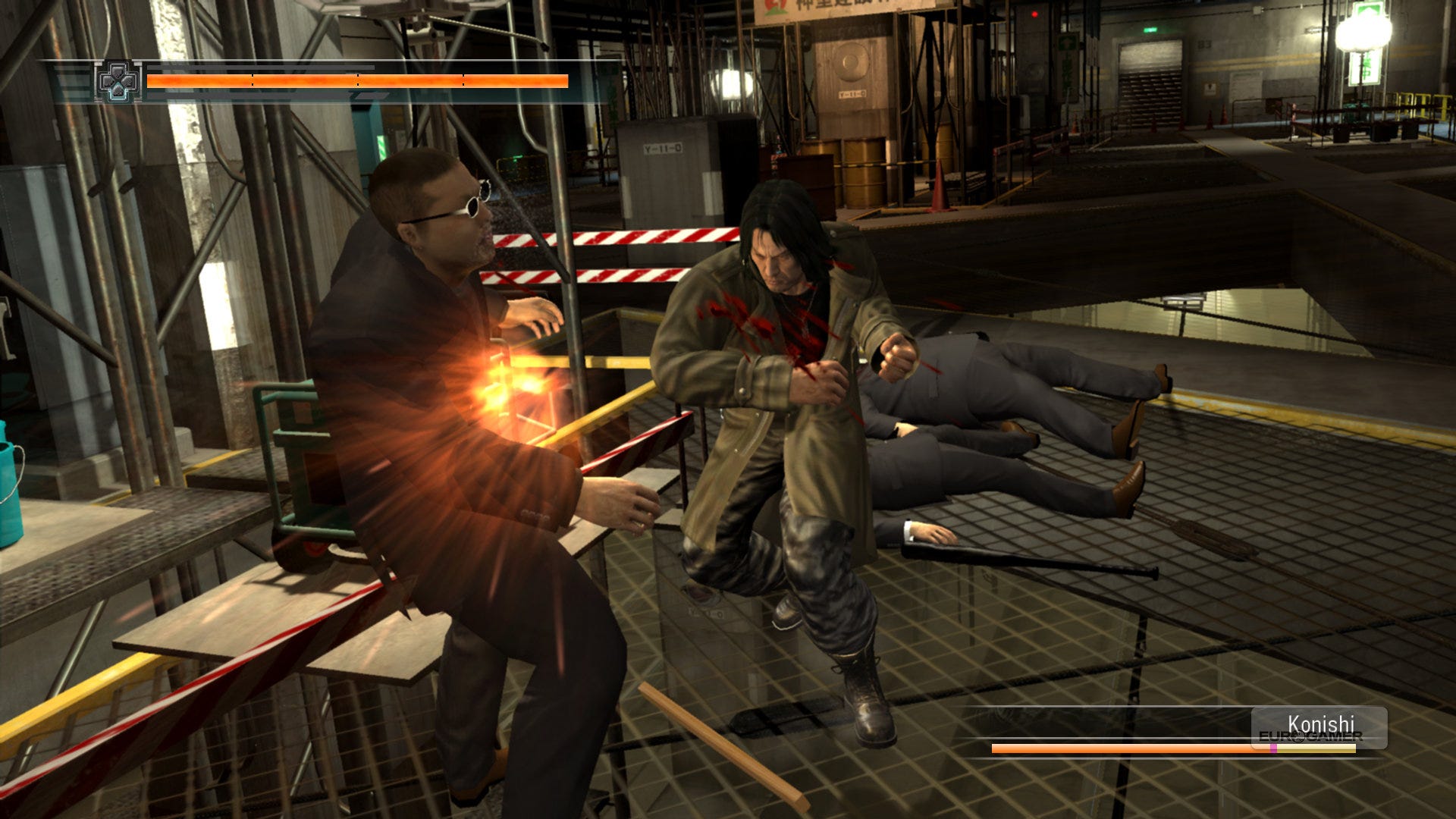
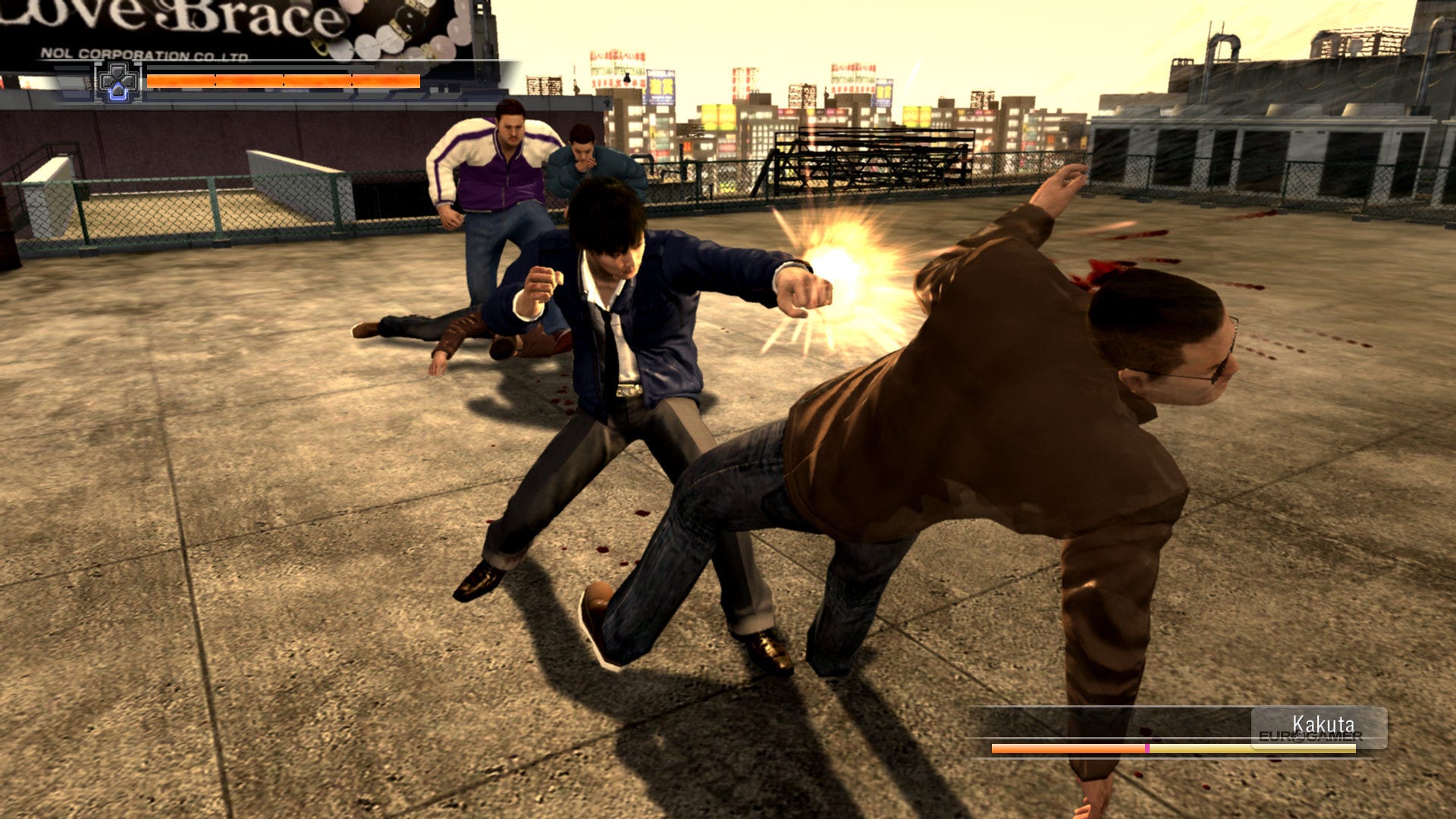
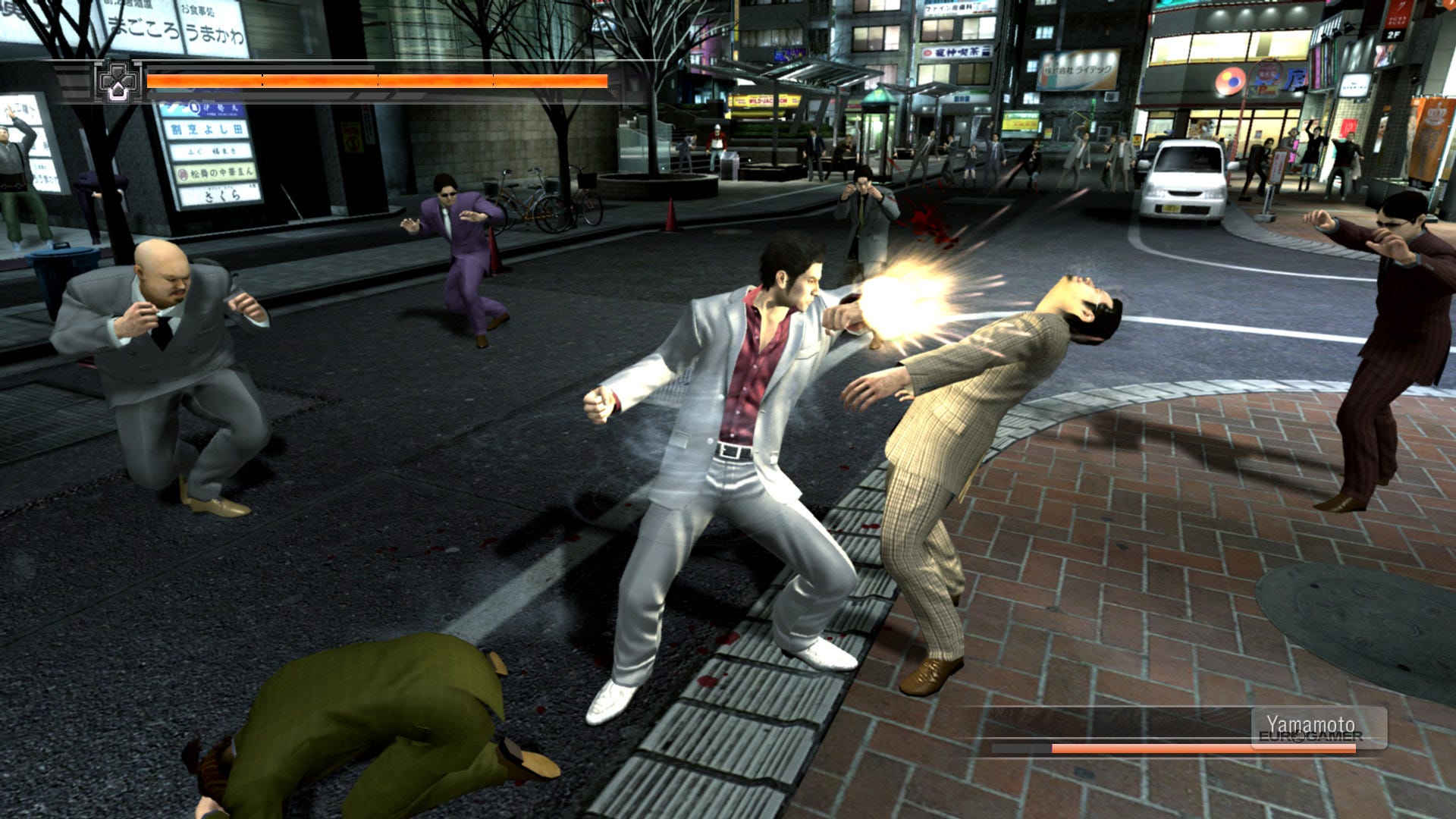
Structurally, the Yakuza series has always defied easy pigeonholing. The main storyline through the game is delivered through regular cut-scenes, which are directed with flair and acted with assuredness. These scenes are interspersed by fistfights in which punch and kick combos can be strung together and bloody context-sensitive finishing moves executed on the street furniture around.

The updated engine – and this is a far better-looking game than its predecessor – gives these battles renewed authenticity, and while the speed of encounters and the use of unlockable moves is decidedly video game-esque, the exploding noses and brutal, dynamic direction of battles is often affecting.

In the downtime between watching cinematics and mashing your way through gangs of goons, you are free to explore Kamurocho, but it'd be too generous to describe Yakuza 4 as a true open-world game. Where SEGA ably matches Rockstar's cut-scene direction and writing, the frequent artificial limiting of player freedom is anachronistic.

When, for example, your phone rings, you cannot answer it on-the-go a la Niko Bellic. Instead your character is frozen to the spot till the scene plays out. Likewise, invisible walls prevent you from exploring any part of the city that the designer doesn't want you heading down, a design restraint wholly at odds with the creative freedom elsewhere.

Nevertheless, when you are given the keys to the city, the number and range of interactive sideshows is dizzying. The series has always relied heavily upon its extra-curricular activities to provide interest, and in Yakuza 4 there are more side-quests and mini-games than ever before.

As with Shenmue, these have had a rare level of attention and polish lavished upon them. So, head to a karaoke booth and you're presented with a fully functioning karaoke interface screen complete with multiple song choices, local leaderboards and, of course, a functional rhythm action mini-game at its core.

While you still won't be able to play the latest Virtua Fighter cabinet if you frequent one of the many arcades in the district, you can try to nab a cuddly toy via one of the crane games, while many an hour (and fortune) can be lost pumping balls into a Pachinko machine.

Not only can you visit the local hostess club and make light conversation with the preened girls therein (even exchanging emails with any who take a shine to you), but there's an entire mini-game in which you can select and train up your own hostess girl, choosing her outfits and make-up to suit the tastes of the club's clientele.

But it's at the point that you realise you can take a cab to an out-of-town links course to engage in a golf tournament when you begin to wonder whether the developer's time could better have been spent polishing the core experience, rather than bulking out the supporting materials to such an outrageous extent.

That's not to say that the game's ambition outstrips the capabilities of its creators. The opportunity to, say, head to the baseball batting nets to attempt a high score when you're tired of chasing the storyline is a welcome one.

Battles are punctuated by outrageously explosive sound effects. But the video game brawler aesthetic is offset by the authentic visuals.

But these additional distractions surely pulled development time away from the core game, and rarely do enough to fuse themselves into the wider game structure. Prizes for excelling at mini-games are almost exclusively weapons or equipment to bolster your fighting capabilities, a telling fact that reveals the limitations of the in-game economy: the only real meaningful intrinsic rewards here must be tied in to the system of violence.

These wide-angle reservations dissipate close up, however. Yakuza 4 succeeds in offering an inviting window into a meticulously observed world. The dialogue and story are strong for a video game, maintaining interest over the hours it takes for the plot to fully unfurl.

A significant step up from Yakuza 3 in terms of visuals and story, Yakuza 4 still lags behind the genre's leaders, lacking the polish in interactions to make it a classic. But this is still a strong, mesmerising video game, an offer that none should refuse.

8 / 10

Read the Eurogamer.net scoring policy

Comments (72)

Comments for this article are now closed, but please feel free to continue chatting on the forum!

  • Loading...hold tight!