As a species, why have we not invested more of our energy into manipulating gravity? Especially when it's clearly so much fun. Sure, toasters with multiple speed settings are cool, and who doesn't like iPod docks - but if a fraction of the R&D budget of, say, the Ford researchers devoting their energies to new trucks was re-employed in the pursuit of a trampoline with inertial dampeners, or a Nerf gun which fires those foam sticks in slow motion, we'd have world peace by next Tuesday. Just saying.
Whether this was the primary motivation for Recoil Games in building Rochard, or whether they just wanted to make a cool side-scrolling 2D action puzzle game, are not questions I had the foresight to ask while being introduced to the game at a hotel near the Game Developers Conference earlier this month.
But that's besides the point; it is more evidence to support the belief that all good things in games revolve (at varying speeds) around gravity.
You play John Rochard, an astro miner (not a space miner - apparently this is important) who is part of a ragtag, largely unsuccessful mining crew searching asteroids and planets for an elusive element called turbinium.
At the outset of the game, Rochard and his crew happen upon a structure in the middle of their current asteroid that proves the existence of extra-terrestrial life. Unfortunately, after calling in their discovery they are set upon by space pirates (and not astro pirates - which is also important).
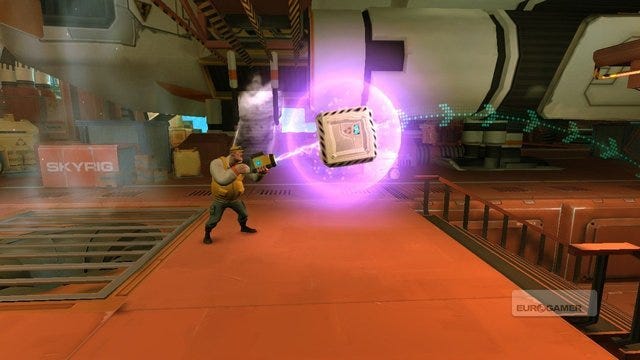
Projectile trajectories are handily marked.
All of which - along with some proudly appalling jokes and silly exposition - comprises an enjoyable pretext for a platform puzzle romp.
Rochard is equipped with a G-Lifter, a mining tool that can be used to grab crates on a kind of electrical lasso and then whip them along parabolic arcs at trajectories determined by the right analogue stick. It's such a simple action, one that's easy and fun to perform.
Grab a crate and then move the right stick and it swishes this way and that through the air until you settle on a direction to fire the object in, at which point you press a button and off it goes. It's not quite playing catch with Dog in Half-Life 2, but it's the same principle - and it's clearly been engineered with the same warmth and playfulness.
The G-Lifter can also be upgraded as Rochard progresses, allowing him to toggle the asteroid's artificial gravity at will. This has the effect of allowing him to hop around with reasonably logical levels of gravity (at least by videogame standards), or, with gravity reduced, to float more slowly and expansively over a greater distance.
Later on Rochard also gets a rock blaster, which is useful for shooting things, but the stuff we've played so far emphasises basic puzzling using different forcefields (some of which permit the passage of organic matter but not crates, and some vice versa), crates, hatches and power cores (which allow you to turn on and off doors, forcefields, etc). The solution usually involves moving things between different areas in the correct sequence and paying close attention to the properties of your surroundings, a bit like Portal.
The space pirates, meanwhile, can be dispatched with a melee attack or by using the rock blaster, but it's more fun to dispense with them using the gravity tools (manipulating gravity, in my view, is entertaining, as you may have already deduced).
Tossing a crate on someone's head is always a gas, but in one section you are pursued across a red forcefield by a goon. If you leap, spin round and use the G-Lifter to haul a power core out of a wall above you, then the forcefield disappears and said goon tumbles to his doom.
Visually it's all happily retro and rendery, with chunky characters and environments reminiscent of Bionic Commando Rearmed (although Recoil would presumably want me to emphasise that they hail from Finland rather than GRiN's native Sweden, as I expect there's a national rivalry there - and also they gave me chocolate).
Chunky surroundings. Just like that chocolate.
While the game is simply appointed, it is awash with neat little effects. Creative director Burt Kane draws our attention to some lovely real-time shadowing on a staircase, for example, and you don't have to work on Digital Foundry to appreciate it.
The whole game has a charming indie naivety and simplicity to it. It's hard to guess at the quality of things like pacing and level design based on such a small snapshot, but one thing that it is not hard to do - especially when listening to Kane explain the archetypes and backgrounds of the characters, discussing seemingly trivial details so reverently - is appreciate the personal passion behind this nifty little platformer. Even the logo is lovely - a splendid blend of Tron and Rez that I would happily wear on a t-shirt.
Playing with gravity is just awesome, and there's perhaps no better illustration of that than the game's signature advanced technique. This may even have given the studio its name for all I know. Grab a crate with the G-Lifter, switch on low-gravity and leap through the air, and you can fire the crate away from you to propel yourself further. It's called a recoil jump, and having spotted it in the trailer it's one of the first things I try out. It's fun - something it is difficult to imagine that Rochard will not be when it is finished.