Plenty of revered games started their lives as mods for existing titles. Counter-Strike began as an inordinately successful Half-Life mod, while Killing Floor and The Ball both tagged onto the back of Unreal Tournament installments.
Factor in the likes of Team Fortress and Natural Selection, whose sequels have eschewed their amateur beginnings to become commercial titles, and the news of yet another mod making the transition to full game might not sound so impressive. When the title in question is Dear Esther, though, things are a little different.
In 2008 the University of Portsmouth's Dan Pinchbeck released this Half-Life 2 mod as a way to test out some design theory, without the financial worry that accompanies the release of a full game.
Pinchbeck wanted to see what would happen if he ignored all the standard methods of play. He focused instead on abstract, meandering storytelling. The results were a world away from the high-powered action of most mods which make the commercial transition.
Dear Esther is at the forefront of gaming research, then - but at first glance, this mod might not sound like the most obvious choice for Valve to pick up as a Steam exclusive. There's no shooting, nor are there any puzzles or tactics involved. It's only an hour long, and during that time you meet no real characters.
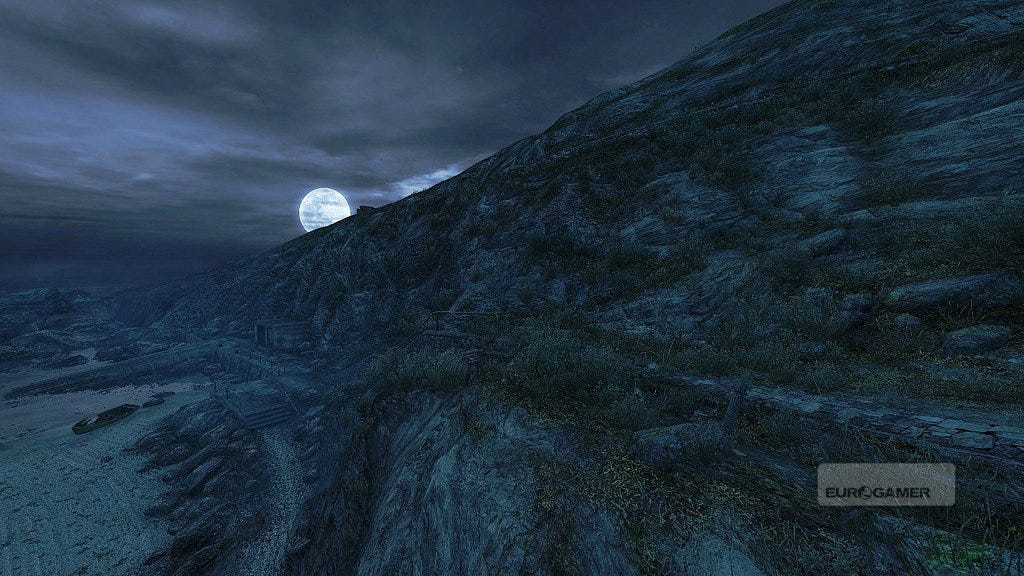
This is almost certainly the most gorgeous-looking Source Engine game to date.
It's a game with all the game ripped out, leaving just an environment and a story in place. Still, the original incarnation of Esther picked up several awards and was downloaded more than 60,000 times. There's clearly an audience for this kind of experimental game design - and that's one of the reasons to be excited about the miraculous overhaul that's heading our way.
Without so much as a hint as to who your character is supposed to be, Dear Esther drops you onto the murky, misty shore of a deserted Hebridean island. The ocean laps at the sand behind you while gusts of wind blow leaves across the beach.
A disembodied voice begins to speak, reading aloud snippets of letters addressed to a woman named Esther. Who is she? That's one of the game's deepest mysteries, and you might have to play a few times to work it out.
With nothing else to do, you'll explore the island. As you take in the sights while following the paths across hills, through caves and up steep cliff faces, you'll hear plenty of these voiceovers. But they're semi-randomised. Every time, the game selects from three different versions of the script, each providing a slightly different take on the unfolding narrative.
This means that an absolute, definitive interpretation of Esther's story is near enough impossible to develop. The narrator begins to contradict himself, occasionally speaking about the island in heavily metaphorical language. He starts to refer to its history, to those who once dwelled there, and to an accident on the motorway in the Midlands.
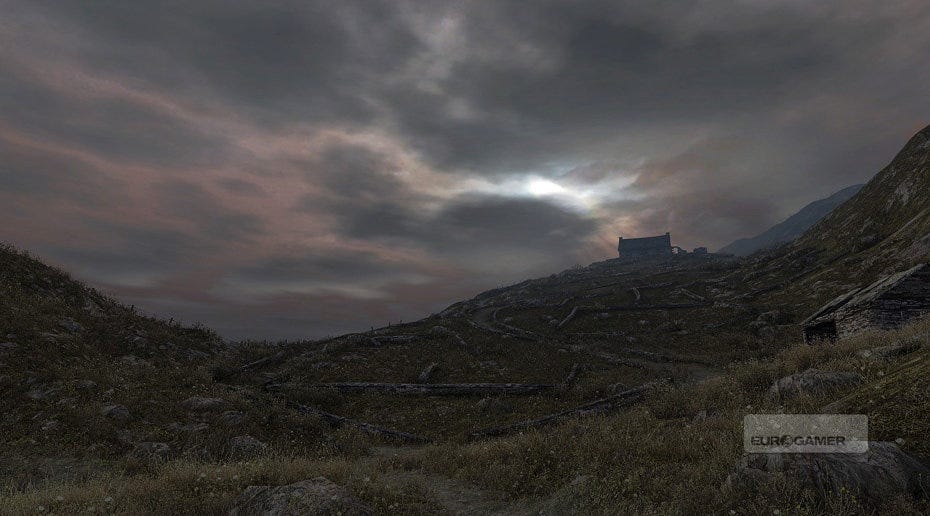
Hope you brought your raincoat, because I haven't got a spare.
Initially it feels too sparse, too fragmented. Then you really start to think about what you're being told and how that relates to the world around you. It's at this point the most strikingly effective story elements start to clunk into place.
Despite Dear Esther's success, the original mod came under criticism for its world design. Many players felt that while the story was interesting - perhaps even profoundly moving at times - the environment stood in its way. It was too bland, people said, with not enough visual cues to keep things interesting from start to finish.
For this remake, Mirror's Edge level designer Robert Briscoe is at the helm. For almost two years he's been painstakingly redesigning and restructuring Dear Esther's island, working to establish new ways of telling its story through the game environment.
The result is extraordinary: a place imbued with more character than you might dare to imagine, with countless opportunities for curious exploration - in contrast to the original's entirely linear design.
The route ahead is always clear, as a tall radio tower at the island's peak provides an omnipresent reference point for where you need to be heading. But you're rewarded for straying from the established path, either with a new snippet of the storyline or simply an astonishing vista to gawp at.
This is, without a doubt, the most beautiful looking Source Engine game to date. Briscoe's careful modelling and texture work, not to mention a few tweaks to the code, have created something that's every bit the competitor to even the flashiest current-gen tech.
Foliage sways in the breeze while the moon is reflected hauntingly in the rippling ocean. In the caves, which make up the bulk of Dear Esther's middle section, phosphorescent light illuminates the dank passages with hypnotic greens and blues as waterfalls cascade down the rock face.
Dear Esther might be an unusual, experimental game, but it's not difficult to see why Valve have snapped it up for a full release: it's an exquisite demonstration of how powerful their technology still is.
And it's not just about good looks. Without any element of challenge to speak of, Dear Esther is a hundred per cent reliant on the atmosphere it creates. Combined with the strong voiceover work and a twisting, unnerving and powerful soundtrack (which will have been completely re-recorded by the time the game's available to buy), the mesmerising visuals draw you effortlessly into Esther's world, captivating and engrossing at every turn.
The atmosphere is extraordinary throughout.
The original version of Dear Esther reached a breathtaking climax with a climb towards the island's peak, as the final strands of the story slotted into place and you strode onwards towards your fate.
Briscoe and Pinchbeck are keeping this section of the remake tight to their chests at the moment, meaning I've only played the first two-thirds of the game. But what I've seen already throws up a few surprises, even to someone familiar with the mod.
Despite having been built by someone not initially involved with the project, the remake feels so much closer to what you expect Pinchbeck's vision was: something occasionally disturbing, often upsetting, but still a magical experience all the way.
Where the team might struggle is in convincing players to pay for what they could previously download as a free mod - especially when the concept is so different from that behind everything else in the gaming marketplace. Dear Esther is slow, thoughtful, and not necessarily what we'd consider to be "a game" in the traditional sense.
I'm reminded of the uproar when Tale of Tales released The Path back in 2009. It featured a multitude of controversial themes, but that wasn't the main thing people took issue with. The problem, for many, was the fact that Tale of Tales had dared to charge money for something so wildly experimental at all.
There are two reasons why I think this won't matter. The first is that the gaming populace has increasingly demanded innovation of late, and this is a brave and fascinating example of what's possible when you dare to play with the form.
I daren't imagine how much time and effort went into building these caves.
It's reassuring to know that people like Dan Pinchbeck are scurrying away within academia, building up an understanding of how games work and how they might work in the future. If Dear Esther does well, that could spell exciting times in the months and years ahead.
The second reason is more straight-forward: Dear Esther is shaping up to be absolutely brilliant. It's a powerful and emotional piece of abstract storytelling, one that pushes all the right buttons despite its experimental nature.
It's beautifully constructed, it looks breathtaking, and the atmosphere that Robert Briscoe has managed to conjure up is enough to rival anything else you could mention.
So put aside any preconceptions about what games should do, and look at Dear Esther as an example of what they can do. We should all be thankful of the mod scene for allowing this sort of bleeding-edge design to flourish.
