SpaceChem
Up and atom.

SpaceChem and Super Meat Boy. One is a game of atomic engineering, the other is about a skinless kid and his hot girlfriend. There's not too much common ground there, except on this essential level: they both nail the "Look what I made!" factor.
Overcome a challenge in either of these games, and you get the urge to call someone into the room, point at the screen and proclaim, "Look what I made!" In the case of Meat Boy, the player-created masterpieces were video replays of your death-cheating exploits; SpaceChem provides a more cerebral counterpart. You build tiny chemical reactors that scoop up atoms and rearrange them into new compounds to advance the interests of your industrial overlords. It sounds dry, but man, is it a kick to watch those atoms go.
The root problem of each stage in SpaceChem is to design a "reactor" that will refine raw atoms and/or molecules into a new compound. Your reactor might be connected to an atmospheric pump that provides you with a 3:1 ratio of hydrogen and nitrogen atoms, and the goal is to cobble these together into – yup, you guessed it – ammonia fuel.
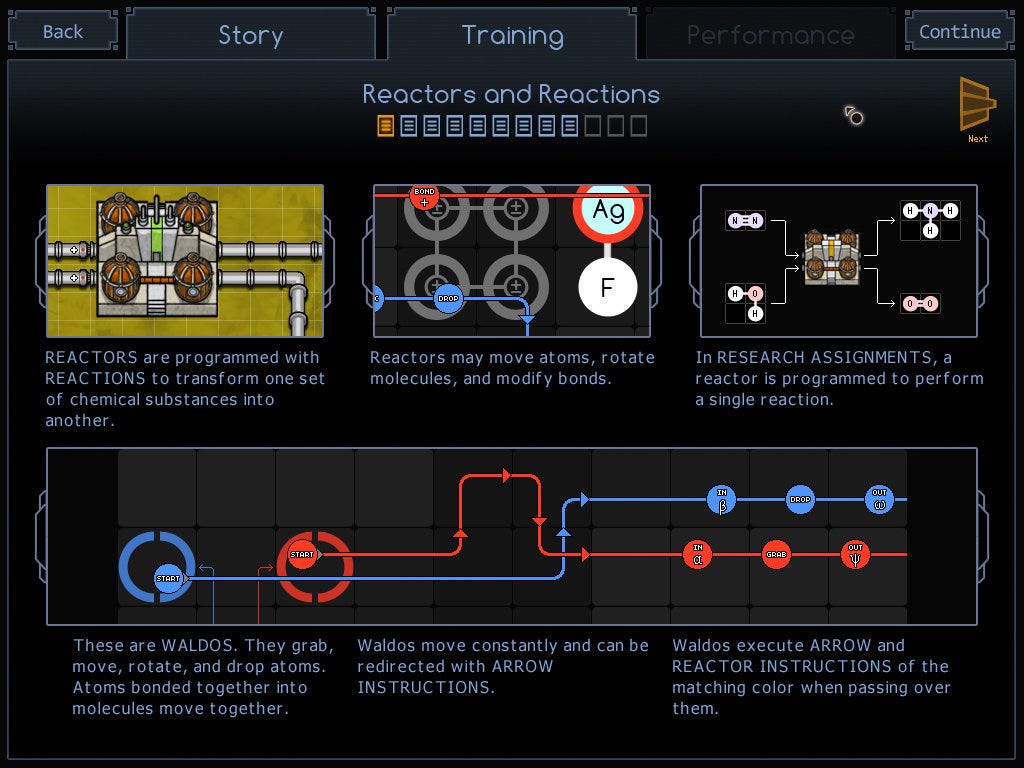
Splicing atoms with your fingers is a messy enterprise. (I always end up getting atoms in my hair.) So SpaceChem provides you with microscopic helpers called "waldos". There are two in each reactor, a red one and a blue one. The waldos move along tracks that you lay out on the reactor's gridded workspace. As they chug along, they execute simple instructions that you place along their route.
For instance, a waldo that passes over a "grab" instruction will pick up whatever atom is on that space in the grid, dutifully toting the chemical in its pincers until it reaches a space you've labelled "drop". Waldos are dumb and obedient, like a Labrador Retriever, except they manipulate quantum mechanics instead of licking their own crotch.
At the outset, your waldos do little more than grab atoms from the inputs on the left side of the reactor and dump them on the output side – maybe adding or breaking a couple of chemical bonds along the way.
In short order, the business of molecular chemistry gets complex, as it's wont to do. Soon, multiple reactors must be chained into a pipeline, conducting high-level alchemy that can't be accomplished with a single set of waldos. You acquire new instructions, such as a sensor mechanism that sends a waldo in different directions depending on what type of atoms are in the mix.
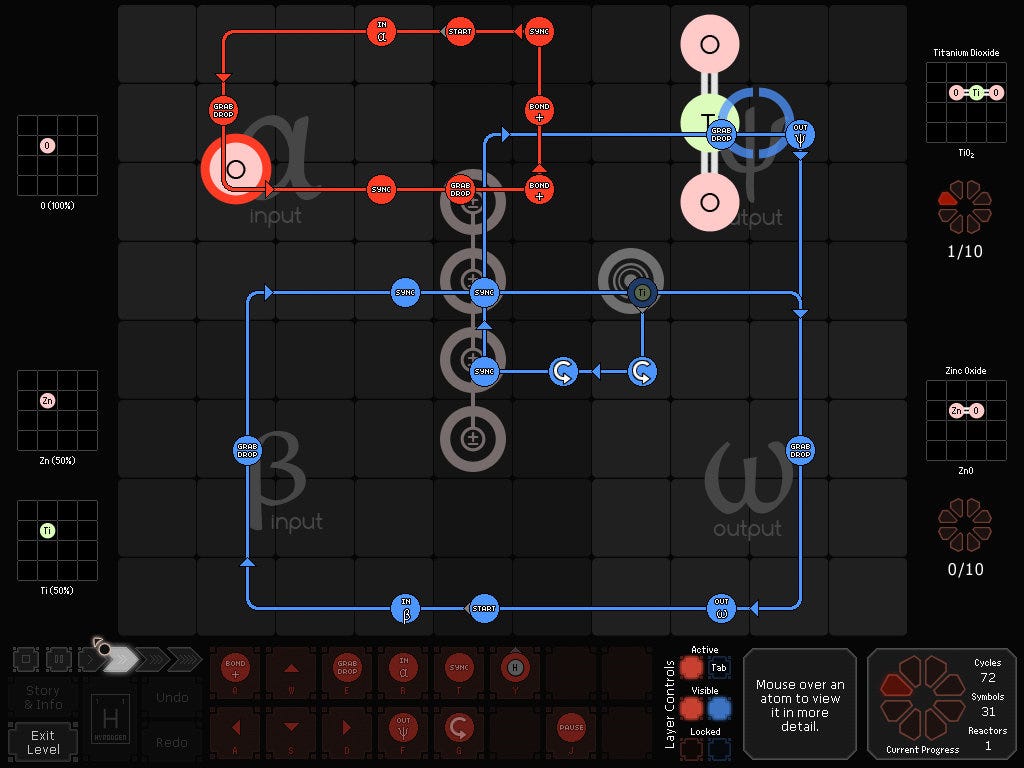
As the universe of possibilities expands, the problems become more daunting, yet SpaceChem is always more accessible than it looks. Creator Zach Barth must have known that his game could intimidate players. I mean, check out the screenshots. Even I hesitated when I first saw this game, and Eurogamer was paying me to play it.
Given that first impression, the trap for Barth would be to browbeat players with tutorials out of fear that they wouldn't get it by themselves. We've all seen it before: You plough through untold heaps of diagrams and explanatory videos, all so the developers can be sure you won't misunderstand any facet of their delicate vision. After all, if you don't have a steel-strong grasp on the rules of, say, the Chocobo breeding mini-game, is life still worth living?
Rather than sticking its fingers up your nostrils and dragging you where it wants you to go, SpaceChem tries an unorthodox approach: not doing that. The tutorials are helpful, but they're brief and almost nonchalant as they unveil new concepts. The unspoken attitude is, "Look, we have faith that you'll see why this is cool, so just try it."