Retrospective: Super Mario Bros. 3

Running and jumping.

In the winter of 1991, my occasional friend and full-time next-door neighbour George hit the bacterial lottery, coming down with an astonishingly rare case of lyme borreliosis, also known as Lyme disease, also known as Bad News, George, This is Going to Hurt. You know you have Lyme disease when you start to get strange circular rashes, when they give way to soreness, fever, and malaise, and when these elements finally develop into shooting pains, memory loss, and, very occasionally, facial palsy.

That's the theory, anyway. George didn't pick up on any of these symptoms because he was spending far too much time in the company of a plumber. He simply didn't notice his joints giving in, his mind falling apart. I remember watching from our living room window as George's family finally bundled him off to hospital. His parents looked frantic, his brothers were subdued. Even their cat looked unhappy. I, meanwhile, was furiously jealous, obviously, leaning my head against the frosty pane, thinking, Lucky you, George. A long, contagious winter with nobody to share the TV with. Six weeks of recuperation and uninterrupted access to Super Mario Bros. 3.

Let me explain. Back then, Super Mario wasn't my favourite videogame character, he was videogames. My friends and I were students of Mario in the early 1990s, professors of Mariology, and we spent our days in rambling scholarly discussions about the intricacies of his worlds, the peculiar richness of their secrets, and whether he could have Luigi in a fight. (He probably could, incidentally, but he would feel bad about it afterwards.)
1

We debated everything, from the safest means of defeating diagonal Bullet Bills to the identity of whoever might have built the Mushroom Kingdom's handy yet mysterious system of warp pipes. We had our favourite levels, and we argued their merits, often bitterly. My friend Ruth could play all of 8-4 in the first game with her back to the TV, platforming by audio alone, and she wasn't considered even faintly deranged: she was entirely normal by our standards, and blind precision jumping was seen as being a fairly standard skill to possess. We weren't alone, either. It turns out that people like Salman Rushdie enjoyed the Mario Bros. games - although I'm assuming he had to play them with the sound down.

Given our deep, sympathetic understanding of Mario, I'd like to think that we instinctively knew that the otherwise wonderful Super Mario Bros. 2 wasn't quite right, with its ambling ostriches and flying carpets, even if we didn't know it was actually a localised and tweaked version of Doki Doki Panic. Equally, I'd like to think that we'd have instinctively known that the Japanese Super Mario 2 - not that we got it at the time - riddled with sudden winds and an over-reliance on hidden platforms, wasn't the team handing in their best work. Either way, that made for a long run, from the delights of the first Super Mario Bros. in 1987, though to the UK release of Super Mario Bros. 3 at the tail end of the summer in 1991, where we hadn't had much in the way of authentic top-class plumber brilliance.

Mario 3 delivered. Super Mario World might just inch it in terms of being the greatest 2D platformer of all time, but the NES' swansong still had its own range of best-evers: the best ever packaging (in my opinion), the best ever advert, with its depiction of an entire planet craving the return of its dungareed hero, and the best ever incidence of product placement in a Fred Savage movie.

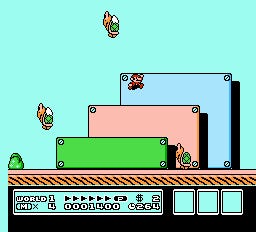
And for something that comes from an era where there were such things as Fred Savage movies, Mario 3 has aged well. It still looks brilliant, for one thing, lustrously basking under peachy skies and filled with little lo-fi gimmicks, such as the flashes of light that dance rhythmically across the game's bricks or the subtle sense of three-dimensional depth as Mario's head wobbles when he runs. The ragtime soundtrack - with a bold blast of reggae when you reach Sky Land - still holds up, and there are plenty of stylish flourishes, such as the dandy zig-zag strip that marks each level's transition to night as you approach the finish line.

When you take Mario games apart - particularly the early ones - it can be like unpicking the dry specifics of a dazzling magic trick. Where's all the fun gone? Mario at his most basic is just running and jumping. The secret, though, lies with the way these basics are handled. The Mario designers tend to treat the simple things as if they aren't that simple. Instead, they seem to spend ages getting them just right, tweaking inertia, weight, and stickiness, until just running and just jumping are fun in and of themselves.

Then, of course, they feed in the extra stuff, and it's the extra stuff that defines Mario 3.

Above all else, Super Mario's third adventure is filled with secrets - filled in the same way that the best Simpsons episodes are filled with jokes. This is the kind of density designers only arrive at by going back over things again and again, by sneaking in one last thing, and then one other last thing because they just can't help themselves.

2

The first Super Mario game is hardly shy about layering in concealed treats, but there were so many hidden, unlikely Easter eggs in Super Mario Bros. 3 that you could spend a fair amount of time simply looking for things that weren't actually there, wrong-footed by cruel playground hoaxes that had you defeating roving Hammer Bros. in specific locations, or being eaten by that huge fish in 3-3 when the timer hits a certain number. (Being eaten by that fish, incidentally, remains one of the few genuinely horrible moments in a Mario game. It's up there with the sequence in Dark World where the hands reach up and pull you off the map.)

Even when you were looking for things that did actually exist, the breadth of asides and gimmicks can still be staggering. Most levels will have hidden power-up blocks, coin-changers, or the odd magical musical note tucked away somewhere, many will have secret areas stuffed with coins and clouds to run around on, and a handful will feature secondary exits that let you collect the ultra-rare Warp Whistles.

Meanwhile, there's an unprecedented range of power-ups to mess about with, too. We remember the classics, like the Raccoon suit or the Frog outfit - pure evil if you fire it up for the wrong challenge - but Mario 3's also home to one-shot oddities like the Goomba Shoe, making its series cameo in 5-3, and allowing you to do the unthinkable, such as stomp on Bob-Ombs without sending them into countdown mode, or finish off spiked enemies from above. It's a crazy idea in a slightly crazy game, and to prove all that, you'll find it in a level that has the audacity to kick off by scrolling right to left.

Playing Mario 3 today, it's heartening to discover that the game's as difficult as I remember it, too - although difficulty in Mario games is often a subjective, rather personal matter. Close as it is to the start, the treadmill miseries of 1-4 or 3-2 still trouble me far more than a lot of the things that lands 6 or 7 will throw my way, just as the Cheese Bridge in Super Mario World strikes me as being far harder than most of that game's Star Road challenges. Whichever bits tend to do you in more than they should, spare a thought for anyone who has to face those tanks in Dark Land, though. Bristling with cannons, turrets, and flame-throwers, they just keep on coming, and the best you can generally hope for when you've beaten them is a fight with some jerk holding a boomerang.

What tempers the potential frustration, aside from the fact that Mario is almost always scrupulously fair with its difficulty, is the specialised knowledge that would have built up by the time you first turned on Mario 3. Replaying it after the best part of a decade, there are specific things that can help you out, like the creepy sixth sense that still leads you to hidden power-up locations long after you've forgotten the names and faces of university housemates and sixth-from girlfriends, but there were always more general things, too. Things like the knowledge that a Bullet Bill cannon won't fire if you're stood right on top of it, a feel for where the designers like to tuck hidden areas, or an inherited awareness of whether you're far enough away from an oncoming object to throw a Koopa shell with no fear that the game will remember to fling it back at you.

Three titles in, whichever second instalment you're counting, a recognisable Mario universe was coming together nicely, in other words. Mario 3 marks the point where Bowser picked up his penchant for flying galleons, and where his single-parent family situation got a bit out of hand with the arrival of the Koopalings, and it also delivered the first of many letters sent by flustered princesses. Equally, just as the 3D games would often riff on real-world materials for their toy-box assault courses, Mario 3 offers its fair share of ledges with recognisable wood grain, or platforms that are visibly powered by spinning mechanical pulleys.

3

Most crucially, however, for me at least, the truly killer thing about Mario 3 is the way it stitches its levels together into maps. These little top-down chunks of real estate gave the whole thing a rakish non-linear aspect, obviously, but they also did far more than that. They suggested a broader, more coherent imaginary world in a way that the side-scrolling roads, cliffs, and pits somehow couldn't do by themselves.

These really were different places Mario was travelling through, and they were filled with their own distinct landmarks, such as the head-bobbing shrubs of Grass Land, the sweet archipelagos of Water Land, and Sky Land's spire, complete with bizarre blue pipes and destructible battlements, that corkscrews you upwards into a fresh run of levels set amongst clouds.

Mario's world was suddenly being charted in order for us students and professors of Mariology to pick over afresh, and it ensured that Mario 3 delivered something that, for all their brilliance, I've always felt some of the more hub-centric 3D games have sacrificed: the sense of a journey, the feeling of travelling from A to B as you progress from one distinct environment to the next.

More than most games, I suspect, Mario's history has a habit of blending with the personal histories of its players. That's why I can't play the third instalment without thinking about George and his Lyme disease, and why I can't pick up the second Galaxy without recalling the time I played it so solidly at a three-day review session that I ended up fainting at Paddington Station on the way home and woke up by the turnstile with a huddle of commuters slapping me therapeutically around the face. (Thanks, everyone!)

The thing that sticks in my head the most about Super Mario Bros. 3, though, isn't my neighbour's illness or all that playground squabbling. It's the potential that Nintendo's game seemed to hinting at with every jump, with every dodge, and with every end of level card I collected. Look at what we can already do, it said. Imagine what we'll try to do next.

Comments (70)

Comments for this article are now closed, but please feel free to continue chatting on the forum!

  • Loading...hold tight!