Fable III Review

The difficult third Albion.

Version tested: Xbox 360

We've hardly been starved of RPGs since Fable II came out. Thanks to BioWare alone, Mass Effect 2 had us chasing the Collectors through the Omega-4 Relay (killing all our friends in the process), while Dragon Age taught us all kinds of arcane trivia that we wouldn't shut up about for six months (boring all our friends in the process). So for the first few hours of Fable III, it's not exactly good news that you sense the law of diminishing returns.

Okay, you're a prince stirring up a rebellion against your brother, the evil king, but you do much the same stuff you did in Fable II, and the most noteworthy changes are superficial. Sure, the pause menu is no longer a list of buttons, it's a series of rooms staffed by John Cleese, but as revelatory new features go this isn't exactly planting an acorn and returning a few years later to discover a tree, is it? (Still no sign of this, by the way - maybe next time.)

Lionhead is traditionally very good at gimmicks, but these can only distract you from the conformity. You're still following the breadcrumb trail - Fable's version of a mission compass - between quests you monitor on a quest log; combat is still a mashy, three-button affair where you alternate between melee, ranged and magic attacks; and it's still an untidy game, where the frame-rate drops, people speak over one another and enemy AI is prehistoric.

Even the outline of the story is eerily familiar. As the younger son of the second game's famous Hero, you're a bit of a nobody until your brother does something so horrible that you and your trusty mentor Sir Walter abandon Bowerstone Castle and disappear off to foment revolution. You do this by travelling to the four corners of the realm to recruit key allies, before a telegraphed break point sends you to a faraway place and you return to a dramatic final third where the rules have changed. Ring any bells?
1

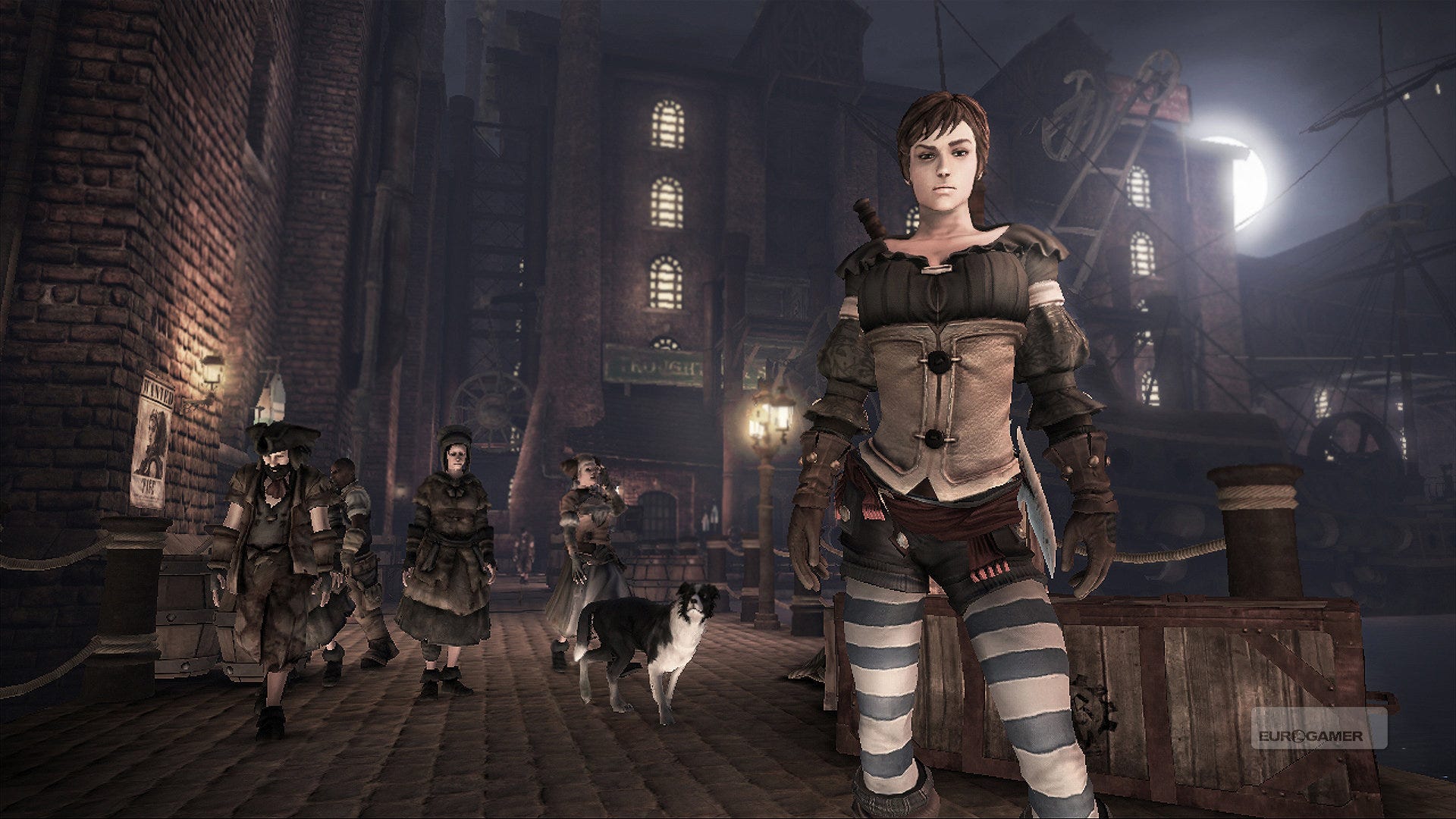
You're still escorted everywhere by your trusty dog, who sniffs out treasure and dig spots.

Fortunately, it doesn't take long to remember something important that all of the above overlooks. Fable was always competently if not spectacularly constructed, but its quality wasn't really in its systems or visuals, it was in the fabric of the land, and while Fable III is not so different to Fable II in many respects, it still has something that sets it apart from the traditional RPGs it agitates to transcend: it has Albion. And it's good to be back in Albion.

Albion! Where everything you touch turns to fun. Where a mission to help three wizards rescue a princess turns into an extended, subversive piss-take of game development, without ever dropping out of character. Where you find yourself pulled into the lost manuscript of a famous playwright's last production and forced to act out key scenes to demonstrate your worth to his ghost. Where a little girl says, "Are we there yet?" on one side of a loading screen and, "Are we there yet NOW?" on the other. Where there is an Achievement for making a royal declaration while dressed as a chicken.

Serious events in your character's life are still only serious events if they're nailed to the main thread of the story. Whatever you choose to do outside that story will be treated with withering sarcasm or sent up for comedy value - side-mission reward screens mock your decision-making with metronomic reliability, while sex is still a punch-line rather than a tacky visual payoff to coax you into developing relationships with other characters.

Albion is also one of the few game worlds that operate successfully in the gap between the comforting, precise clockwork of a Legend of Zelda, where everything leads somewhere and none of your time will be wasted, and the jazzy emergence of Fallout, a game which is whatever you make of it once you step away from the path.

Sure, you disobey Albion's breadcrumb trail first and foremost to make sure you aren't missing anything, but only part of you is concerned about goods and bounty; the rest of you is exploring, because Albion has riddles, vaults, unmarked pathways into icy caverns full of treasure and peril, enchanted creatures and surprising discoveries. It taps into your imagination. You're a child playing in the woods.

There's still a bit of RPG paraphernalia to contend with, but you can tell the developers long to do away with this sort of thing entirely. Cleese's walk-in wardrobe and inventory is a nice distraction from the monotony of menu screens, but the new Road to Rule, where you walk around upgrading weapons and abilities, doesn't really add anything. Fable III would work fine without an overt experience system; Fable IV will probably do exactly that.

It's all fun and games, then, but all the while you're plotting to overthrow your brother, Fable III is plotting to turn your world upside down. The section of the game where you go away, return and finally become king, and discover why your brother did so many horrible things - like encouraging Reaver, played to rakish perfection again by Stephen Fry, to employ child labour in Bowerstone Industrial - is as clever and compelling a change of pace and tone as Fable II's excellent Spire sequence.

The flashes of inspiration don't dry up once you hit the throne, either - you can still go off and explore, and there's Reaver's delicious devil's advocacy to look forward to whenever you're petitioned to do something noble - at one point he suggests turning a homeless shelter into a brothel to fill the exchequer. So there's still a lot of fun to be had before the curtain falls on another generation in Albion.

2

Building a property empire means you have funds for trinkets and to pour into the treasury when things get real later on.

But once you have taken the throne, it turns out it isn't much fun breaking your promises or dooming your subjects, and it's very hard to find a credible alternative to these actions. Of course a monarch can't please everybody, but in trying to evolve beyond the pantomime dichotomy of good and evil elsewhere in Fable III, your time as king nearly breaks the game's internal consistency, and, coupled with a rather sad development at the end, means that for most players the journey will end on something of a double downer. Our advice? When you become king, take your time and drag things out for as long as possible.

Even if you are left slightly cold by events that follow, however, the chances are that you will be drawn back into Fable III before too long, whether it's because you want to play again with hindsight, or just because you want to explore. The irony of the breadcrumb trail, sometimes mocked for sparing you the difficulty of thinking, is that it's often harder to stay focused on it than it is to wander off and play. Everywhere you go you're tempted by the siren call of previously unnoticed footpaths, strange sights and eerie noises.

It may be messy and clunky from time to time along the way, but Fable III is only guilty of indulging its designers' whim at the expense of necessary polish, and in the royal scheme of things it's a crime you're happy to pardon. Many more RPGs will follow between now and whatever Lionhead does next with the series, but few if any will possess half as much heart, and most importantly, whatever else they have to offer, none will have Albion.

8 / 10

Read the Eurogamer.net scoring policy

Comments (190)

Comments for this article are now closed, but please feel free to continue chatting on the forum!

  • Loading...hold tight!