Here's a little insight into the world of games journalism for you. When previewing a game based on a presentation at a press event especially if that game is a sequel you can normally count the number of important pieces of information you need to convey on the fingers of one hand.
The rest of your word count will be fleshed out with writerly "impressions", historical context, jokes, quotes from the International Brand Manager, a contrived introduction and, if you're feeling brave, a little light analysis. Stick "We'll just have to see how things turn out when it's released later this year" on the end. Job done.
Things are going to be different with this preview of Rock Band 3. Apologies if it reads like a laundry list I had to be restrained from using bullet points but it's out in a couple of weeks and this is no time for fripperies.
That's because Rock Band 3 is an astonishingly feature-packed and comprehensive piece of software (and, for that matter, hardware). Harmonix, admitting Rock Band 2 was just "polish" and "we haven't done a series update since the first game", has thought of everything you could possibly want, and a few things you would never have dreamed of. It's spent three years putting the game together and more money on it than on any previous project. Rock Band 3 is immense. It is the όber music game.
I've wasted too many words already. We've got work to do.
Songs? There are 83 new ones on the disc, covering dadrock classics (Bohemian Rhapsody, Freebird), metal past and present (Slipknot, Dio) and a spot of pop dilettantism (Amy Winehouse, Roxette's The Look).
Rock Band 3 is backwards-compatible with the entire Rock Band library, supporting disc import from the two previous games and, of course, the store. That's 2000 songs at launch, then. Two thousand.
Bring on the Billy Joel back catalogue.
Instruments? The headlines are the new keyboard, the 100-button Pro guitar, the real guitar (yes, an actual functioning electric guitar that also works as a game controller), a Pro drum kit with three cymbals, MIDI instrument support, three-part vocal harmonies and compatibility with all legacy equipment ever released for Rock Band and its sire and rival, the Guitar Hero series. More on most of this later, but for now let's point out that 63 of the new songs feature a keyboard part and all of them support Pro mode.
What's Pro mode? In a way, it's what Harmonix has been striving for since it released Frequency almost a decade ago: a fusion of gaming and musicianship that teaches you how to play real instruments and actual musical parts. It discards the five-button shorthand of music games for full fingering and notation of guitar, bass and keyboard parts (naturally it has less impact on singing and drums).
This isn't quite as intimidating as it sounds. There are primers and tutorials included that teach basic techniques and are, Harmonix reckons, equivalent to "the first couple of weeks" of musical instrument lessons. Pro mode also has its own full difficulty scale, starting with a slow-paced Easy setting that only asks you to play some of the notes it's just that you'll have to play the notes, or chords, themselves.
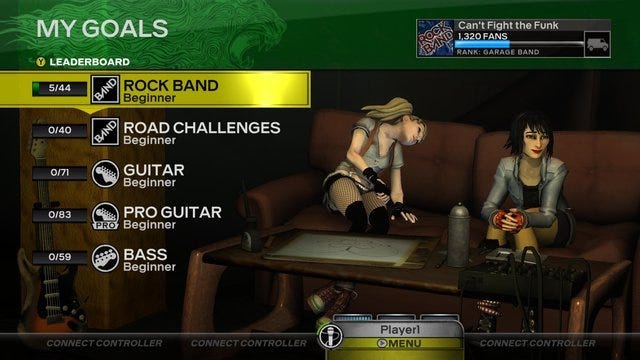
My Goals is a sort of build-your-own-career screen.
Pro mode effectively doubles the size of the game, offering completely different transcriptions and a discrete difficulty progression for each song. There's now a wide chasm of difficulty between, say, Normal Easy and Pro Hard, but players at both levels can still happily play and enjoy songs together.
Playing Pro means using the full two-octave range and semi-tones of the wireless, 25-key keyboard
(£70) put together by Rock Band's new hardware partner Mad Catz. On Normal, you just use five colour-coded keys. The full keyboard also has colour-coded sections to help you break down the detailed Pro notation.
Manufactured at the Roland factory, the keyboard's a light but solid little unit that can be placed on a stand (£25) or worn with the supplied strap, keytar-style. They keys are velocity-sensitive and have superb responsiveness and feel; there's also a pitch-bending touch-sensitive pad on the neck along with an overdrive button (or you can opt for a separate pedal).
It has a headphone socket and is a fully-functioning MIDI keyboard that can also be used with any standard music equipment or software. Conversely, after launch, you'll be able to purchase Mad Catz's £40 MIDI Pro Adapter to use your own MIDI keyboard with the game (or MIDI drum kit, or certain MIDI guitars). It's a small box with a belt clip and the appropriate console navigation buttons.
You'll need one to use the astonishing Fender Squire Stratocaster for Rock Band, due in early 2011 (price TBC). This handsome instrument is a normal-looking and fully-functioning electric guitar with invisible sensors in the fret board and pickups that track your fingering and allow it to be used as a MIDI instrument or Rock Band controller.
Early (or less rich) Pro guitarists will need Mad Catz's Fender Mustang Pro guitar (£125), a somewhat bizarre hybrid of controller, MIDI instrument and real guitar. The 102 buttons down the neck correspond to every possible string/fret fingering, while the strum switch is replaced by a "string box" with six nylon-coated, stainless-steel strings for picking and strumming. It's heavier, with a superior finish, than a standard Rock Band guitar.
The frets are numbered, with the numbers appearing above the appropriate strings in the on-screen readout to show you where to finger and what to pluck. Since this is a reversal of the normal Rock Band display the channels now showing you what to do with your right hand rather than your left it's absolutely head-scrambling at first, especially when you need to ensure both hands are on the right "string" and translate a number to a hand position at the same time.
Nonetheless, this complete guitar novice was able to go from hopeless confusion to hitting every note on a Pro Easy bass part in the course of one song. I had a few piano lessons as a boy, so the Pro keyboard ought to have been easier to master, but even seasoned musicians will take a while to adjust to the speed and idiosyncratic notation of the screen readouts which, given Rock Band 3 can now accommodate seven musicians (drums, keyboard, guitar, bass and three vocalists), are rather cramped.
At this point you start to worry that Rock Band 3, with its 2000 songs, seven players, five instruments, two modes, multiple difficulties and new-found educational manifesto, could get very unwieldy to use and lose sight of its roots as a party game. It all sounds a bit fussy and hobbyist. That's why the structural and interface improvements are perhaps the most quietly impressive part of this huge undertaking.
Most crucial is the "overshell" interface, which gives every player (except backing singers) their own small pop-up menu which can be used at any time and independently of the others to change settings and pick options, eliminating what Harmonix calls the traditional "tug of war" for control.
In order to deal with the ballooning song library, there's a song filter that lets you search by a wide range of criteria: genre, decade, length, difficulty, family-friendliness, rating, whether it has a keyboard part and so on.
You can compile your own set lists on the console or at the game's website and send them to yourself or your friends, with challenges attached. Or you can set up a filter and hit Party Shuffle, which makes a cycling random playlist from the selected tracks. No Fail mode is always instantly accessible.
More on Rock Band 3
-
Interview: Can Rock Band Save Music Games?
Harmonix on making keyboards sexy and crafting its defining statement.
-
Review: Rock Band 3
Finished symphony.
-
News: Licences for old Rock Band DLC songs are expiring so they're disappearing
Some of the DLC is nearly six years old.
-
Video: Rock Band 3's Pro Guitar mode
Fender bender.
-
Screenshots: Rock Band 3
Rather than offering a single, linear career mode to play through, Rock Band 3 has a sort of persistent meta-career in which you "level up" by collecting fans for completing a huge range of goals and challenges.
The Road Challenges are like shorter versions of the old Rock Band career. They're "beat Rock Band in a night" party experiences themed around venues, songs and archetypal rock stories, and linked by cute cinematic vignettes starring your own bands and avatars (made with the vastly improved character customisation system). They might last an hour, or four.
The meat of the long-term game will be in choosing your own Goals (Rock Band 3's own achievement system) to pursue, however. These might be structured campaigns leading you through each instrument, say, and the game will automatically construct set lists for you based on what you haven't achieved yet.
That's the remarkable thing about Rock Band 3. There are so many ways to play it, but it seems so comprehensive and flexible that it can always and instantly shape itself to your needs: whether that's to embark on a long, solo journey of instrument mastery, blast through a narrative rock fantasy with friends or simply party like it's 1990-1999.
As hour-long game presentations go this was a head-spinning one, and although the Harmonix rep is too modest to say it, Rock Band 3 looks like the ultimate music game. Can it live up to that promise? We'll just have to wait and see... but I know what I'm betting on.
Rock Band 3 is released on October 29th for PS3 and Xbox 360. A Wii version will also be available.
