Despite some notable successes, it still doesn't feel like RTS has made a clean transition from PC to console. Bridging the gulf between input methods has always been a massive challenge. The nature of control offered by the keyboard-and-mouse combo is pretty much hardwired into the genre's DNA, and that's something of a ball and chain.
The comfortable remapping of even that simplest of commands - group unit selection - to the welcoming arms of the twin-stick joypad has enjoyed varying degrees of success down the years. Staggeringly, it still feels like nobody's really cracked the interface problem. At least, not well enough to offer a properly fluid sense of battlefield control, where the creation and management of vast armies is a breeze and the very process of waging war isn't a constant barrier to the desired result.
That's your opponent's job, after all. Until some clever-clogs has a mental cabinet-reshuffle on the matter, and builds the experience around the tools, it's going to carry on being a sticky issue.
Reshuffle ahoy! And it's high time. You barely notice RUSE's physical interface at all. Just seconds in, you're flitting around WWII maps in all their richly-detailed glory, with a sexy abandon unbecoming a high-ranking military figure. With zoom and pan on the right stick, and movement on the left, it's as comfy and familiar as an FPS, and gives you an airy sense of freedom that, frankly, is a first for console RTS.
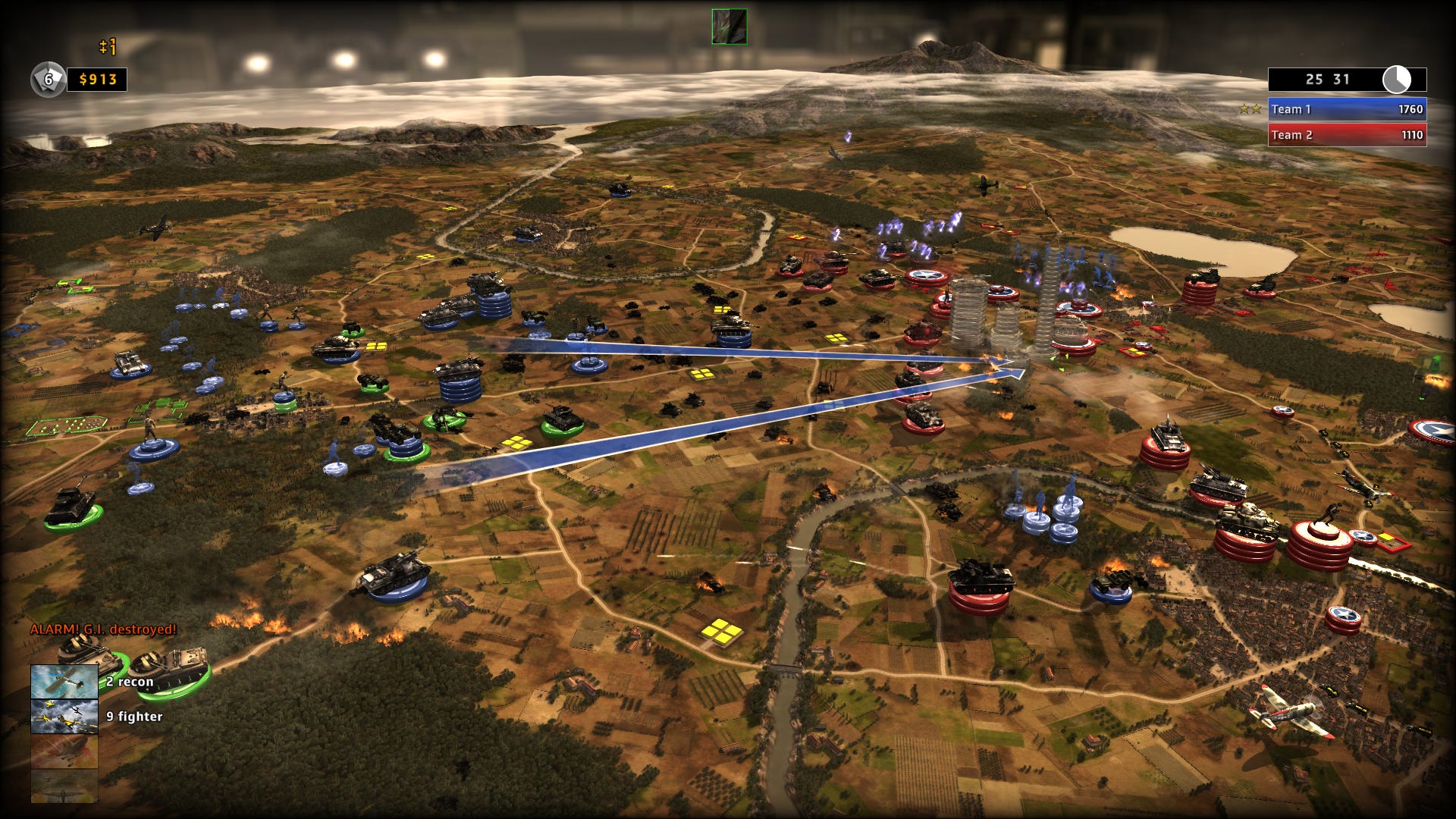
Movement arrows indicate orders you've given, but using the Decryption ruse, your enemy's move-orders are also revealed.
Point the camera near a unit and the engine offers you the choice of selecting it, or all units of that type in the area. This makes pernickity precision, the preserve of the mouse, no kind of issue. After a little time spent with the PC beta as well, it's plain to see that the PC version suffers not a jot from this joypad-friendly interface.
Zoom the camera out a bit and the visual representation of those units changes from individual models to chip-stacks which describe light, heavy and air units with their differing size and shape. Zoom out further and it bundles these chips together into pleasing mega-stacks, which can be ordered to move as a whole.
Issuing mass-movement commands, therefore, is more about rescaling your viewpoint. With a single swipe of the thumb you've a commanding view of the distribution of arms across the entire map. It's empowering. It's easy.
And the nuances of the engine prove that accessibility can be about intelligent design and user-friendliness, and not, as the rest of RUSE's experience happily reiterates, about dumbing down the gameplay and flashing some boob. Developer Eugen's IRISZOOM engine gives you first-class battlefield intelligence.
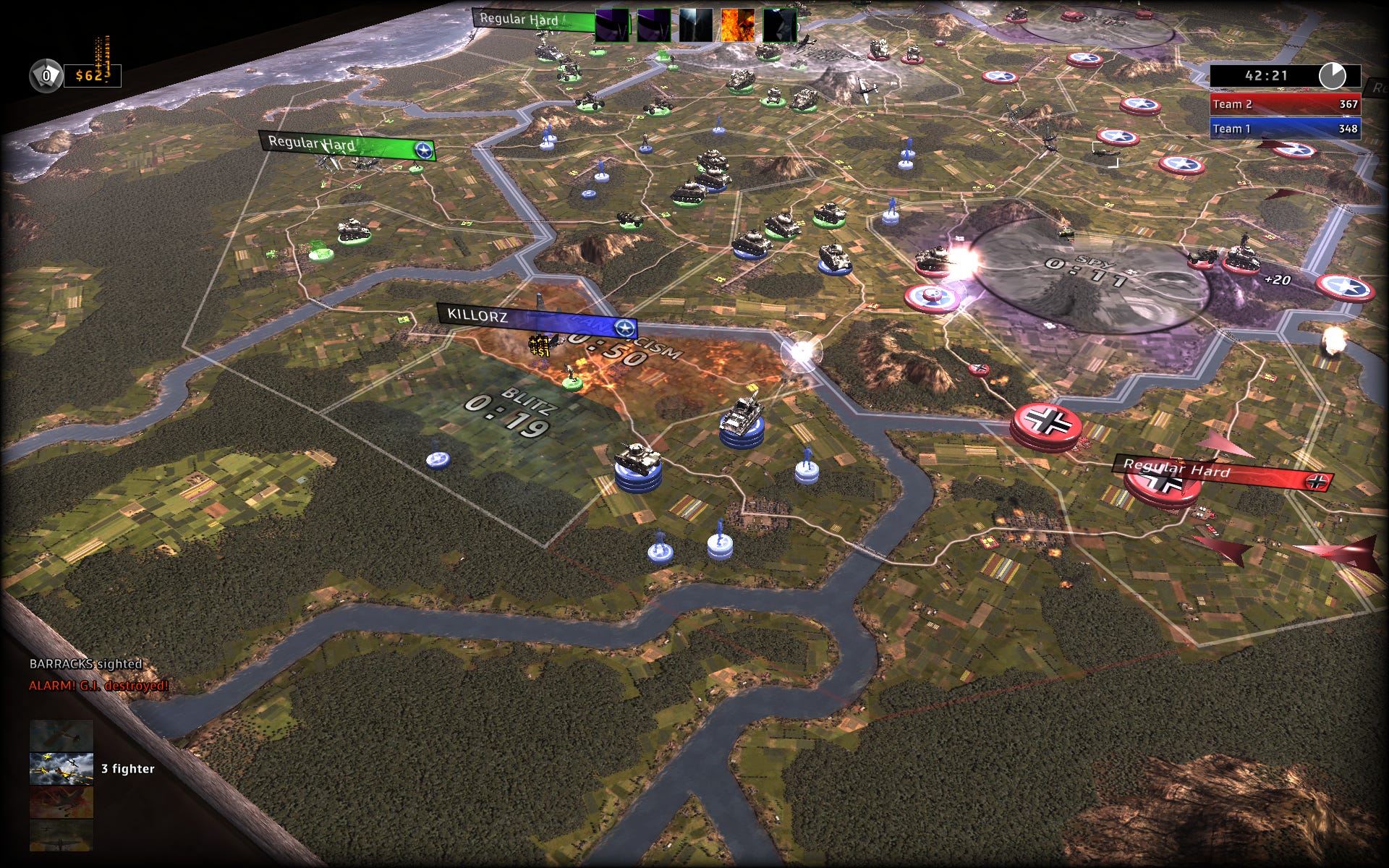
Zoom out to a high-level, and you get a pleasing tabletop view of the theatre. It's a tremendously scalable engine.
Or does it? Not if your opponent has a say. Which of course, he does, the blighter. While at any point you can see your enemy's entire force deployment in the form of mobile stacks, the nature of the units themselves is hidden from you until you get a unit within line-of-sight. This important distinction between generalities and details, and ultimately the exploitation of that distinction, forms the basis of RUSE's way of war, and explains the thinking behind its title.
Each battlefield is delineated into a number of sectors and at any stage you can employ one of ten distinct 'ruses' in any given sector. These ruses improve your battlefield intelligence or disrupt your opponent's, and can swing the balance of a conflict quite considerably.
Radio Silence, for example, hides all your units in a sector from your opponent's strategic view, though they'll suddenly appear if he brings a unit into line-of-sight. The Spy ruse reveals the exact nature of enemy unit-stacks in an area so you can see precisely what flavour of armour is in that heavy-unit stack, and deploy your response accordingly.
Reverted Intel, a personal favourite, is hilarious - it simply disguises your light units as heavy and your heavy units as light. See that stack of relatively harmless infantrymen? Surprise... They're all Tiger Tanks!
In practice, these ruses create a fog of war that shrouds intelligence and affects decision-making. They enable you to deceive your opponent into crippling actions which can disrupt his carefully ordered deployment, and create opportunities for your own forces. The scope for coming up with favoured personal strategies, and reacting in specific way to specific opponents, is huge, and I'll be delighted to see these strategies evolve as players get to grips with the game.
Woven into this cloak-and-dagger framework are the standard pre-requisites of RTS: base building, resource management, and the timeless rock-paper-scissors of unit differentiation. The single-player campaign kicks off during the Africa conflict, and sees you barrelling around the arid flatlands from a allied perspective, performing hit-and-run strikes on German positions, and holding the line when the Panzers reply.
The game teaches you how to use your units in a pretty effortless fashion, and while the first four or five missions are clearly tutorial, they feature enough intrigue and scope for experimentation to not really feel like it.
Deploying decoy units and structures is a great way to draw out your enemy's forces, and place them where you want them.
Infantry, the backbone of any army, is at once terribly brittle and massively useful... When employed correctly. Scamper a few platoons through open countryside and they're horribly weak, but secrete them in a treeline where tanks fear to tread and they can perform ambushes which strike for triple damage.
They're also the only units that can capture enemy structures, such as armour factories and airbases, making them essential support for the war effort throughout the game.
Elsewhere in the tech tree, there are enough shade-of-grey variations to support any strategy. Long-range strikers may prefer to plump for air-support and artillery, and porcupine their home structures with tank-hunters and hidden troops fortifying nearby towns and forests.
Likewise, there's scope for huge Kursk-style armoured divisions sweeping across the map, if that floats your boat. Although to some extent your choice of roster is dictated by terrain; spotting natural choke-points for troops to lie in ambush, and letting geography help you decide the best place to deny flanks, is all part of the equation.
If it's not already plain, I've high hopes for RUSE. I'm not too fussed by the rubbery, bargain-basement CG and the throwaway rise-to-military-greatness storyline that links the missions. But the interface is slick and approachable, it shows innovation in the areas where it's most needed, and the promise of tense multiplayer bouts, peppered with troughs of deep dismay and peaks of blazing glory, is pretty compelling. Let's hope it's not all some kind of... Ruse.
