Version tested: Wii
Two words strike fear and loathing into my heart in the world of gaming: light puzzle. Just like some people can't read maps (like me), and some can't roll their tongues (can't do that either, actually), I absolutely, completely cannot fathom light puzzles. My brain is completely incapable of processing such esoteric concepts as angles of reflection, and every single time a light puzzle crops up in a game I'm reduced to a helpless, gibbering mess in front of my television whilst my brain tries to escape my head from sheer embarrassment at my complete and utter spatial incompetence. Usually I have to call someone up and get them to come over and do it for me. It's terrible.
I admit this to you because Zack & Wiki has a light puzzle quite early on in the game, and I had to go through this entire mortifying charade before I could progress. I've hi-jacked airships with ease in this game, figured out fiendish item-based puzzles on the first attempt, pieced together complex machinery, fooled big scary monsters, tamed baby dragons and used a Wiimote in more ways that I thought it was capable of - but present me with anything involving mirrors and the strategic placement thereof, and I'm as hopeless as someone's dad trying to play Guitar Hero at Christmas. While pissed.
Zack & Wiki follows a long tradition of excellent pirate-themed adventure games, and a not-so-long tradition of fantastically intuitive Wii games. It resurrects the point-and-click adventure in a modern, universally appealing, tactile new form, divided up into non-threatening chunks of gently demanding to outright fiendish item-based puzzle-solving. You take control of wannabe pirate Zack and his monkey companion Wiki in a hunt for the 21 bits of treasure (plus plenty more secret bits) that comprise the legendary pirate Barbaros. It combines baffling variety in its puzzles with gorgeous visuals, and along with MySims and Trauma Centre, it's a compelling reason to own a Wii for those of us who are completely sick of mini-games and ports.
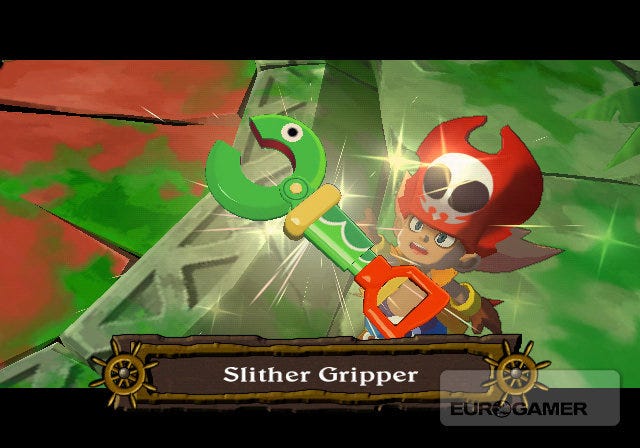
A thing-longener! Yay!
The bright, clean visual style is reminiscent of One Piece - not just in its cartoonishness and happy buccaneering theme, but also in its slapstick visual humour. It's funny and likeable, especially during its comedy death sequences, which see Zack squished by giant rocks, impaled on spikes and burned to a crisp by angry mother dragons. This is actually the prettiest game I've yet seen on the Wii, except perhaps Mario Galaxy; like Wind Waker, it encompasses everything in its style so that the entire game look consistent and beautifully well-designed.
Zack & Wiki divides its world up into separate little puzzle scenarios, which can take anything from ten minutes to an hour or two depending on how fast you figure them out. They range from ridiculous to perilous, enjoyable to absolutely inspired, and gloriously, they barely ever repeat themselves - each scenario is unique, and finds a new way to unlock the instinctual fun at the heart of the Wii control system. In one, you're playing tennis with fireballs in order to get an elaborate, self-constructed see-saw system to operate - in the next, you're feeling around inside magic paintings with the Wiimote to grab helpful items from within.
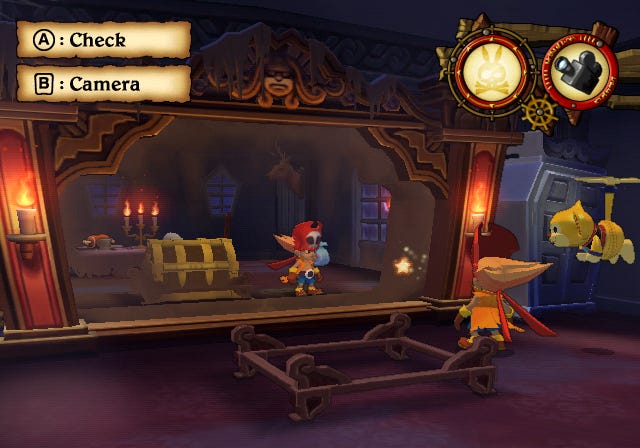
This mirror-based puzzle involves picking up an incessantly ringing telephone and listening to eerie noises emanate from the Wiimote. It's also FIENDISH.
The whole basis of Zack & Wiki is the use of shiny, shiny items. They're the key to every puzzle, and the source of many of its genius moments. Each scenario is full of contraptions, levers and cranks, all of which are Wiimote-operated - sometimes it's as simple as pulling down on a lever or turning a key in a lock, but more often you'll be twisting pieces around to fit into the mould of a giant key or complex machine, or pouring out measurements from beakers to make a potion.
On top of that, most living things - snakes, bats, moles, boars, evil pirate goons - can be turned into items by ringing Zack's bell with a shake of the nunchuck. At first the problems are simple - itemise a centipede to get a saw, use it to saw down an obstacle with a little Wiimote enthusiasm, bask in your incredible cleverness - but later on in the game, turning creatures into items and back into creatures again at appropriate times form the basis of Zack & Wiki's most fiendish puzzles.
The excellent thing about Zack & Wiki's puzzle design is that although it can take hours to figure a scenario out, carrying the right actions out in order once you know what you're doing rarely takes more than a minute or two. It means that dying isn't much of an inconvenience, which perhaps allows Zack & Wiki to be a little generous with its humourous death sequences. Nine times out of ten you'll die for a good reason - like misguidedly poking a monster fish with the pointy end of a broom - but occasionally it throws a collapsing bridge or unpredictable mishap into the mix, just for a bit of fun.
Only during the one-off boss battles does Zack & Wiki deviate from this winning, frustration-free formula, forcing you to repeat the whole battle again (god, remember when playing entire levels again fifty-eight times was standard?). Helpfully, though, the inconvenience of dying is further alleviated by platinum tickets, which save you running through the first minute of puzzle/boss battle again by reviving you a little before your most recent demise. There's also a just-unambiguous-enough hint system to help prevent frustration (unless it's a F***ING LIGHT PUZZLE); the fact that you have to pay for it prevents people from cheating their way through, but it's an absolute lifeline when you're genuinely stuck.
Note to developers: MORE OF THIS PLEASE.
It's in the combination of the control system and the puzzle design that this game's genius lies. It's more in tune with the Wii control system than anything else except Wii Sports, and Zack & Wiki's application of the technology exceeds even Nintendo's own in breadth and imagination. Whether you're turning a key, answering a ringing telephone or rocking a baby dragon to sleep, it's always completely instinctive and weirdly exciting. The joy is in working out what to do with the various mysterious things placed around you in each puzzle - it's like being presented with a brand new playset every level, and as the scenario begins to fall into place there's a glorious sense of things coming together. It's an absolute joy to play, almost every second. There's more than fifty hours' worth of sheer delight in this fifteen-hour game.
Zack & Wiki actually goes on a lot longer than you expect it to at the start, which is a welcome surprise, and absolutely none of it is padding. Each level brings its own, very specific challenges, its own unique playset of items and contraptions to play about with. There is considerable replay value, too, in finding all the hidden Capcom-themed treasures or trying for a perfect run of previous levels for a ludicrous high-score; rarely does an adventure game offer scope for a second playthrough.
These diagrams aren't even necessary. It's always so wonderfully obvious.
I should probably point out amongst all this praise that like all puzzle-based adventure games, Zack & Wiki requires some patience and occasional trial-and-error. If you're a Halo-addicted twitch gamer with no mind for puzzles - although as a Wii owner, you probably aren't - you'll find enjoying this genre rather hard, but frankly I've little sympathy for you. It's occasionally repetitive when you fail a scenario and run out of revive tickets, but only very occasionally - the genius puzzle design prevents tiresome re-treading for the vast majority of the time. Usually the levels are so enjoyable that you won't mind anyway; you'll enjoy basking in your own perceived intellect as you zip through puzzles that had you stumped half an hour ago, and have fun bashing, twisting, cranking and sawing things with the Wiimote one more time.
Far and away the best original IP on the Wii, Zack & Wiki is a compelling reason to own this console. Its superb puzzle design and ingenious mix of humour, cleverness and the occasional bout of trial-and-error recall the best adventure games in history, and yet its gorgeous cartoonish looks and innovative control make it refreshingly modern. And unlike most Wii games, the novelty and appeal of the control system stays beguilingly strong the entire way through.
I can even forgive it for having a light puzzle.
8 / 10
