"Was it a tough decision?" echoes Blizzard's chief operating officer Paul Sams. "I can tell you that me, the business guy, the operations guy... We were going through the whole process before we knew all the reasons why, and I was sitting there going, oh my God, really? Can we do that? Should we do that?"
Sams is a smooth operator and a die-hard Blizzard loyalist. He trusts his developers to know what's best for their games and supports their decisions unquestioningly, and he's not an easy man to ruffle. But even he was shocked at what the World of Warcraft team proposed to do with the game's third expansion. Namely: take the planet's most popular online world, tear it up, and start again.
As well as raising the level cap to 85, adding two new races, seven new zones, a new profession, a new character advancement track, three player-versus-player Battlegrounds and a new way to play them, a radical overhaul of the game's stats system and a major social initiative to revitalise guilds with customisation and advancement - as well as all that, World of Warcraft: Cataclysm will revamp every single zone in the original, pre-expansion game. The experience of levelling from 1 to 60 will be changed forever, flowing through remodelled zones in a different order, offering new quests and storylines, better rewards, and retuned dungeons.
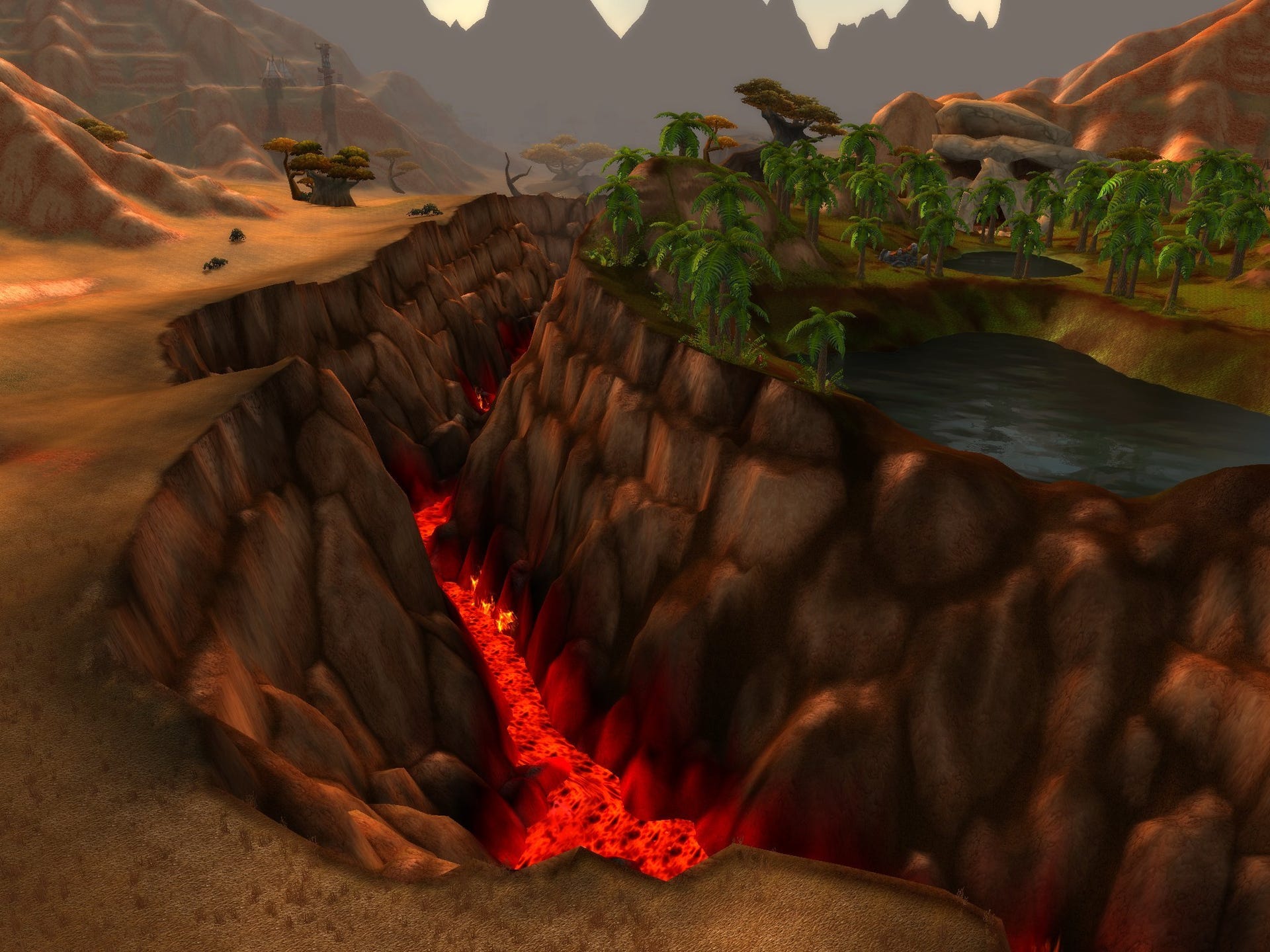
The Barrens: broken.
It's a mammoth undertaking, and a brave one. But as much as it seems unthinkable the first minute, it seems like a no-brainer the next. Five years on, the epic slog through the continents of Kalimdor and the Eastern Kingdoms stands as a barrier to adventures in Outland and Northrend that have far outstripped them in variety and quality. They had to go back to the drawing board. Blizzard's vice president of game design, Rob Pardo, shows no sign of his colleague's qualms. "I think we could have done it a long time ago," he shrugs. "Well, if we're waving our magic production wand, then a long time ago."
A happy catastrophe
Blizzard needed an agent for all this change, and it comes in the form of Cataclysm's star villain: Deathwing. A dragon lord who has lived too long in the bowels of the earth and been driven mad by the whispers of the Old Gods, he's so deranged that he's been welded together with iron plates to stop his own uncontrolled power ripping himself apart. In Cataclysm, unable to contain his desire to subjugate all life, he tears through the matter of Azeroth and erupts into the world, causing a global disaster of volcanoes, tsunamis and giant molten rifts.
The disaster leaves its mark on the geography and narrative of familiar areas: the huge Barrens plains are split in two by a yawning crevice, the arid wasteland of Desolace is flooded and life returns to it, the Night Elf town of Auberdine in Darkshore is destroyed, and the faces of capital cities like Orgrimmar and Undercity are changed forever. You'll be able to use flying mounts everywhere across the old world for the first time, including these cities, although we don't know from what level.
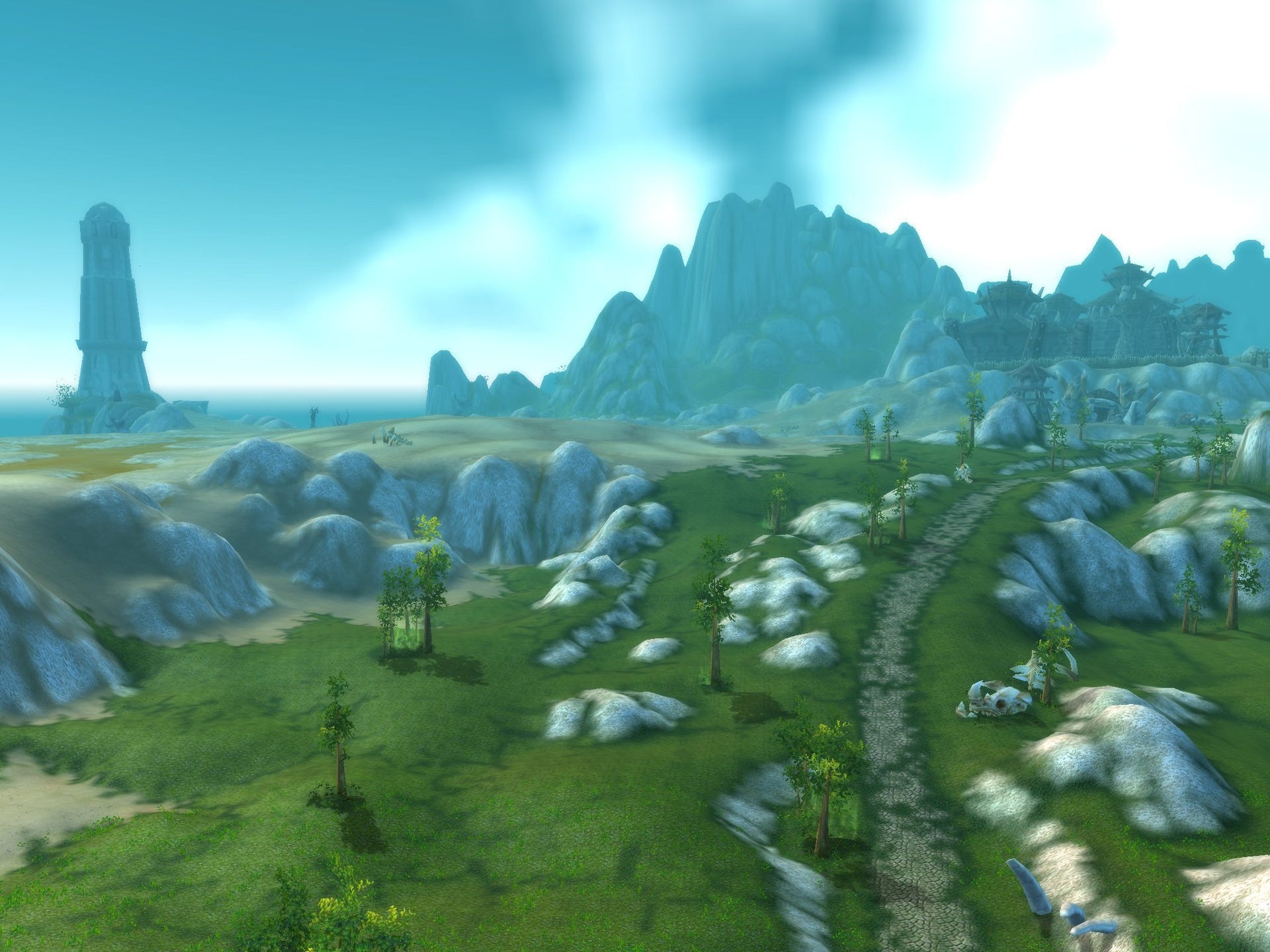
Desolace: reborn.
Some zones will be disrupted more than others, probably depending on how much Blizzard felt they needed work - the relatively polished human lands of Elwynn and Westfall, for example, will largely be left to their rural idyll. But all will see revamped questing, employing the dramatic techniques, varied gameplay and phasing technology used to such famous effect in Wrath of the Lich King's introduction to the Death Knight class. "After doing the Death Knight starting experience, we really felt like, wow, this should be the template for what we try to do with all our content in the future," says lead designer Tom Chilton. "We want to apply those lessons to 1-60 and make it feel cohesive. As people go through our 1-60 content now I think it does feel like a bunch of random stuff that all got put in the same place."
The zones will also be re-ordered and their level bands changed. Mid-level Azshara becomes a low-level zone for the Goblin race, the high-level Plaguelands are demoted to the mid-levels and so on, as Blizzard seeks a new flow for adventuring that, currently, gets frustratingly fractured from level 30 or so onwards. The classic dungeons will also get some attention: "Certainly some of those will change or be improved, as it comes to spawning or scripting, boss encounters, that kind of stuff," says Chilton. "I don't expect them to physically change very much."
For a few levels more
The Horde has an aggressive new presence in Ashenvale.
Deathwing's rude intrusion into Azeroth won't just change what you know. His passing has opened up five new zones that will take players from 80 to 85 (the shorter five-level step will allow Blizzard to concentrate not just on the old-world revamp, says Chilton, but also more endgame content at launch - a deliberate skew away from levelling and towards having more to do at maximum level). The ruptures he creates open pathways to the elemental planes created by the Titans to contain the primordial Elementals, who now emerge to war with each other and life on Azeroth.
Mount Hyjal is now a staging post for an invasion of fire Elementals led by the fire god Ragnaros, a returning raid boss who featured in the classic Molten Core raid. The Maelstrom whirlpool in the centre of Azeroth's ocean sucks players down into the Sunken City, a ruined Atlantis of the Naga civilisation, now overrun by bright corals and rifts opening onto the elemental plane of water, the Abyssal Maw. This submerged zone will feature special underwater mounts for transport, and will allow combat on the sea floor just as on land, although you'll be able to swim up from it at any point.
These two level 78-82 areas lead to the "Dragonblight of this expansion", Deepholm. A vast subterranean cavern located in the elemental plane of Earth, this is Deathwing's domain, overrun with his Twilight's Hammer cultists and delivering much of his story. After Deepholm, you've two options to take you to level 85. Uldum, an Egyptian-style delta that had been hidden from view by the Titans until the cataclysm destroyed one of their cloaking machines, is rumoured to hold a super-weapon and is home to a new race of stone cat-people, the Tol'vir. The Twilight Highlands, east of the Wetlands, is a mountainous area that features port links for both Horde and Alliance, and Grim Batol, the great city which Deathwing has seized for his own.
Grim Batol will house one each of the four raids and eight dungeons planned for Cataclysm. Alongside new locations like Uldum, the Abyssal Maw and the mysterious Skywall, there's a nostalgic theme: Blackrock Caverns, a new five-man dungeon, is located in the old instance hub Blackrock Spire, and the Firelands, a raid on the elemental plane of fire, sees players take their second pop at Ragnaros. Nostalgia will reach overload, though, in the new level 85 Heroic versions of two much-loved low-level instances; the spooky ghost-train of Shadowfang Keep and uproarious romp through the Deadmines will return, with all-new fights and creatures.
There's no change to the philosophy of how Blizzard makes instances though, Chilton declaring himself happy with the status quo of normal and Heroic five-player runs, and raids for groups of 10 or 25. "We also have our Hard Mode philosophy better developed now, and we plan to have that right out of the gates with the Cataclysm content so that... we don't have the problem we had with Lich King where a lot of people just found Naxxramas too easy," he says.
Darkshore is getting one of the more extensive remakes.
On the player-versus-player side, Cataclysm promises three new Battlegrounds at launch, as well as Tol Barad, an open PvP zone much like Lich King's Wintergrasp, with timed control-point battles for access to a prison containing a raid boss. When the battle's not up, Tol Barad will serve as a major daily quest hub for both factions. More important than any of this new content, though, is a new system: rated Battlegrounds, which will bring Arena-style ranked competition, old-school Honor titles and top-tier rewards to what is currently the more casual end of WOW's PvP.
Race relations
A reboot of the entire old world of Azeroth is probably reason enough to consider trying WOW if you haven't before, or re-rolling a new character, but Blizzard's seen fit to sweeten the pot further with Cataclysm. You get new combinations of race and class to try out that weren't possible previously: Troll Druid, Human and Undead Hunter, Dwarf Shaman, Blood Elf Warrior, Gnome Priest, the ridiculous Tauren Paladin (or "holy cow" as Chilton puts it) and more. And you get two new races - Goblins for the Horde, and Worgen for the Alliance.
Blackrock's back.
New races are a chance for Blizzard to stir new flavours into the melting pot for each side. The idea is that the Goblins, diminutive tinkerers like the Gnomes, will bring some comic relief to the warlike Horde, while the Worgen werewolves will give the whitebread Alliance something edgy and monstrous and conflicted, with a Wolverine vibe. They're also a chance to tell new stories with the newfound narrative muscle of post-Lich King WOW, and necessarily so, because Blizzard has some explaining to do in both cases. Most Goblins NPCs are faction-neutral (and will remain so), preferring profit to war, so the reasons for the specific cartel of the player Goblins joining the Horde need to be laid out - while the Worgen are traditionally evil.
The level six-to-eight sections of the starting areas we get to play at BlizzCon provide some answers, but not all. After the Cataclysm, the Bilgewater Goblins find themselves shipwrecked alongside an unhappy crew of Orcs on the Lost Isle - a land that time forgot, with dinosaurs, pygmies, mischievous monkeys and man-eating plants all presented in the rich, saturated colours of a Mario Sunshine. Helping the Orcs out - riding panthers one minute, scything through forests of plants with a whirling chain of death the next - you discover Alliance spies on the island, and in a shock twist find that they've taken the Orc chief Thrall captive, and liberate him.
A glimpse in the Abyssal Maw.
A level-six Worgen wakes up in stocks and on the point of execution. The human land of Gilneas has succumbed to the Worgen curse, but for some reason the transformed creatures remain humane, and you end up helping your captors and former neighbours repel an invasion of Forsaken Undead. Once again, there are plenty of set-pieces and varied, comical quests as you blow up Abominations by planting barrels of explosives on their heads and do chores for an old lady, while the Cataclysm hits midway through, changing the coastline of the zone. WOW's cheerful relationship with anachronism has allowed Blizzard to go full-on Victorian Gothic with Gilneas - it's all stove-pipe hats, cutlasses and gaslight. Both episodes follow the Death Knight experience formula to a tee, albeit with a lighter touch; they're jolly, fast-paced and the quests are studded with variety and surprisingly light on straight combat.
Goblins will be familiar to any WOW player, and they've got plenty of charisma, but it's their eye-popping racial abilities that will attract - a rocket belt that jumps you forward and shoots missiles, the ability to access the bank remotely every 30 minutes, and always getting the best cash discount from vendors. Oh, and a mount that's basically a hot rod. The Worgen have a dash skill, can change into human form at will (but only out of combat), and have a bonus to skinning. They're loping creatures with exaggerated animation, and look fantastically menacing in high-level armour.
Less is more
One aspect of Cataclysm that Blizzard didn't mention at the first unveiling ended up causing the greatest uproar at BlizzCon. There's going to be a sweeping change to the way stats on items work, aimed at eradicating many lesser stats - mana regeneration, spell power, attack power, armour penetration and even defence will all be binned - and reassigning their benefits to core stats like spirit, intellect and agility, or to the talent trees. "We want to be able to add more depth and add more stuff to World of Warcraft, but it's really difficult to do that without at the same time removing some of the needless complexity," Chilton explains.
"So what we've done is we've taken a look at the game and decided what's working and what's not really working, like we're doing all the time, but we're doing it very aggressively. And we've come away with things like - do we really need the two-hand sword skill, for example? The actual skilling-up process of just hitting a mob over and over, it doesn't seem very interesting. If it's not adding much to the game then it's just making the game needlessly complex. Or we have Spirit and mana [regeneration], and they're both kind of doing the same thing, but you sort of have to be a mathematician to know which one you should have for your character."
Goblins have all three cloth-wearing classes.
So it's not just in questing and zone design the Blizzard is taking out the trash. World of Warcraft is getting a truly deep overhaul in Cataclysm. Talent trees are getting pruned too; despite the five new levels they're not extending, and talents are being simplified, with many of their benefits ploughed into a new Mastery rating for each tree. Two classes also get big redesigns: Hunters lose mana and gain focus, a fast-recharging resource similar to Rogue energy, while Warlocks' soul shards are now spell-amplifying charges that regenerate out of combat.
All this simplification makes room for more depth elsewhere, and this will be delivered in the new character progression track, the Paths of the Titans. These Paths are completely independent of character class, and they're intended to provide satisfying advancement at maximum level away from the slow percentage gains of gear progression, with new talent-like skills being created by crafting and questing for Titan cults. The new Archaeology gathering profession - which all players can learn, like cooking or first aid - will feed into this, after allowing players to get utility and vanity items at lower levels.
These changes are the muddiest, most contentious, and hardest to read of what Blizzard is proposing for Cataclysm. But the company's willingness to remake its basic systems and even redesign a class, the Hunter, at the most fundamental level this late in WOW's life is thrilling, and the Paths - if they offer a genuine alternative to loot as a way to develop a max-level character - could change the endgame for good. But there's one final addition in Cataclysm that might have an even bigger impact on Warcraft life.
All for one and one for all
The Worgen starting zone, Gilneas.
Beyond the critical adjustments to raid sizes, Blizzard has mostly refrained from social engineering in World of Warcraft, choosing to let its community be shaped by its content. Cataclysm changes that with the introduction of guild levelling and customisation, a system that doesn't reward individuals but societies - and that rewards them for being societies, and for sticking together.
Guilds will advance through 20 levels, gaining XP from the actions of their players: level-ups, boss kills, Battleground and Arena wins, improvements in profession or reputation ranks. Each level awards a guild talent point, which might be spent on a mass resurrection or summoning skill, or an increase to gold drops - something that will be useful to everyone in the guild without making individuals more powerful. Guild XP also converts to guild currency, which can be used to buy rewards: vanity items like mounts with guild flags, profession plans to make Heirloom items (which can't be taken with you if you leave the guild), cheaper potions. There will be guild achievements, too.
Sit up and beg for mercy.
The system will tie into a new Looking for Guild interface where players can browse recruiting guilds' talents and achievements, see how they've defined themselves and whether they'd be a good fit. It's a huge step towards making it easier to find and join a guild, and more meaningful to do so, and a more lasting relationship when you do, because of the personal investment you'll have in its progress. Guilds make WOW more fun, and Cataclysm will make guilds more fun. It's a vital move for the future of the game.
But what, in this extraordinary expansion, isn't? Wrath of the Lich King stunned with its quality, but it was very conventional - 10 new levels, one new class - and by aiming at the maximum levels, it preached to the converted. Cataclysm shows that Blizzard's appetite for improving its game and expanding its audience even further isn't just undimmed by five years at the top, it's absolutely voracious. Any expectation that WOW might settle into a well-honed production line now looks ridiculous. This is nothing less than an attempt to remake an ageing MMO into a new game.
Can you do it, Mr. Sams? It's a very, very tall order, but we wouldn't ever bet against Blizzard. Should you, Mr. Sams? Without a shadow of a doubt.
