World of Goo Review

Squishing well.

Version tested: Wii

Little round blobs that form slightly elastic bonds when they're held up to one another. There's your core puzzle mechanic. From these beginnings, you can build a tower, or a bridge, or the means to escape from the belly of a giant creature and float, hearts filled with hope, on helium-filled eyeballs into outer space.

You simply cannot pin World of Goo down onto the wooden board and start methodically dissecting it with clear and concise scientific rationale. It has this horrible habit of coming back to life, jumping up and giving you a giant hug, then spinning on the spot until it gets dizzy and falling down giggling.

Eurogamer has of course previously (and magnificently) reviewed World of Goo when it was released on PC last year. Now it has reached WiiWare, and for good reason should be looked at all over again.

Goo begins by asking you to achieve small goals. The first level is about connecting the most basic Goo balls together to form a small tower, allowing the remaining blobs to run up the bonds of the structure and reach each level's goal, the exit pipe. "Weeeee!" they cry as they make their way inside it. The next level asks you to apply the same technique, but this time horizontally, using the Goo to create a short bridge. There's a minimum number of balls you need to save per level, but you're strongly encouraged to recover as many as you can beyond this target.
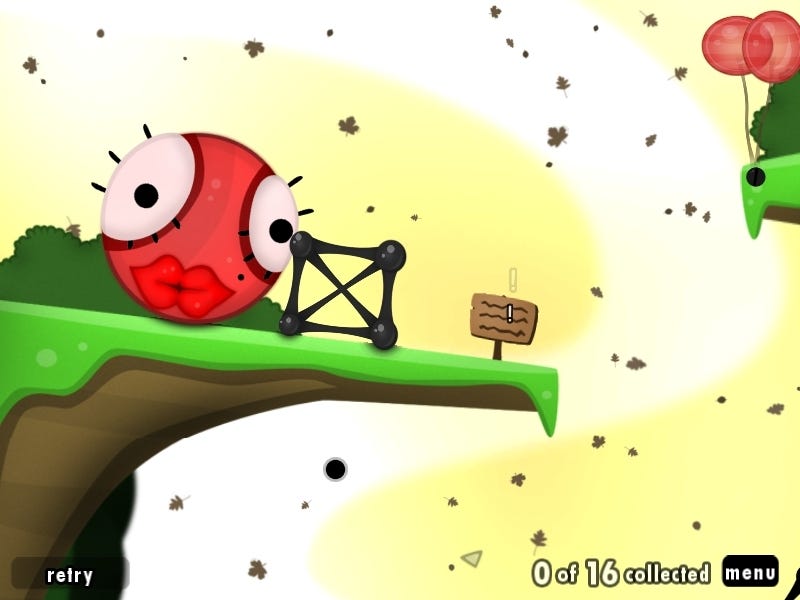
1

Why, she's beautiful!

It would have been perfectly reasonable for these approaches to be applied in increasingly imaginative and complex ways as you progressed through the game, resulting in something fantastic. What you're not expecting is to soon be working out how to suspend a chain of single-bonding droplet Goos via floating red balloons so they don't allow the heavy wind to buffer them into the spinning blades of a windmill.

Or stacking blinking, sentient stone blocks into precarious towers to provide support for a thin bridge. Or firing pull-back-and-release balls into suspended chains. Or arranging flammable Goos into elaborate fuses to explode robots. Or rolling giant Goo balls over suspension bridges into crushing machines.

In fact, before Chapter One (of four, plus an epilogue) ends, you'll encounter the first dramatically different approach. The Tumbler has the green Goos - those capable of forming three detachable bonds - in a revolving, octagonal room. As you build, your structure is constantly rolled over, making the build for the pipe a completely different experience.
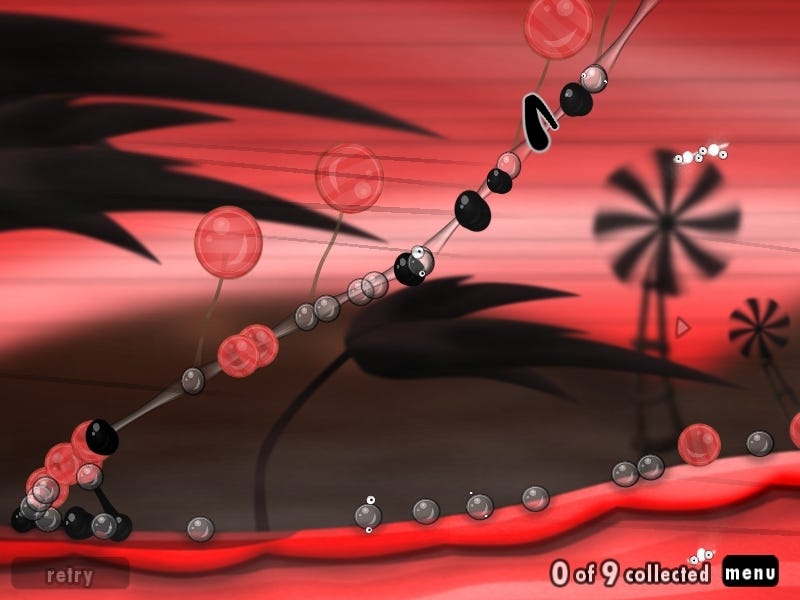
2

Blustery Day stands out as one of the most serene levels. Simple to complete, but the introduction of wind is wonderful.

It shows off the peculiarities of the elastic physics, the breaking points of the bonds, and teaches you useful tricks for later, very different puzzles. Figuring out how to get the pipe to hoover up the maximum number of Goo balls in a revolving room is a challenge worthy of a game on its own, and it's the only time you'll see it throughout. That's the key to why World of Goo is elevated so much higher than any of its peers: it is ceaselessly inspired, reinventing itself with a regularity unheard of. And this example is one of the simplest deviations the game makes from your initial expectations.

The puzzles are only one element of why World of Goo is such a ludicrous pleasure to play. The most important element, certainly, but much else is responsible for the idiotic grins on the people who sit down to play it.

The cartoon world has been compared to Tim Burton's style a great deal, and it's remarkably appropriate. However, Goo replaces Burton's gothic edge with something more emotive. It's less sinister, and more fragile. At first glance it appears entirely buoyant and happy, but there is a constant underlying bleakness as the chapters' oblique stories suggest struggles of the under-classes, and the crushing oppression of big business, and the temporal nature of beauty. Although you may be pleased to know that you can let these elements slide over you, and just stare at how remarkably pretty it is and focus on enjoying the puzzle solving.

The sound is another stellar achievement. From the gorgeous chirrups and gasps the Goo balls make (a splendidly clever means of helping you differentiate different types when things get hectic), to the swelling, evocative music, it's one of the most aurally perfect games ever. Combined with the stretchy, wobbly physics, and tactile nature of everything you can move, it's all so tangible.

And here's the really important bit: the Wii version is better than the PC version. The mouse for Wii remote swap is not necessarily a simple one, but in this case it's seamless. The cursor on-screen is a fat blob with a short tail, easily managed. It's games like this that realise the Wii's magic wand. As Elebits and other games have demonstrated, the remote is perfect for picking things up and flinging them around in a way the PC's mouse cannot quite articulate. And best of all, the temptation to embrace gimmicks has been completely avoided. Everything is on one button only.

Where the Wii version really stands out is through the co-op. The implementation is just sublime. There's no menu option, no restarting a new game, no registering a new player. You can be muddling your way through the gorgeous challenges, and a friend can walk in, pick up another remote, and they're playing too. There's no fuss, no, "New player joins" message on screen. It just hears the electronic hello of a new remote - or three - and up pops a new cursor in a slightly different colour.

3

Wildly swinging a block around isn't possibly the best plan.

To avoid the complete madness of multiple players trying to move the camera around by pointing to the edges of the screen, only the primary remote has such a power. This can lead to confusion, obviously, so you need to communicate. And of course you can mess up each other's plans. But in practice this just leads to more fun. As a friend (who had never played before) and I attempted to complete some of Chapter One's later levels, we fell about laughing as we kept accidentally removing crucial Goos from structures the other was working on. Then, coordinated, we polished off puzzles far more quickly than we could have alone.

There are two immediately obvious applications of the co-op. A group of up to four people playing the game for the first time can all muck in, throwing out ideas, each trying something without having to share a controller, and then everyone piling in once the goal is apparent. Then there's those looking to achieve the toughest OCD challenges - the super-tough optional goals each level sets - who can work together to speed up construction. (Imagine solving the huge tower construction puzzles with four people working together - it's impressive stuff.) And there's a third, perhaps less apparent use. At one point, in one of Chapter Four's glorious block-building levels, I held a remote in each hand so I could stack things on either side without sacrificing balance. Smart!

4

Five different Goos in one level here, including the poor, hated Sticky Goo. Aw.

It's hard to describe criticisms of World of Goo as mistakes, but rather suggestions for improvements. The same ideas for the PC version remain wishes here. It would be great to be able to zoom the camera out to see a level all at once, and there doesn't seem to be a good reason why the "Retry" button needs to disappear once a level's main goal is completed, as you may have fallen short of the OCD aims. And most of all, there's still the occasional frustration of not being able to pick up the specific Goo you're after due to dozens of others rushing past. A way to tell the game you want to get the red balloon Goo, and not the droplet Goos in front of it, would make things even smoother.

But it's hard to think of anything more you could possibly want from a puzzle game. World of Goo is breathtakingly fresh while built on the foundations of genre classics. It offers a gentle challenge as you make your way through its seasonal chapters the first time, and then a fiendish one as you try to fathom quite how it's possible to attain the OCD targets. And while it's doing all that, your spirit soars, elevated by the depth of love that's gone into it, and pours out of it. The addition of a social way to play is the cherry ice cream with cherry sauce and real chunks of fresh cherries on top.

10 / 10

Read the Eurogamer.net scoring policy

Comments (100)

Comments for this article are now closed, but please feel free to continue chatting on the forum!

  • Loading...hold tight!