"The acronym should be WOAR, not WAR," our esteemed and not at all pedantic editor complained in the pub last night. Well, he's half-right; Mythic Entertainment's long-awaited, oft-delayed, EA-backed, Games Workshop-licensed monster fantasy MMO, Warhammer Online: Age of Reckoning, should technically be dubbed WOAoR.
But he's also missing the point. Mythic picked the abbreviation with the same single-minded sense of purpose with which it has crafted this impressive new entry in the field of massively multiplayer RPGs. Those three angry letters send a message just as clear and pointed as Blizzard's three-letter exclamation of wonder. For all its tremendous debt to World of Warcraft, Warhammer Online is not about losing yourself in the scale and grandeur of an extravagant fantasy world. It's about the hard and gritty business of battle. WAR is all about war.
The push and counter-push of the battlefront is everywhere you look: from the bar in the top right of the screen that indicates whether Order or Destruction controls the zone you're in, to the grand Realm-versus-Realm endgame of capital city sieges; from the dynamic NPC battles littered throughout questing zones, to the way even small-scale player-versus-player battles naturally coalesce around a single, see-sawing frontline. At its best, WAR is less about standing toe-to-toe with your enemies than shoulder-to-shoulder with your allies.
As we remarked in our recent E3 and closed beta reports, this makes Warhammer Online a genuinely massively multiplayer game in a way most of its immediate competitors aren't. Although it's entirely possible to enjoy solo - and although it contains almost everything the millions who came to MMOs through WOW have come to expect - WAR's focus on realm warfare and the brilliant Public Quest system rely heavily on player mass.
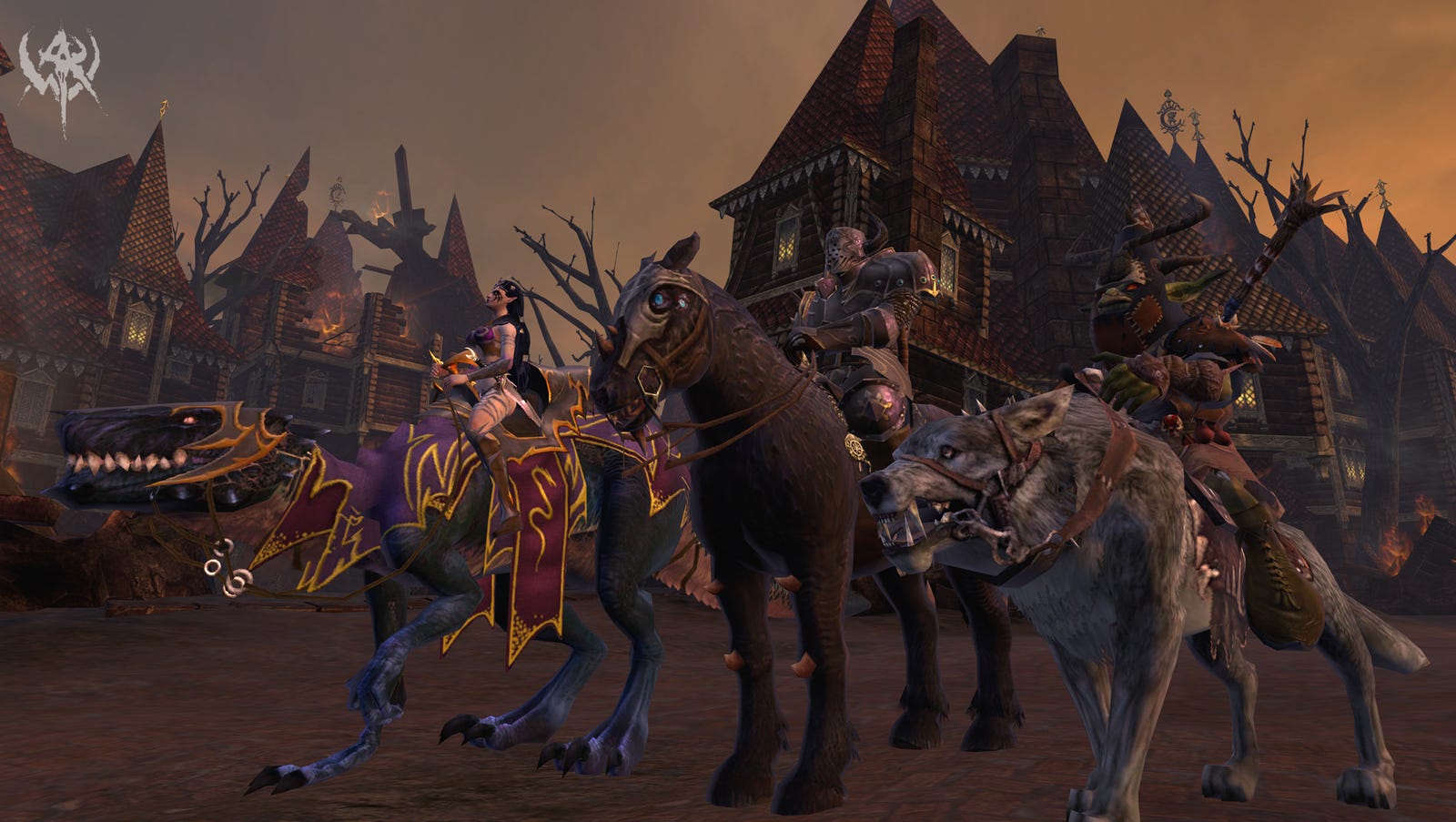
Horses for courses, dinosaurs for scandily-clad evil elf ladies.
This makes it hard to review before launch, especially on the underpopulated servers of the European open beta. However, there's nothing to say that this side of the game will have settled down in weeks' or even months' time; and in the meantime, we've had ample time on the finely finished and stable beta, exploring both early and late-level content. That's the basis of this review.
It's been obvious for some time now that Warhammer Online would be fighting-fit for its launch, and that's absolutely the case. With those final troublesome crash bugs eradicated, the game boasts sturdy networking, stable servers, rare bugs, a functional and detailed interface, a lavish amount of quests and play styles, and a reasonably if not spectacularly well-optimised engine (the frame-rate struggles a little more than it should, although most landscapes are more than usually busy with monsters and NPCs). With the account-creation problems of European operator GOA now ironed out, this is a very solid gaming experience, by MMO standards.
Solid is also the best word to describe the way WAR tackles the MMO basics. Mythic's grand vision and greatest innovations are all focused on pitching the Chaos mutants, Greenskins and Dark Elves of the Destruction side against the Empire humans, Dwarfs and High Elves who fight for Order. But like all grand visions, this needs to be built on something, and in this case it's the foundation stones of every RPG: class design, character progression, combat, loot, questing. In these, Warhammer Online is absolutely competent - but seldom inspired.
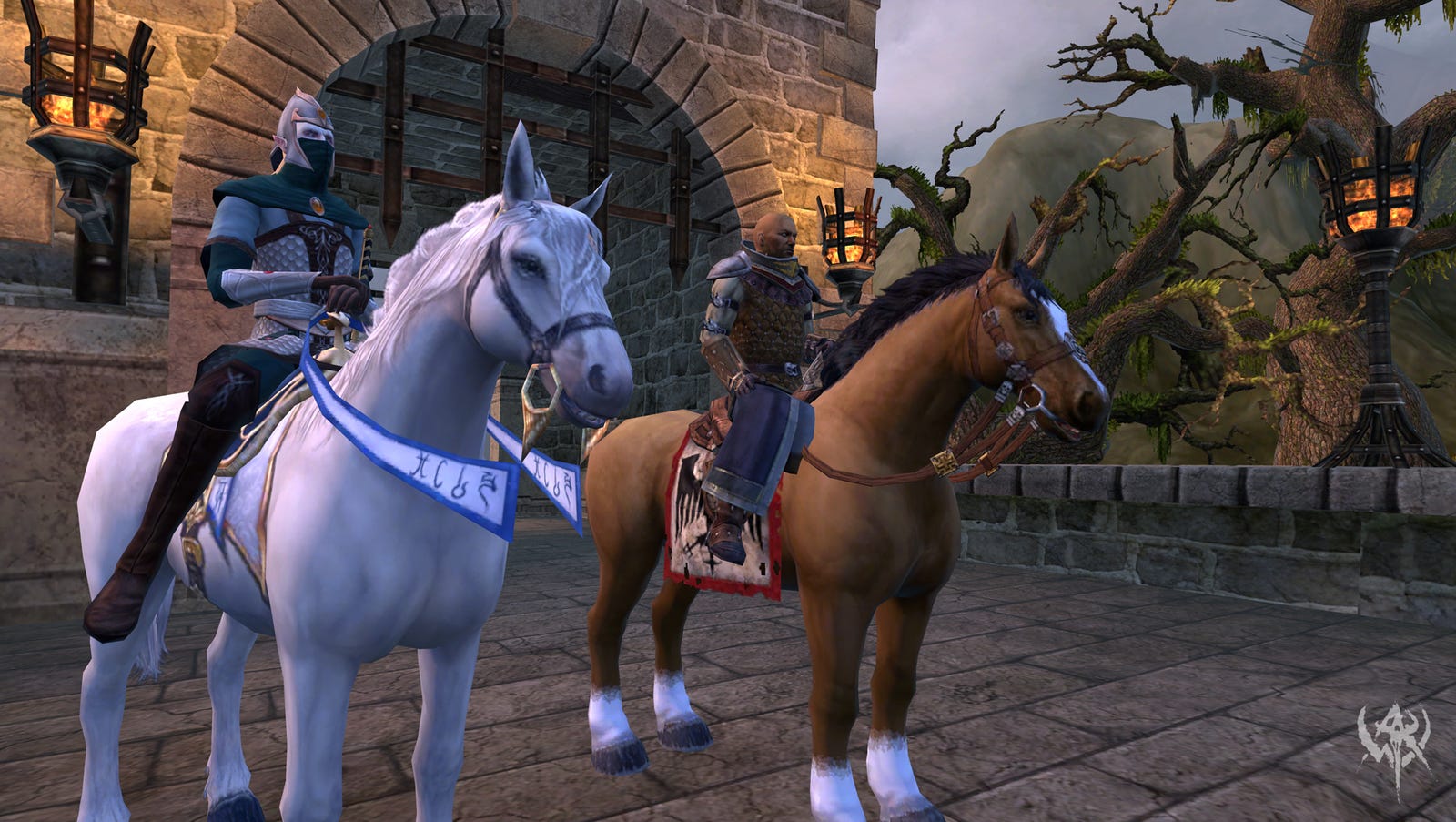
Dwarf on gyrocopter not pictured. Yes really.
With Warhammer lore demanding that every class must be specific to one of the game's six races (technically seven, if you count both the goblins and orcs of the Greenskins), Mythic has had to field a huge roster of character careers. The fact that an additional four had to be cut shows just how difficult this was, and of the 20 remaining careers, there are no out-and-out duds. Most offer an interesting spin on one of the four classic archetypes (melee damage, ranged damage, tank and healer), but few have the clear personality, depth, and flexibility that characterise the very best MMORPG classes.
There's an attempt to give each class more individuality with a plethora of gimmicky skill mechanics, but in most cases, this doesn't help. The Witch Hunter's Judgements are just dressed-up combo points, and do nothing to distinguish this admittedly stylish gun-slinging crusader from a regular rogue. The Black Orc's three-stage battle plan makes playing this capable tank more limited and repetitive than it should be. The Sorceress's gradual build-up of risk-versus-reward is exciting, but frustrating in day-to-day play.
It's notable that one of the game's best careers - the Dwarf Engineer, a defensive rifleman who can build gun turrets - has no such overlaying system, succeeding on the ingenuity and variety of his abilities. Creating skills for 40 levels of play across 20 careers seems to have been too much for Mythic, and far too many of them are anonymous and indistinguishable variants on damage-over-time, or damage X plus debuff Y.
Past level 30, the skills can become something of a mish-mash, and there are limited specialisation options - the Mastery talent trees are basic, although equippable Tactics make up for this a little. But it's probably more important that each class is well-defined and functional, both solo and in a group, and that much is certainly true. The broad range of adaptable and fun-to-play healers who can handle themselves in combat is particularly welcome, and they seem popular with players so far - a definite plus on the battlefield.
The feel of Warhammer Online's combat worried us when we first played it early this year, and although it's made some strides since then, it still falls short of perfection. Skills now have plenty of punch, but the timing is off, especially in the laborious animations. It's easy to trigger skills too early or too late, and it does make the combat feel stodgier than it actually is. The Morale system, however - which rewards constant fighting with increasingly powerful super-skills - brings a terrific guts-or-glory savagery to prolonged battles, especially in large groups.
With so many classes to cater for, you'd think Mythic would make itemisation as flexible as possible - but no. Weapons and equipment are allotted on a purely per-career basis. It means each career has a very iconic look, but it does lead to a sameiness in appearance which is only partly remedied by the ability to equip trophies and dye your armour sets. This is not a game for individualists - you could argue that WAR's greatest pleasure lies in feeling like part of an army, rather than feeling like a great hero.
Although loot drops are pretty frequent and generous, you'll mostly be getting your new gear from Renown and Influence rewards. The former relates to your contribution to fighting other players in RVR, the latter to your contribution to Public Quests. They provide a satisfyingly steady stream of new equipment - almost too much so. You don't really lust after loot in Warhammer Online, when incremental upgrades are never more than an hour or two's play away.
Best handlebar moustaches in gaming, 2008.
This has implications for the game's economy - it's hard to imagine player trading being a major part of Warhammer Online. That impression is reinforced by the game's perfunctory crafting professions, essentially a bunch of simple refine-and-combine mini-games that make consumables and trinkets and little else.
Tick feature box, make it as quick and painless as possible, move on. Warhammer Online has everything you expect from a modern MMO, but anything that might distract you from Mythic's mighty war effort, or from rapidly levelling your character, has been streamlined and curtailed and smoothed away.
This is by no means a bad thing - there's little downtime or fuss in WAR, and the game has a fast, linear, well-crafted and densely-packed flow that makes it highly compelling, and unusually rewarding if you have limited time to play. However, it does raise a question mark over Mythic's aim to make the ultimate, all-consuming hobby experience. While there's plenty going on, the variety, the silliness, the lazy luxury of wasting your time in a world you love, isn't really there.
Case in point: the linear structure of tiered zones, divided with systematic neatness into questing chapters and RVR war camps, leads you smartly through the levels without punishing travel times or backtracking. But with trainers and merchants in every encampment, and rally masters throwing new gear at you faster than you can equip it, why take time to visit the game's two extravagantly well-appointed capital cities, Altdorf and the Inevitable City? They're often quiet (at least in the early stages of a server's life; how they'll develop once city sieges kick in is an unknown at present). WAR lacks genuine social hubs; places you'll call home, hang out in, grow attached to.
Silliest armour set in gaming, 2008 (runner-up).
Not that WAR's world isn't well-realised. The races have strong characterisation and the architecture, in particular, is stunning, almost every landscape having been littered with rampant Gothic constructions of staggering detail and size. Natural landscapes are a little less graphically impressive and more clichd in style, with some puzzlingly complex layouts that make the route from A to B something that requires detours through J and Q. Zones are large and there are a respectable 27 of them, but their division into three separate lines - High Elves versus Dark Elves, Dwarfs versus Greenskins, Empire versus Chaos - dents the cohesion of the world somewhat.
But we're forgetting ourselves; we're forgetting those three letters, scribbled repetitively in blood on every loading screens. We're forgetting the WAR. Every barrier, every curtailment, everything that seems to limit your freedom and immersion is there for a very good reason: to relentlessly channel and focus players on the deadly serious business of beating each other, and everything else, to a pulp.
Disparate players, following the disparate threads of solo quests, find themselves thrown together in one of the game's hundreds of excellent Public Quests - the addictive, dynamic openworld scenarios that culminate in big boss fights and exciting fruit-machine loot drops. Opposing bands of players charging from spawn point to Public Quest (respawning on death is instant, and penalties are cheaply bought off, meaning you can use suicide as a travel short-cut) find their paths crossed, and battle ensues.
All hell breaks loose, all over the place. The culmination of this is seen on the final level 30-40 tier, where players naturally fall into Keep sieges and monumental scraps for control of key zones; we took part in one memorable massed battle for Praag, the central town in the final tier of the Empire versus Chaos line, the fulcrum of the ultimate struggle for control of Altdorf and the Inevitable City.
Keep sieges, intended to be the focus of Guild-on-Guild warfare, allow you to employ cheap, consumable siege engines, from boiling oil to battering rams, around their strategically-placed choke points. Incredibly, every single zone has its own instanced Scenario battleground, with a flawlessly simple queuing system that allows you to jump in at any point in play. They're based on simple game-ypes - capture the flag, base capture, tag - but with a splendid variety of tweaks and quirks of map design, and agreeably short-and-sweet play times. They're always busy, and rightly so; as good as WOW's handful of Battlegrounds are, this lavish banquet of PVP action shames them.
The openworld battlefield objectives seem less successful at gathering a critical mass of players behind them at the moment. Once a side has gained control of them, they're guarded by tough NPC opposition, which despite some tasty loot drops, tend to scare off the losing side. One of WAR's greatest strengths is how easy it is to get involved with other players without formally grouping with them - in Public Quests and RVR alike - but the downside is that the will to get organised when it's called for is a little lacking.
Stuck together with spit. Orc spit has excellent adhesive qualities.
This, Mythic hopes, is where guilds will come in to play. It's offered every incentive, with a guild-levelling path that allows access to ever greater rewards, and the system of Standards that can be used as buffs in battle as well as decorative emblems. Social organisation is key to making a game like this work, and while it's still relatively untested, the very fact of its existence shows that Mythic knows exactly what it's doing here.
It's probably fair to say that there isn't a single massively multiplayer game out there that's better at throwing players together than WAR. But - and it's a pretty big but, this - the players have to be there in the first place. When they're not - because it's a quiet server, because it's an unsociable hour, because everybody's over on the Empire versus Chaos line - Warhammer Online has the life sucked out of it.
You can play it solo, or in a small group; WOW made that a base stipulation of the modern MMO, and WAR meets it to a fault. It's just not that much fun. It's hard to say what, if anything, is wrong with the questing, because it's painless and well-organised and grind-free and provides a steady stream of cash and XP and generally does what's needed. The Tome of Knowledge in-game encyclopaedia, and excellent map system, make it a breeze to keep track of your achievements and progress, and the Tome provides the satisfaction of constant unlocks and plenty of diverting nonsense besides.
Perhaps it's that the monster behaviours aren't all that sophisticated, or that their placement isn't just so, or that the humour and storytelling seem a bit forced. Perhaps it's that those watercooler quests, despite Mythic's evident and worthy efforts, aren't really there. Perhaps it's just that you know that the other things the game has to offer - Public Quests and Keep sieges and Scenarios - are that bit better. You can theoretically advance all the way through Warhammer Online without questing, and that amazing fact tends to dent your desire to quest.
Iron like a Lion in, er, is that the Chaos Wastes?
Mythic has dutifully done everything it needs to to compete with Blizzard's jack of all trades and master of most. Crafting is weak, and dungeons - the small, instanced experiences that really cement the group dynamics in an MMO - are frustratingly rare, but aside from that WAR does it all, and does it well. That said, you can very easily tell which parts of this grand enterprise Mythic's heart was in, and those parts - RVR and Public Quests - are completely thrilling, and surprisingly accessible.
But they're also fragile. They're at the whim of an unpredictable player base and a hundred other factors besides. They're utterly dependent on en even balance between the two realms on each server - and at beta stage, there's a worrying bias towards Destruction on all servers. That means that, until it's been out in the wild a while, this extremely well-made and highly enjoyable MMO remains unproven. And it remains - until our first re-review, at least - one step short of true greatness.
8 / 10