Virtua Tennis 3
New balls please.


The sign of a really good sports game is one that you find hugely enjoyable even when you're not a massive fan of the sport itself. Take the Virtua Tennis games. Despite only having a passing interest in the rising fortunes of teenage wunderkind Andy Murray, and despite watching a sum total of, ooh, two matches a year, as a videogame it's probably in my all-time top five. Few sports games have ever been so easy to pick up and play, yet had so much hidden depth. It sounds like the sort of tired hyperbole that you'd read in an excitable press release, but it's true.
The secret of AM3's success has always been to combine a simple, precise control system with spectacularly fluid animation. Everything after that falls into place and just works the way it should. Virtua Tennis 2, in particular, is one of the most beautifully instinctive videogames ever created for the simple reason that the game reads your shot input so precisely. Once you give that degree of control and flexibility to the player, you quickly zone out of even thinking about what you're doing any more. Played with someone of a similar level, it's almost a mind game where you're constantly having to second guess where the opponent is going to play their shot so you can run into the space and dictate the play.
It's one of the fastest, most competitive and challenging sporting titles out there, but one where you rarely ever curse the game when things don't go right for you. You'll lose because your position left you exposed, or you didn't time your shot properly, or maybe you just chose the wrong shot. It's one of those games where one more go is never enough, and one that even when you've mastered it will be kept alive in multiplayer forever.
Where did the years go?
More than five years have passed since VT2 graced the Dreamcast, and although the inferior PS2 port, the ill-advised GBA version and the splendid PSP port have kept the brand alive, the need for a proper sequel with full online play has been there ever since. With such a gaping void to fill, challengers such as Top Spin have come close to giving us what we wanted, but always slightly missed the mark. Adding novelties like risk shots and a more elaborate control system might sound like good ideas on paper, but they failed to give the game the same flowing playability. Inevitably we'd always come back to VT 2 for a quick session whenever fellow Virtua-philes popped round for the evening.
Perhaps even more inevitably, those 'quick sessions' often went on long into the night, making the lack of online play even more galling. We always knew that with online play it would have been played ten times more than it was. The fact that VT3 on 360 has online play is perhaps one of the best decisions Sega has ever made. The fact that the PS3 version doesn't have it is, at the very least, annoying - and possibly the main reason why we'd immediately suggest that any serious VT fans plump for the Xbox on this occasion, even though it's, technically, a 'port' by the ever-reliable Sumo.
But before we get bogged down with the online issue, most of you are probably fretting that AM3 (a.k.a. Hitmaker) has broken the game with unnecessary tweaks and refinements to the fundamentals. Relax. The basic control system is, thankfully, the same as ever, with a main 'shot' button being the one you'll focus most of your attention on, along with the usual slice and lob shots. Serving works exactly the same as it always did, with a single tap to fill a rising power bar, another to confirm the power, and the dpad or stick direction determining where it will land. One minor difference is how much harder it is to aim the ball in the corner of the court, and at first you'll find yourself faulting far more than you might expect.
Running man
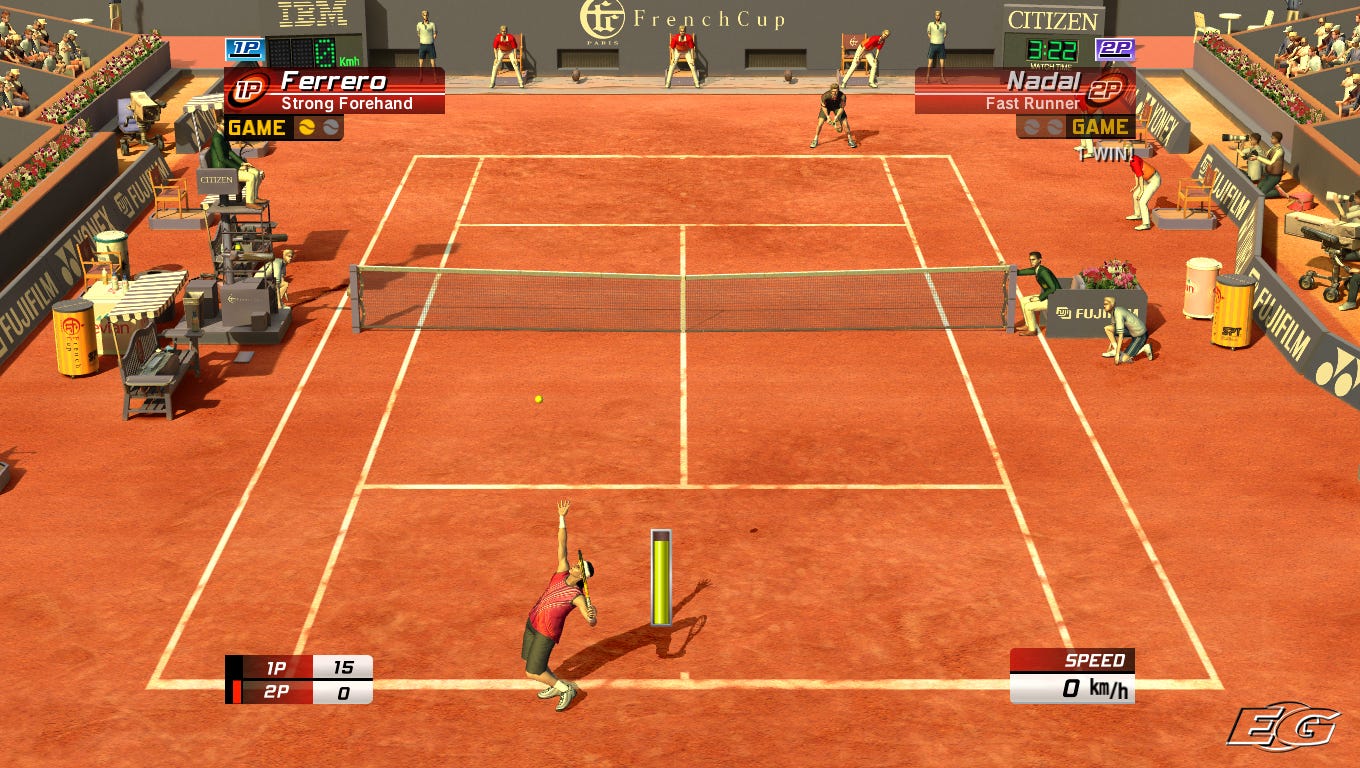
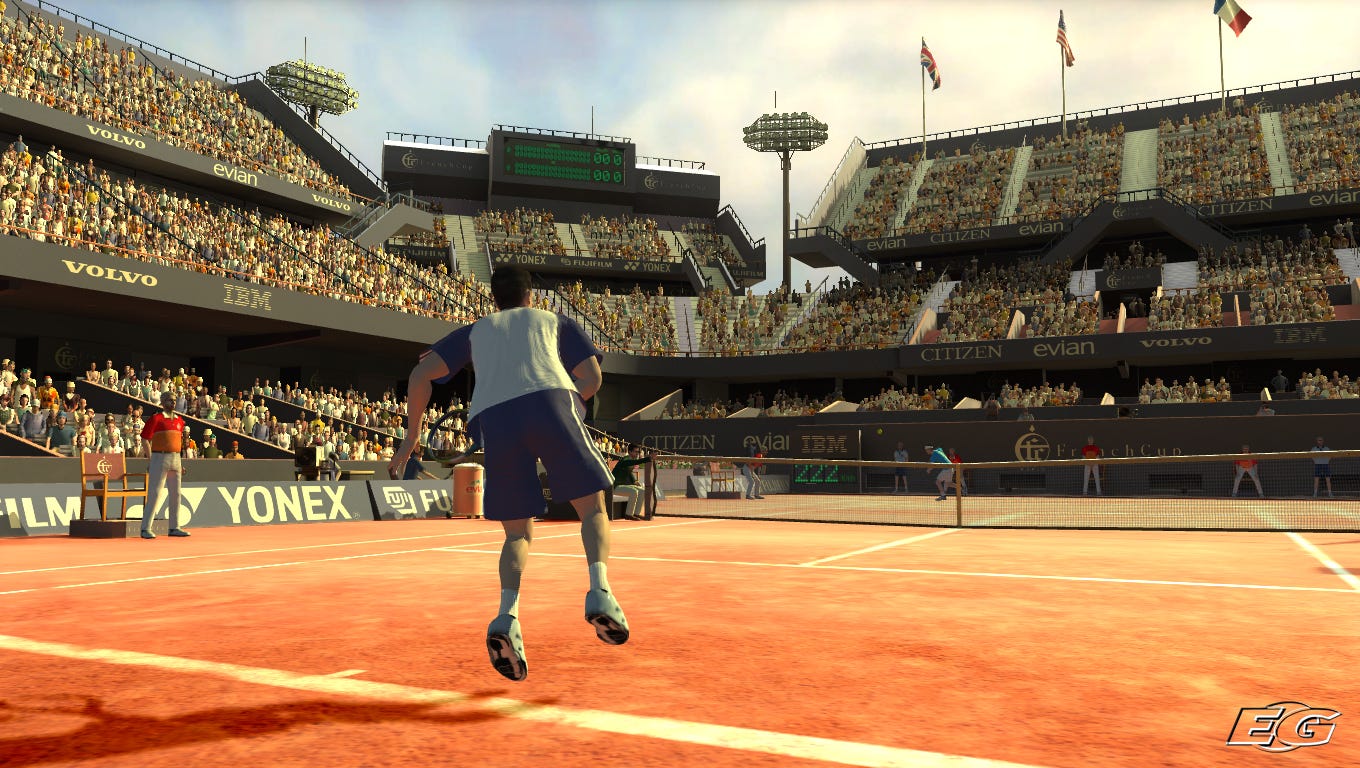
Similarly, returning shots isn't quite as straightforward or as forgiving as it once was. In the past, the AI would give you a fighting chance of returning ball even when you weren't all that close to it. It wasn't cheating as such, but sort of worked out a correct transitional animation in an instant and blended it into a flowing movement that made it a plausible spectacle. Try playing VT3 the same way, though, and any shots that are obviously out of reach will cause your player to attempt a Running Shot and dive in a rather dramatic attempt to reach it. Now, as much as that was always a factor in previous VTs, it's immediately apparent that you have to do a bit more work in actually positioning your player in advance of hitting the shot button. As jarring as this feels to begin with, it's makes the game slightly more believable, and adds a certain depth to how you play. Previously you could basically focus all your efforts on where your shot was going; as long as you were quite near the position of the return ball, you'd be able to deliver a powerful, precise return. In VT3, though, positioning is a much bigger part of the way you play, because the better your position, the more time you have to prepare yourself for the shot, and the more power you will apply to it when the ball comes to you.
As you get better at reading the game, and anticipating where the return ball is going, you'll be regularly pulling off what VT3 calls 'power' shots, complete with an extra grunt of effort and a little leap into the air to show that you've really put some welly into it. Just like previous VTs, applying a direction to your shot determines where you want it to go, and the longer you hold that direction, the more extreme the results will be. Working out how to hit a particular part of the court isn't quite the exact science it used to be, but as a result the game feels more unpredictable. In the long run, I can't help but feel that's going to be a plus.
So, in terms of how the game works, there's not a huge amount to report. It's largely sticking to a tried and trusted system, but has been tweaked in such a way to give it a little bit more depth. You might not initially get on with it, but as you might expect, you soon get used to it, and soon become just as instinctive with your play - so that's the really important stuff out of the way.
Tour of duty
The main single player World Tour career mode is arguably the place you should spend most of your time re-learning the ropes. It's largely the same as it's always been, with a few minor additions to spice things up, and a few rather pointless elements grafted on, but more of that in a moment. First up you'll have to create your own custom character, and utilising a slider bar system you can quickly knock up something suitably ludicrous. It's not quite in the league of the methods used by EA, though, so don't expect much - the results are relatively limited.
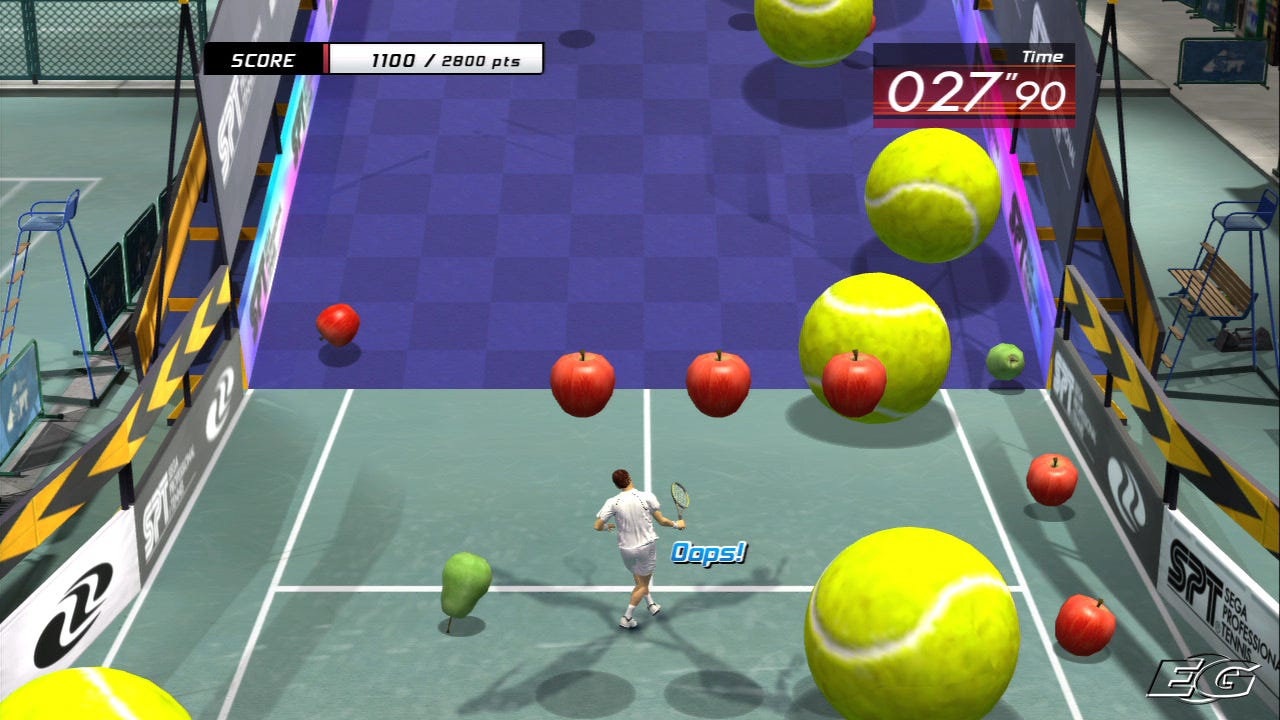
Once that's out of the way, you set about working your way up the rankings from 300, all the way to the world's number one. To do so, you have to enter singles and doubles tournaments over the course of the year and try and win them, but to do so requires a fair bit of effort on your behalf in terms of upgrading your character's various skill levels. Just like before, you have to successfully complete numerous training mini games, such as the Avalanche footwork training game that involves dodging giant tennis balls while collecting fruit.
Elsewhere, some old favourites return, such as Prize Defender, where you have to protect at least one prize from being knocked off its pedestal by several ball firing machines. In addition, there's the service improving Pin Crusher, which involves trying to knock down bowling pins, as well as Drum Topple, Alien Attack, Bull's Eye and even one based on Curling and Bingo. Series veterans will recognise most of them from previous incarnations of the game, but this time the challenges go up to level six and can get particularly severe. Usefully, once you reach later levels, you're not restricted to only playing those higher levels, and can continue to improve your stats by playing the lower level versions - with the benefit to your stats being proportionately lessened.