Version tested:
Virtua Tennis has almost become a victim of its own success. By nailing the fundamentals with intuitive precision and peerless fluidity at the first attempt, subsequent improvements have been somewhat incremental. The 2001 sequel added female players and speeded up the gameplay a notch, while the third added long-awaited online play and sharpened up the already superb visuals. Apart from updating the roster and perhaps making the online mode a tad more expansive and flexible, there's not much else tennis fans could really want from a 'new' version.
Perhaps not calling this Virtua Tennis 4 is more significant than it initially appears, because what we're dealing with here is a refreshed VT3 rather than a true sequel. The clue is in the choice of developer, with series creator SEGA-AM3 (aka Hitmaker) taking a back seat to UK starlets Sumo Digital (responsible for the Xbox 360 and PSP ports of VT3, and, more recently, last year's SEGA Superstars Tennis). After seeing how well the Sheffield-based studio handled both of those, no one should worry about technical credentials, but alarm bells always ring when a new team takes over a beloved franchise. Does Sumo stay true to the feel, or does its fresh perspective tinker to a ruinous degree in a misguided search for progress?
Initial concerns are laid to rest the first time you pick the game up. Sumo definitely hasn't broken things that didn't need fixing. The overall feel is much the same as it's always been, which is to say instinctive, stripped-down and fluid. The controls work on pure timing, positioning and shot direction, with the choice of topspin, slice or lob shots mapped to the same buttons as ever (and with four configurations available, every preference is catered for).
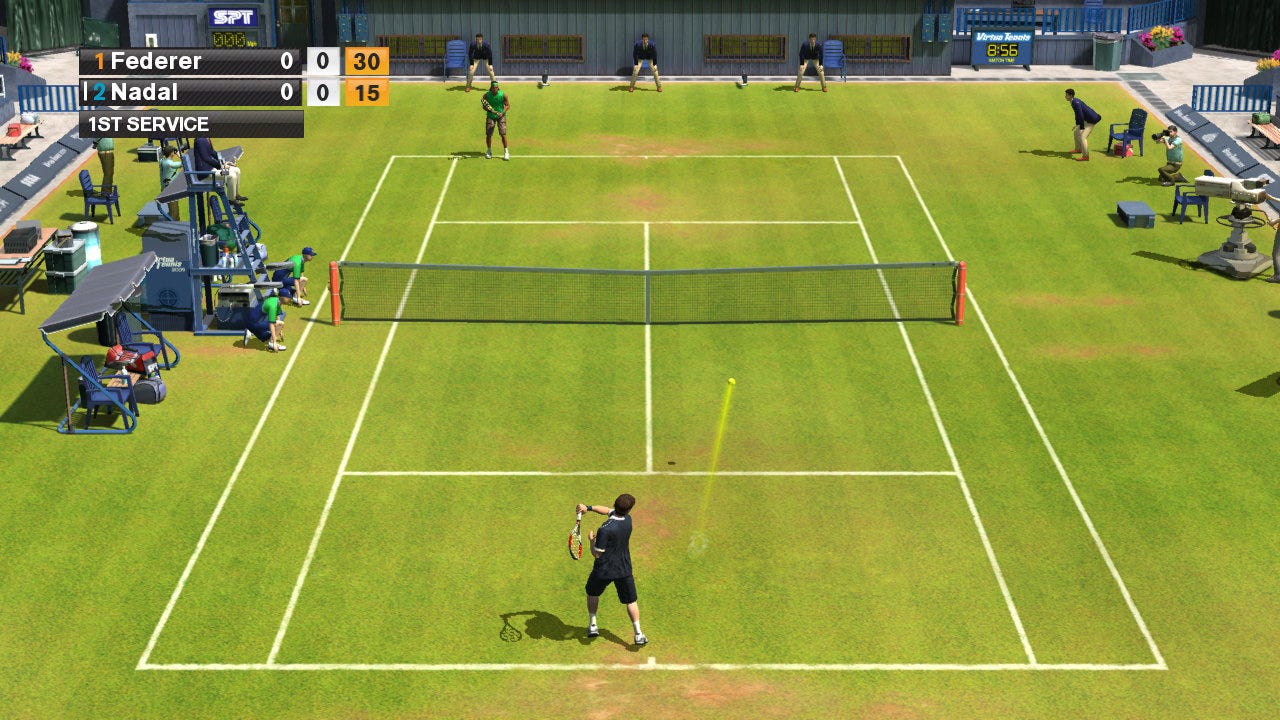
Wrong way, Rafa.
Whether you fire in a forehand, backhand, drop shot, cross court or smash shot is a mixture of shot-selection and raw timing, mixed with the small matter of where you place your player at the point you decide to try and hit the ball. Set yourself early enough, and you'll have time to hit the ball at the peak of its bounce and therefore maximise the power on the shot. Leave it too late, and you'll either scuff the return weakly or end up stretching for the ball on the run - neither of which gives you optimum power, accuracy or direction. One difference is the way players no longer make ridiculous dives for the ball in the manner which blighted VT3 for a lot of players. Instead, players stretch in the manner they used to back in 1 and 2.
Unlike other tennis games, Virtua Tennis 2009 continues to stick by the series' 'no gimmicks' principle. That means no special power bars, turbo shots, morale meters, energy gauges or hand-crippling button combos. While you'll certainly see and feel when your player has hit the ball sweetly, and notice when your player is starting to tire, it's all pulled off with admirable subtlety. The only time you see a power bar is during the serve, and even that's slightly superfluous.
While the fundamentals remain largely familiar, Sumo has tried to freshen the game up elsewhere - most noticeably in the familiar, single-player only marathon World Tour, where you're tasked with building up your rookie from the lowly depths of rank 100 right the way up to the pinnacle. You work your way through a calendar year, entering tournaments, playing surreal court games, diving into the Tennis Academy and generally trying to both improve your rank and your player abilities.
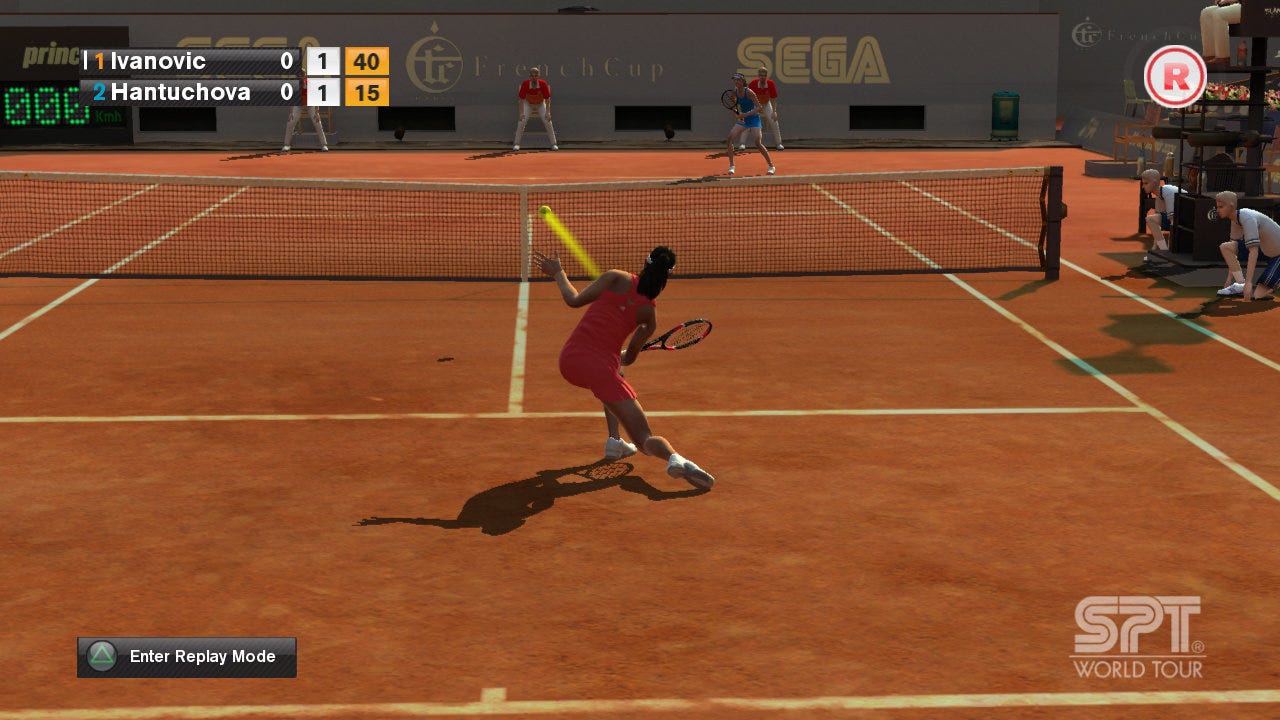
The game's default 'arse cam' might look ace in screenshots, but it's pretty impractical to the play it that way.
Ranking up is simple - just enter the singles or doubles tournaments closest to your rank, and attempt to win them. What's not quite so straightforward is improving your abilities. While all previous Virtua Tennis games kept things nice and transparent, 2009's take has you choosing to play the court games or try and beat the numerous challenges housed in the Tennis Academy, and the net result is that you gradually fill up three sections of skill: Ground Strokes, Footwork & Technique, and Serve & Volley. Every time you fill one of these bars, you unlock a new play style, which you can then assign to your player. 23 are available in all, allowing you, for example, to become a Serve & Volley specialist or perhaps a fast runner or big server.
The problem with this system is that all it appears to do is allow you to hot-swap these styles between matches - both offline and on. In previous editions you were safe in the knowledge that your player character was slowly getting better in a variety of tangible ways, and the progress bars accurately reflected how good you could be. You knew that if you gradually levelled up your service or footwork, that there would be a measurable, quantifiable difference when it came to playing a match. The same just isn't true in VT2009, and as a result you never really feel like your player's properly progressing in the usual way.
Being able to essentially implant new abilities might help level the playing field in an online context, but offline it doesn't make a huge amount of sense. Many players may prefer, as I do, for your unique player character to become better in the areas you have trained him to be, and not to simply turn into some sort of tennis chameleon because you happen to have passed a few arbitrary academy lessons. Likewise, being able to use my all-conquering champion online in VT3 was great. It might not have been particularly fair to those who hadn't gone to the same lengths to level up their character, but I thought that was kind of the point.
This lack of level-up payback appears to have had other implications too. With an inability to level up, it's obvious that your World Tour rookie is fairly overpowered from the start compared to previous Virtua Tennis titles. After 80-odd matches over countless hours, I'd barely dropped a point, and while my rank inexorably rose accordingly, it was clear that all the training exercises I had undertaken in parallel hadn't made a scrap of difference. VT's World Tour mode has always been a bit of a grind, but this felt even more like plumbing the depths of obsession. Chipping away, winning every point, inching towards some sort of magic moment where the game starts to provide a challenge. It takes far too long to provide a reward, with even basic unlockables and new gear failing to appear long after you've grown tired of win after boring win.
Maybe 10 or 12 hours in, it begins to get more interesting. Charity fancy-dress tournaments and higher-ranked opponents begin to test you in the better competitions. But it would have been much nicer to skip all the low-level stuff much earlier, or perhaps to pitch the challenge higher. To make matters worse, the new mini-games are somewhat lacklustre, with the likes of Pirate Wars and Shopping Dash providing limited thrills alongside series staples such as Alien Attack, Avalanche, Drum Topple and Pin Crusher (which take a considerable effort to unlock in World Tour). It's the same old drill, really, with a surreal task attached to a time limit, and a swiftly rising difficulty curve. Fortunately all 12 are available unlocked outside of World Tour, with scores uploadable to online leaderboards if you fancy a challenge. Better still, they can also be played in multiplayer if you fancy a quirky challenge.
The player likenesses for the likes of Andy Murray are spot-on, but the rest can be pretty rough.
Speaking of which, the Online HQ is fully integrated into the World Tour map, allowing you to play opponents across the globe in one-off ranked matches (with points gained contributing to a worldwide leaderboard), while a new SPT Online Tour gives you the opportunity to enter a competition that lasts one real-world week, and is available for Amateur, Pro or Champion players - presumably to make it more attractive to all comers. The idea is that you can play as few or as many events as you like to earn Tour Points, with the winners awarded medals.
Technically speaking, not a lot has changed about Virtua Tennis 2009, and while certain nips and tucks make sense (like the absence of ridiculous diving antics, and a more effective lob shot), some of the tweaks aren't for the better. At first glance the player models still look as beautifully animated as they were before, but close up they look like they're suffering from some sort of flesh-eating disease. We used to joke about 'Zombie Tim' in previous VTs, but something's gone a bit awry here, and it's not a pleasing effect. The contrast, for example, between the anonymous low-ranked World Tour players and the game's star names is marked, with the former looking like they were churned out through the same basic character-creation generator that kicks off the World Tour. Happily, the licensed pros are up to scratch, but would it really be too much to ask to have a broader roster of players? Even some ex-champions would add some colour, not to mention gameplay depth. The truth is, next to most modern sporting titles, Virtua Tennis is starting to feel a little on the low-budget side, and could quite easily be usurped by an ambitious rival without a great deal of difficulty - as evidence by licence-happy EA entering the fray next month with Grand Slam Tennis.
Four shadows. Count 'em.
The general cheapness of the VT2009 project infuses much of what's on offer. For example, the lack of tournament or venue licences, and the limited attempts made to bring the crowd to life. Stiff, featureless character models are still very much the order of the day, and one bland location blends into the next. There's no real attempt to bring a match-day atmosphere to the game, with limited, repetitive celebration and reaction animations, and anonymous crowd audio samples. In addition, the whole spectacle feels a little sparse and predictable. Weather, lighting and atmospheric changes never intervene, and nothing that would affect a real pro, such as dehydration, ongoing injuries and the like ever enters the equation. On the one hand it's nice that VT continues to keep things simple, but the fact the designers haven't attempted to inject something new into the dynamic leaves this feeling very much like a rehash of an old game with a tweaked roster.
But with all that said, a lot of these complaints are more like minor niggles than fundamental flaws given that the old magic remains. The game is and always will be best played in multiplayer mode, so it feels churlish to slam it on the basis of a weaker single-player offering than usual. With a full suite of offline multiplayer options for up to four players, and fleshed-out online options which make it accessible to everyone from newcomers to old stagers, there's still good reason to welcome this release. As usual, the online experience is only as good as the connection between machines, but from our initial impressions, online play can be as slick as offline play once you get the right match-up. How the weekly tournaments will add to the fun is hard to say at this point, but it's a welcome addition and one that long-term fans will be keen to investigate.
Still, taking both elements of the game into account, it's hard not to feel a little underwhelmed by what Virtua Tennis 2009 has to offer. While the online multiplayer facet has undoubtedly been improved, the disappointment over what's been done to World Tour mode and the general lack of ambition in certain areas leaves me wanting.
7 / 10