"I understand our competitors are using... buttons?" The SEGA producer demoing Virtua Tennis 2009 to us on Wii (also PS3, of which more later) allows surprise and a hint of scorn into his voice. This, his tone implies, is the brave new world of MotionPlus. Buttons are so last year.
With this week's MotionPlus announcement from Nintendo out of the way, SEGA is finally able to own up to supporting the enhanced motion-control add-on with Virtua Tennis 2009. It is also able to step out on to the court and face its "competitor", EA Sports Grand Slam Tennis. This is set to be an almighty grudge match: SEGA has a near-impeccable pedigree in tennis games which EA, having largely steered clear of the sport, lacks; but the US giant is bringing its mighty Sports brand, better licensing, and the explicit support of Nintendo to bear.
In the end it might just come down to the buttons. The EA game uses A and B to modify your swings into lobs and drop shots. This, reckons SEGA, is weak. "To do a lob, you just... do a lob," says my coach, as he generously allows me to be the first journalist to try the game's MotionPlus controls.
It takes a little getting used to, especially immediately after using the regular Wii controls which, like Wii Sports Tennis, use timing accuracy within a fairly generous range to determine the positional accuracy of your shot. Now, timing is just that - timing - meaning the window for nailing each ball is a little narrower. Positional accuracy is determined entirely on your swing.
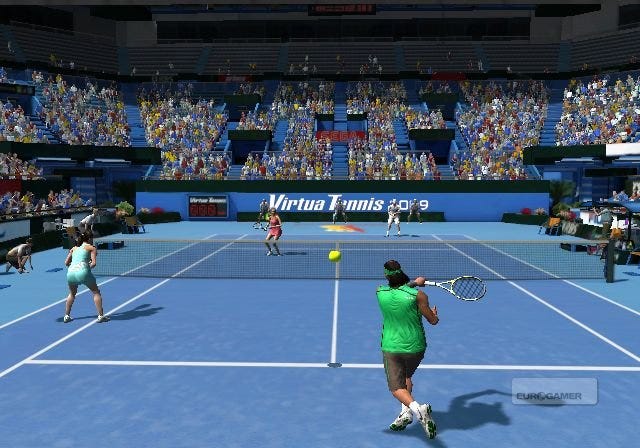
SEGA leads the Campaign Against Super-Deformed Wii Games.
Holding yourself ready for a forehand or backhand swing becomes much more important, since now the on-court player's movement is working around your shots, rather than the other way around. You can add topspin or slice by rotating your wrist through the shot, but before you get that far, you'll just want to get the hang of aiming the shots properly by concentrating on the direction your arm follows through.
I found I was naturally sending balls down the right of the court, which became a particular problem when serving to the deuce court; double faults galore. In the end I learned that really quite definite, to the point of exaggerated, swings to left or right would send the ball where I wanted it. As soon as you've made the subtle shift in perspective - as soon as you've understood that the machine is no longer reading sign-language in your gestures, it's actually following your movements from one microsecond to the next - it clicks. And it's extraordinarily natural.
As with the unassisted Wii controls, you can play MotionPlus Virtua Tennis 2009 with or without the nunchuk. With it, you'll have full control of your player's movement. Without, there's a degree of automation, but you can still use the d-pad for more general movement commands, such as rushing the net.
Lobs and slams or drop shots are easily executed with, again, slightly exaggerated scooping and slamming motions. You need to point at your player to re-calibrate the controller between points, but aside from that, it's entirely transparent. It would be going too far to say that the veil between player and machine has been lifted - with the player's automated movement, you still feel like you're issuing commands rather than playing the shots yourself - but it's definitely a huge step forward. The subtlety and skill in each stroke ushers in a new era for tennis videogames. Sadly, I can't compare it to personal experience of EA Sports Grand Slam Tennis, but going by Martin's impressions, this will be a close contest.
Virtua Tennis 2009 handles very well without MotionPlus too, thanks to its willingness to wear its mechanics on its sleeve. In fact, it's the most precise and predictable Wii tennis game I've played. Dissatisfied with their efforts on SEGA Superstars Tennis, SEGA and developer Sumo reverse-engineered Nintendo's shot-accuracy system from Wii Sports Tennis - and then put it on the screen.
This not being a family knockabout, but an arcade game with mini-games that demand razor-sharp shot placement, they included an optional shot indicator that shows the exact relationship between timing and placement. A bar representing the width of the court appears over your character's head when you're about to hit the ball; a pointer moves across it (faster the harder the ball's been hit at you); the ball goes where the pointer is when you strike. You can see that a forehand struck early will go down the line, a fraction later cross-court, and later still, out. It's a marvellously clear system that helps you get great results out of the basic remote.
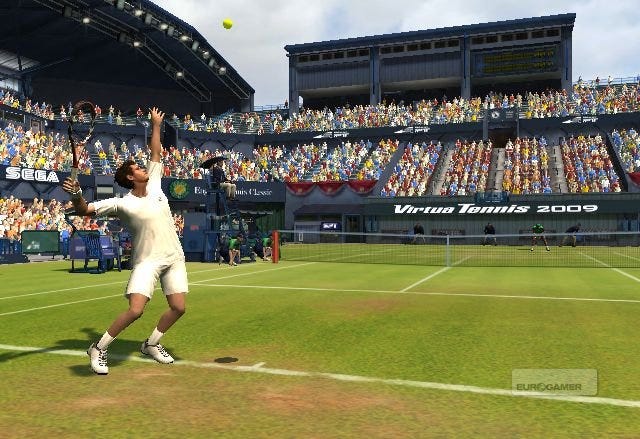
It's a handsome enough game on Wii, eschewing Grand Slam Tennis' toons in favour of realistic representations of the stars (now including the likes of Andy Murray and Ana Ivaonvic, as well as legends Boris Becker and Stefan Edberg) and the familiar, hard, bright, arcade-machine look of Virtua Tennis. And here's the best part: controls and graphics aside, the Wii version has 100 per cent of the content and modes of the PS3, 360 and PC releases, online included.
That means all versions get the massively overhauled World Tour mode that's been integrated with ranked player matches and tournaments, allowing you to earn prize money and improve the ranking of your custom player online or offline. There's a much-improved character editor (the results of which can be undone by buying cosmetic surgery, for a price); and a new amateur tour populated with no-name characters to work your way through before you get a shot at the big names. The arcane unlocking system has been stripped out and replaced with a store bulging with clothes and accessories both realistic and outlandish.
PS3 version: not even the real Nadal is that brown, surely.
Five new training mini-games have been added, some by SEGA's original Virtua Tennis developers in AM3, some by Sumo (you can tell which, the Brits contributing 9-ball pool, the Japanese a game where you have to feed zoo animals appropriate foods and something involving cardboard pirate ships). Building your core skills - ground strokes, volley and serve - in the mini-games feeds into the all-new system of play styles.
Intended to introduce more variety and strategy into the online game - and bring it closer to the Virtua Tennis culture in Japanese arcades, where players hot-swap characters they've built with different styles - there are 23 set styles you can build towards and use brief mini-game training regimes to switch between, with various strengths and weaknesses against each other. They include categories like All Rounder, Fast Runner, Strong Forehand and Rocket Serve, and should introduce welcome clarity online, as well as levelling the playing field some.
Smaller tweaks include a much more effective lob (Virtua Tennis 3's was, by admission, "tactically useless"), less over-the-top diving, more nuanced player-specific animations, some low-slung over-the-shoulder camera options - but sadly, no licensed courts or tournaments. The blessing of Wimbeldon and the other Opens bestowed on Grand Slam Tennis will undoubtedly be a mass-market draw for that game. There's naturally a casual network-multiplayer mode too, aimed at your Friends list.
PS3 version: the new low camera view.
Playing the PS3 version raised nothing at all to concern the VT fan or casual tennis enthusiast. It's as crisp and accessible as ever, presenting a slightly more natural, flowing game of tennis. The high-contrast, over-saturated graphics are maybe on the gaudy side, and the players' faces are muddy masks that shift between recognisable and alien like the clouds that ostentatiously pass across the court - but presentation is superb, with a plain, clear-cut, Rez-influenced graphic design for the front-end.
There's no reason to suspect this won't automatically be the best tennis game available on PS3, 360 and PC when it launches in May. On Wii? We're not going to call that before the match with Grand Slam Tennis begins in earnest. But with a handsome, full-featured conversion and excellent controls - with or without MotionPlus - SEGA is certainly putting its best foot forward.
