Version tested: PC
There is a horrible, horrible section near the start of Universe at War where you suspect that perhaps developers Petroglyph don't have their collective tongue firmly wedged in cheek. Just for a few minutes, it seems entirely plausible that the team has created a game script plastered in a heavy layer of over-familiar clichs and sci-fi homages - and that it means every single word of it, without a hint of irony on the landscape.
The feeling passes, thankfully - but the fact that it's there at all is a demonstration of how close to the wind Universe at War sails at times. We're certain... Well, we're almost certain that the game is intended as a kitsch, over the top pastiche of the science-fiction games and films of yesteryear, like Mars Attacks with more resource management. At least, we hope so.
Mild suspicions regarding the intent of the story and script writers aside, Universe at War does a number of things right, and it's worth making sure those are writ large from the outset. Firstly, it dispenses entirely with the idea of plucky humans fighting off an interstellar invasion. In this game, humanity forms the tutorial levels - the real fighting is all about the aliens.
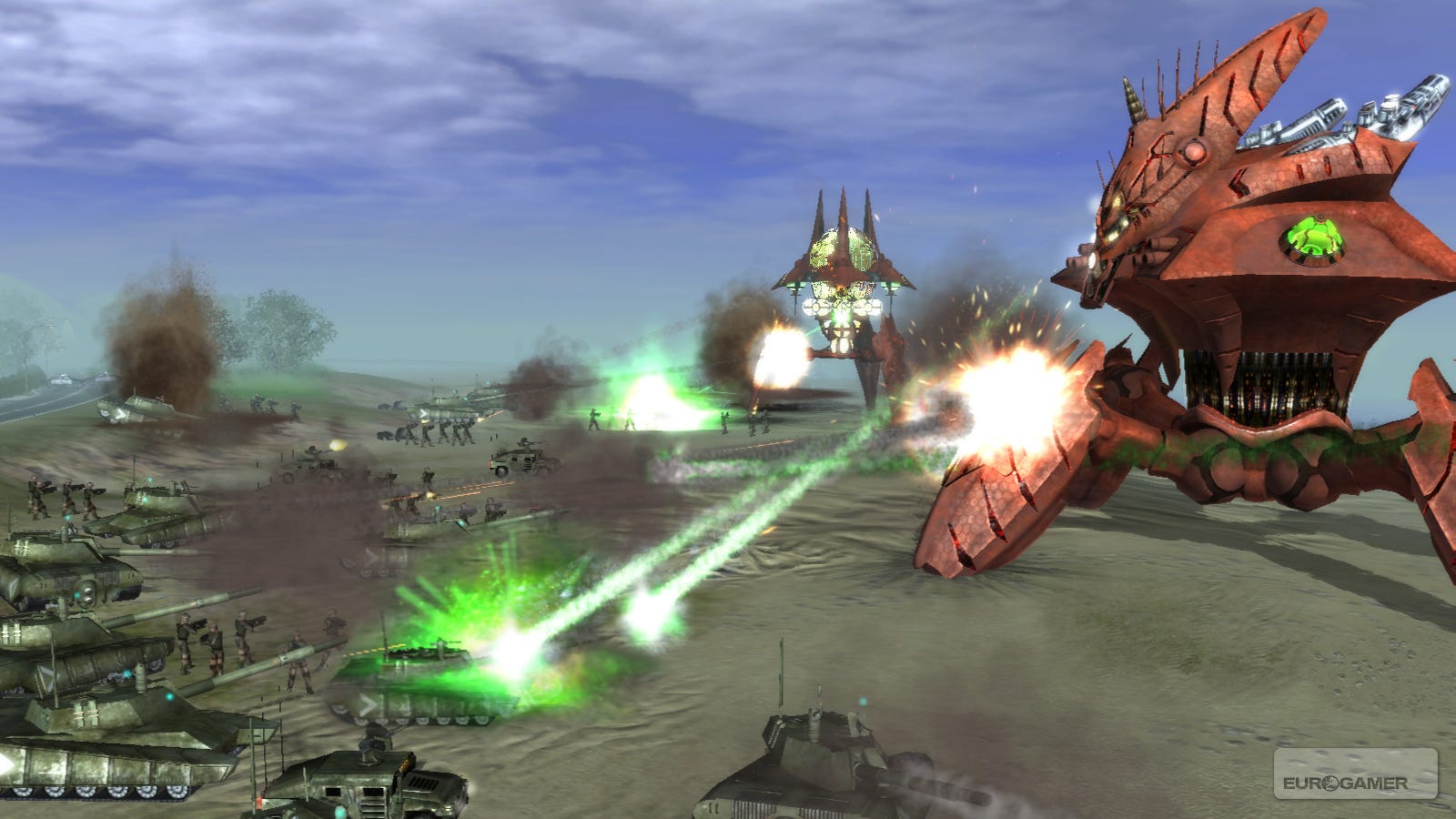
Crush the puny humans like insignificant insects! Evil cackling is the order of the day where the Hierarchy are concerned.
So, you control a band of US marine types for long enough to learn the controls - and then they're promptly shoved to one side when it becomes clear that the first remotely powerful alien unit to come along will annihilate them. The game proper only begins when the Novus, a race of gleaming silver robots, turn up to challenge the invasion of Earth by the Hierarchy, a race of giant multi-legged biomechanical walkers.
Later on, the Masari turn up - they're a race of incredibly posh-sounding high-tech types who fell asleep inside the Earth ages ago and are annoyed by the racket the other two are making. Throughout all of this, humanity's main role is to run around in the background screaming - with no sign whatsoever of Bill Pullman in a biplane. Music to our ears.
A Lesson from Future History
The second thing that Universe at War gets right is that it takes the incredibly clichd idea of a rock-paper-scissors set of RTS races, combines it with three of the most hackneyed science-fiction concepts imaginable for the races themselves - and then somehow turns out three of the most extraordinarily innovative forces we've seen in a strategy game in years.
You could, for instance, characterise the Novus as being the Zerg race of the trio - but you'd be a long way wide of the mark. Their units are cheap and low-powered (although surprisingly effective against the right kind of targets, especially if you learn to use their special attacks at the right moments), and their basic attack pattern is certainly to swarm enemy forces in a sea of infantry.
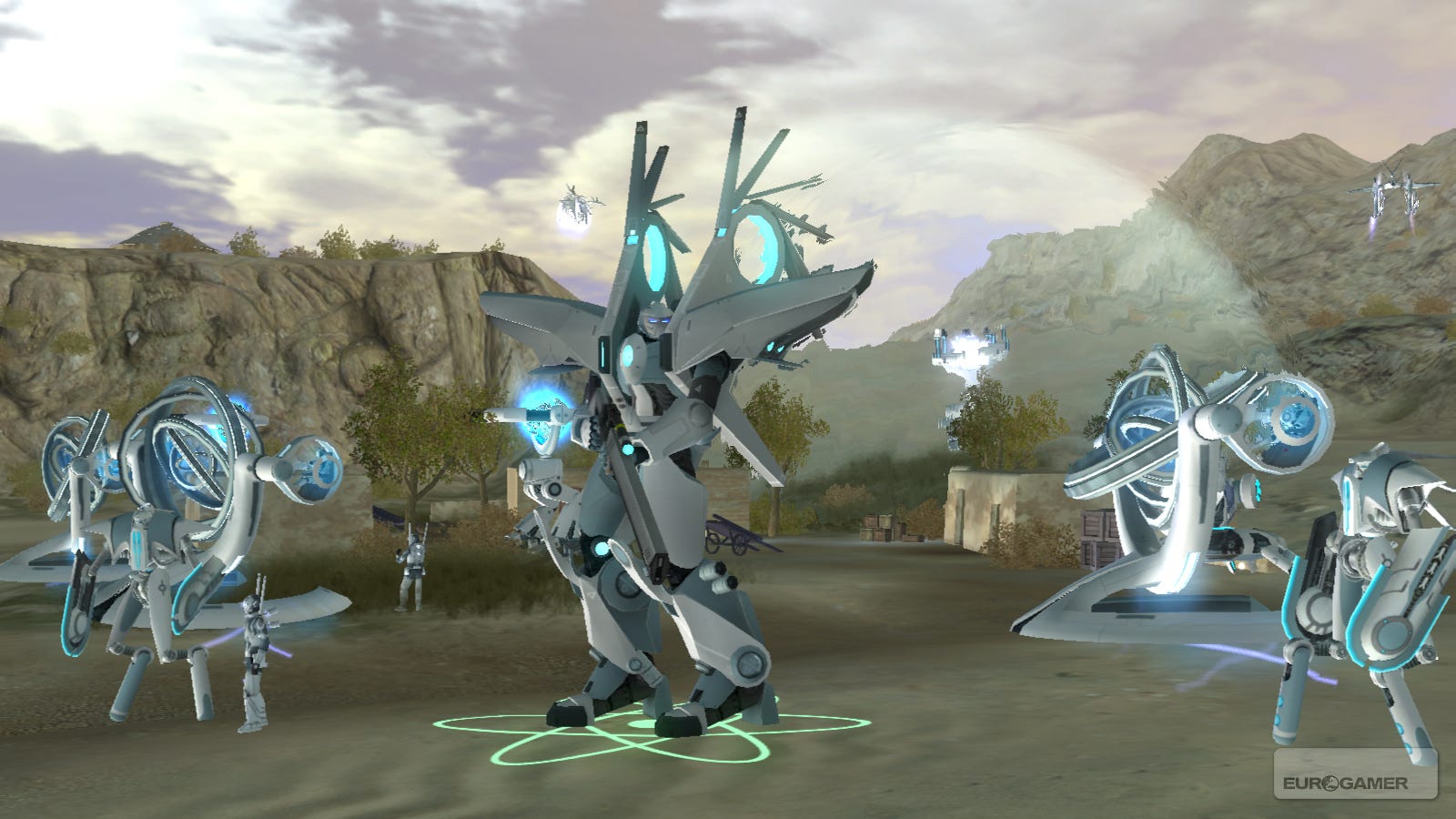
You may be thinking that the Novus look like refugees from an obscure Japanese mech PS2 game. You are correct.
However, their differences from Starcraft's lovable xenomorph horrors are more important than the similarities. The Novus construct an array of slender towers all over the map, creating an inter-linked grid - and can then move their forces almost instantaneously along this grid, dropping down a full attack force miles away from their base in seconds. The fully automated resource-collection units also travel along this grid, making them into near-impossible targets for enemies.
Lined up against any conventional RTS faction, the Novus would seem shockingly unfair. You can't fight them in the normal manner, inching across the map and claiming strategic positions as you advance. They don't have supply lines that you can cut. Indeed, the only way you can do them real damage is to assault their base.
Just as well, then, that the Hierarchy are just as innovative and unusual in their own right. They are yin to the Novus' yang, focused on three absolutely gigantic walking structures both for attacking power and for unit production. In essence, the Hierarchy have a mobile base that's bristling with weaponry - giving you the ability to walk your barracks right up to the front lines and start churning out units, while simultaneously pounding the enemy with heavy cannons.
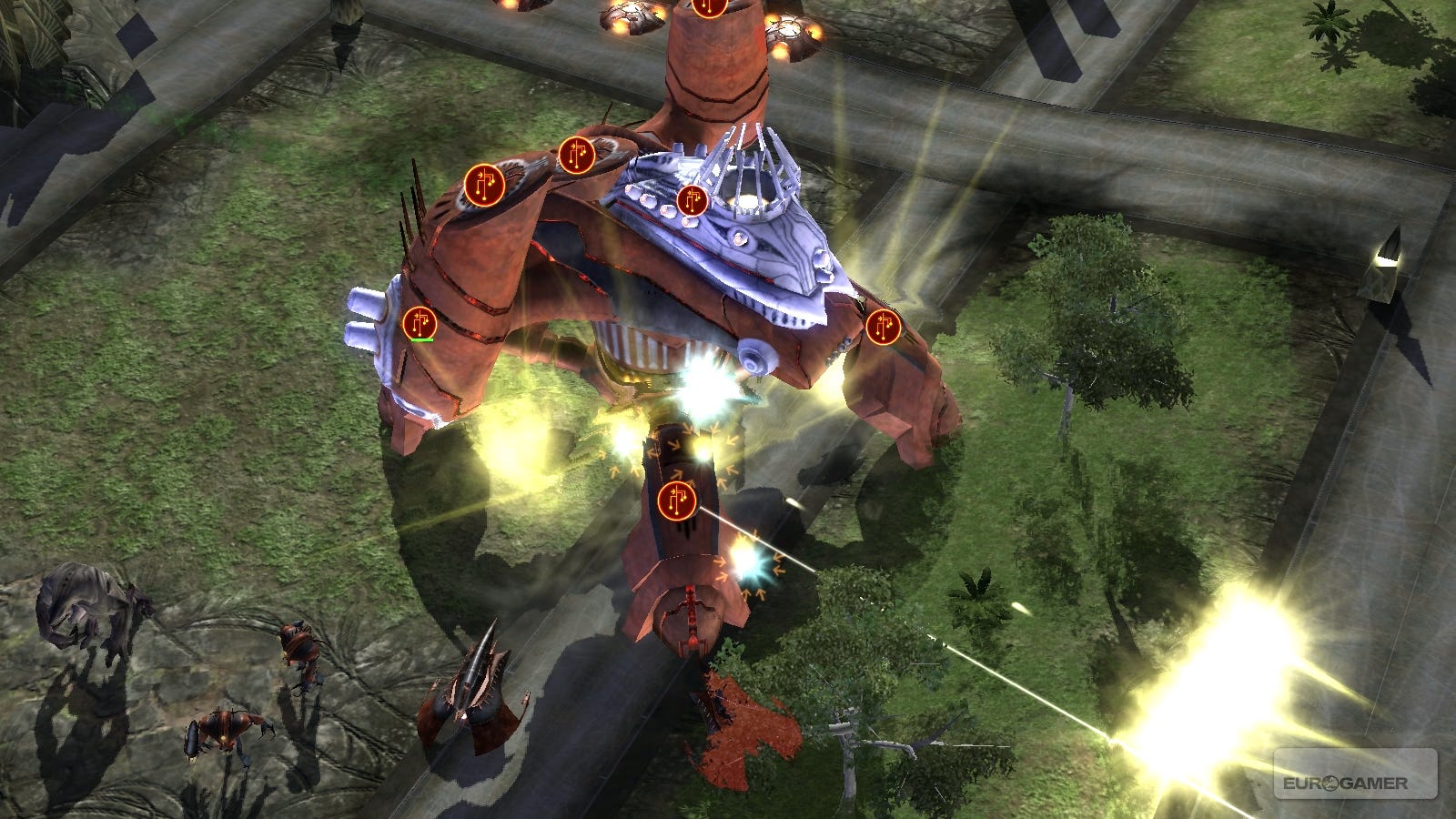
The only thing more satisfying than controlling one of these Hierarchy walkers is managing to take one down. Each of those icons is a different target that needs to be destroyed.
The final race are the vaguely mystical Masari - who are arguably the most conventional of the races, being largely focused on base-building and research. However, they are specifically tuned to appeal to one aspect of RTS gaming. Unlike the other two races, the Masari are designed for "turtling" - the strategy of building a complex, well-defended base, and allowing your enemies to smash their forces up against your walls and turrets while you beaver away on super-weapon research inside.
The three factions are vastly more differentiated than even Starcraft's races, and yet seem perfectly well balanced. That's the mark of a great RTS game, we reckon - one which offers three utterly different play experiences but keeps them balanced and fair, so that your choice in multiplayer can be based entirely on your preferred style.
The third thing which Universe at War definitely gets right is the range of research and strategic options it gives to players. The branching research tree offers very different strengths and weaknesses, and you'll need to modify your strategy as you progress along the tree to allow for the choices you've made - or to defend against your opponent's research choices. At its best, this turns games into a tense experience, forcing you to adapt constantly rather than pursuing a single strategy to victory.
Illegal Aliens
It's fair to say, then, that Universe at War gets plenty of things right. Unfortunately, it also gets a few really key things wrong - badly wrong enough to upset quite a lot of the sterling work Petroglyph has done on the factions and balance. There are huge, glaring problems with both the single-player and the multiplayer aspects of the game, which doesn't leave a whole lot of untainted ground in the middle.
Let's look at the single-player first. The structure here is fairly conventional, with the player taking on the roles of all three major races (first the Novus, then the Hierarchy and later the Masari) as you progress through the story. The individual missions, however, are extremely weak - and do little to showcase the strengths of the game in terms of balance and innovation.
Most of the missions are very heavily scripted, offering no opportunity to experiment with the strategic options on offer. You're generally funnelled down one clear path, and strategy tends to dissolve into a case of simply ordering a big group of units to the requisite point on the map to trigger the next cut-scene. Later in the game, things open up a little and you get a little more decision-making ability, but it's still fairly restrictive.
These handy towers allow the Novus to zip around the map instantly - a mind-bending ability which turns many RTS concepts upside-down, but which works remarkably well.
Moreover, the game largely removes the research system from the campaign - something which isn't uncommon in RTS game campaigns, we admit, but which feels terribly disappointing in a game which has expended so much effort on creating great research benefits. Instead, you're given a cropped-down and restricted sub-set of each faction to play about with, which doesn't give a realistic impression of the faction's capabilities.
In the game's defence, it does offer single-player users a pretty competent skirmish mode, as well as the option to play through some pre-rolled scenarios. Both of these modes give you the full monty as regards research, units and buildings, and offer a chance to get your teeth into proper strategic play - although the AI is somewhat predictable, and not remotely as much fun as playing against human opponents.
It probably goes without saying, then, that if you're not into multiplayer, you won't find a lot of value for money in Universe At War. It's when you roll your army out against other human players that the game really comes into its own - the beautiful balance of the three diverse factions, the wide array of strategic options and the need to react to your opponents' research choices all combining into a genuinely great experience.
The moment when you see the Hierarchy's flying saucers is the point where it's clear that they're taking the mickey. It was touch and go until then.
Certainly, it's not without its flaws - we got very annoyed by the fact that the camera can't zoom out to take in a decent portion of the battlefield, leaving you with a very tight viewpoint on a couple of large units, and no overview of the surrounding area. You'll spend a depressing amount of time peering at the tiny mini-map or scrolling around, which is ridiculous - and perhaps a symptom of the game's rather creaky graphics engine, which looks reasonably good but runs into fairly serious performance bottlenecks on a regular basis.
Satan Live
The single biggest flaw, however, is on the verge of being a deal-breaker - and it lies in Petroglyph's frankly baffling decision to use Games for Windows LIVE for its online functionality. Now, sure, this enables nifty features like Achievements, but it's also, frankly, utterly broken on a lot of systems - and to add injury to insult, Universe at War doesn't enable its most interesting game modes unless you're a Games for Windows LIVE Gold subscriber.
That's fine if you're an Xbox Live Gold subscriber already, for instance (although that still doesn't change the fact that Live on Windows is buggy, unstable and badly implemented) - but if you're not, you'll have to pay for a Live Gold subscription in order to use the Conquer the World and Ranked Match options in multiplayer. Given that Conquer the World, where you challenge other players for control of territories, is by far the most interesting mode, this is a massive pain.
Novus bases all look suspiciously like posh, over-designed art galleries. Don't let that fool you - the emotionless Novus actually don't give a toss about art.
It gets worse, though. Because of this restriction, you'll also need a Gold account to get the higher Achievements in the game. Achievements give you in-game medals which you can use to boost your stats as you play - so what this boils down to is that Gold users are being given in-game bonuses over and above those who opt not to pay for features that PC games have offered for free for decades. This is a shockingly poor decision, and if if puts people off buying the game, frankly, we can't blame them.
The heart of Universe at War is a beautifully crafted strategy game which could have been one of the best things in the genre in years. This just makes it even more tragic that it's let down by a passable but unimpressive graphics engine, utterly dull single-player and the disastrous decision to use the godawful Games for Windows Live Gold service for multiplayer.
If you're planning on playing LAN multiplayer games, or if you're an Xbox Live Gold subscriber already, we can happily recommend Universe at War; it's tarnished brilliance, but brilliance nonetheless. We suspect that most players, however, will find this game simply too flawed to spend too much time on. A seven is respectable - but it's depressing just how little work Petroglyph would have needed to do to make this into a nine.
7 / 10