Version tested: Xbox 360
All sport is a metaphor for combat. The team games - football, rugby and so on - are sprawling battles; attackers and defenders ebb and flow up and down the field in a clash of will and power, led by steel-eyed captains. American Football is a series of frantic First World War-style scrambles for territory measured in 20-metre increments. Tennis is a pistol duel, squinting shots lined up in the glare of a high-noon sun; foot races are breakneck chases between predator and prey.
But while there's always risk, sometimes injury and occasionally death, sport largely remains metaphor. This is how some have argued that boxing falls outside sport's definition. There is, detractors say, no metaphor: it is deadly, brain-injuring combat, killer blows softened only by the padding on each fighter's fist, a concession to civility perhaps only introduced so the participants live long enough for promoters to make extra cash from intermission snack sales.
If you baulk at the lack of metaphor in boxing, then the unflinching brutality of mixed martial arts will scramble your mind. While the UFC - both in reality and in this game - assumes the glitzy presentation of the WWE, underneath the hot lights, pomp and swagger, stand two men entirely uninterested in providing entertainment. There is no metaphor: each eyes the other weighing in the mind how their own rock, paper, scissor combination of martial arts proficiencies might bring the other to a state of unconsciousness as quickly as possible.
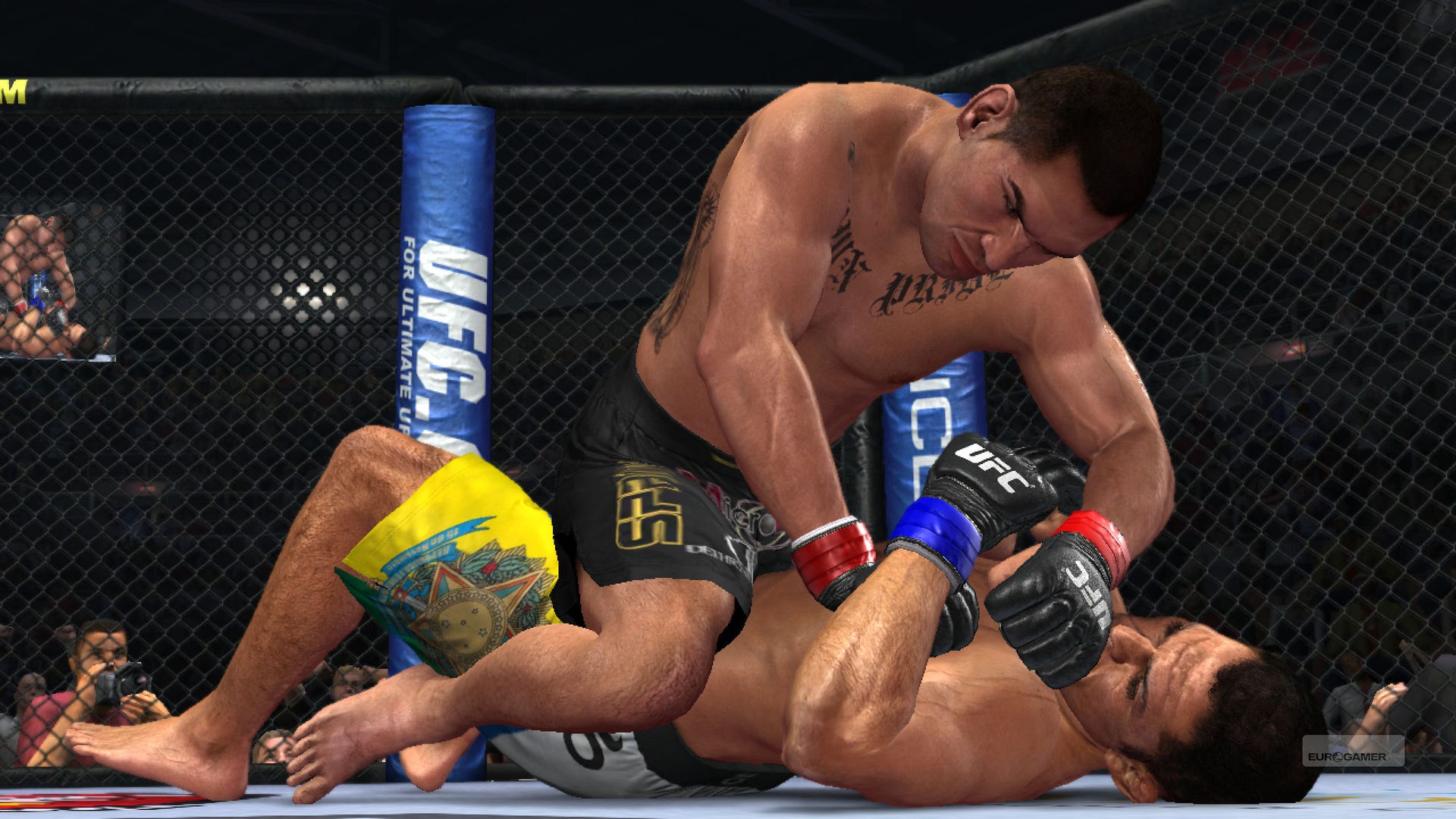
Along your career you face every type of opponent imaginable in your weight class, adapting your approach to meet theirs; every loss provides tutelage and helps towards the pay-per-view cards at the top of the game.
Perhaps for that reason, the UFC delivers mixed entertainment for the viewer. For every scintillating match that rotates between show-boating roundhouse kicks, rapid-fire pummels up against the arena wall and chess-like wrestling transitions on the mat, there's an unshowy first round tap-out from a vicious arm lock or ankle twist hold.
And therein lies a great deal of UFC's appeal as a videogame. Each match has the scope for the kind of upsets that boxing rarely offers, where wearing your opponent down blow by blow into a hazy submission can often become a repetitive chore.
In MMA, by contrast, you might go multiple rounds on your feet, zoning your opponent with high kicks and Muay Thai-style knees to the torso. Or you might spend four minutes on the floor, trading positions in a celebration of Greco-Roman wrestling while attempting to get the upper, strategic hold. Or you might score a Flash KO three punches in with a well-timed sway and counter-combo that strikes your opponent in just the right way to send them reeling down the tournament ladder. These kind of unpredictable outcomes define the game, and help keep it interesting (and occasionally frustrating) long after developer Yuke's bread-and-butter wrestling titles may have dulled in appeal.
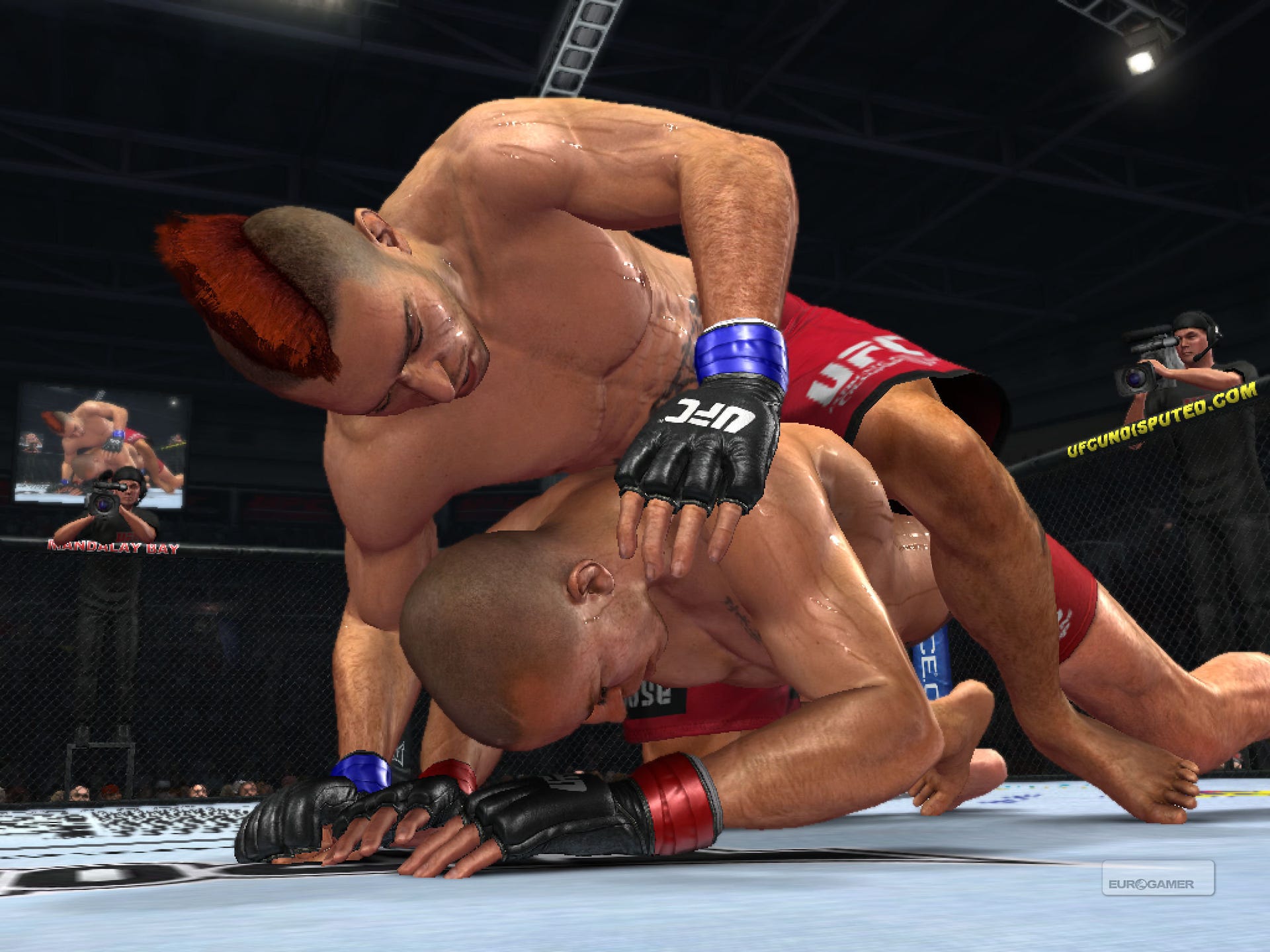
Yuke's skilfully integrates its peculiarly Japanese approach to collectables with hundreds of shop unlocks available, from new items of clothing to new taunts, nicknames and even Topps trading cards.
The controls are logical but take time to learn and absorb, especially as the style of play differs greatly between fighting on your feet and fighting on the ground. As in Tekken, the face buttons are each mapped to a limb, and standard attacks are modified with trigger and bumper presses to aim high or low on your opponent. Blocks can be integrated seamlessly at the end of basic combos, but it's the reversals and counters where the high-level game really opens up, with a well-timed flick of the analogue stick allowing your fighter to grab an incoming kick and hurl the opponent to the ground in a single fluid motion, if you can spot the opening and react in time. The ground game, by contrast, consists of a series of safe-cracking quarter- and half-rotations of the analogue stick, characters vying for positions of dominance before attempting the occasional submission hold.
The key to lasting the distance is in managing stamina. Attack too hard or whiff moves and your stamina will deplete fast, only refilling when you back off and defend. While your health will chip away every time an attack lands, if you don't settle into the micro-rhythms of attacking and recovering you'll weary your fighter and leave him open to a Flash KO or hazy stun, even if his health bar is well-stocked. In this way, the game seeks to mirror reality, where a flurry of red mist attacks would leave any opponent open to a deadly surgical strike, and it provides a neat way to discourage button-mashing and force beginners to weigh the wisdom behind each blow.
UFC 2010's impressive roster of over 100 fighters (spread across five weight classes) is nothing short of exhaustive, featuring recent newcomers and old hands in force. But the gigantic range of different styles and abilities on offer is perhaps made most clear in the extensive Career Mode. The 10 minutes spent creating a fighter at the front end of the experience is the tip of the iceberg as, while it's here you set general stats - height, weight, lead fist preference - and the look and garb of your fighter, it's not until you start along the long road from amateur fights, through the World Fighting Alliance and into the UFC itself, that you begin to add tactical and stylistic meat to the bones.
Your career is divided into weekly chunks, the gaps in between scheduled fights open for you to train your fighter, rest up or visit various martial arts clubs. Training, mercifully, isn't tied to a mini-game, but is rather a pull-down option from a menu allowing you to put time into developing strength, speed or stamina. Here the game is one of juggling numbers, ensuring you maximise improvement between fights, while managing fatigue with proper rests so you don't enter a battle exhausted.
But it's in visiting training camps that you really start to customise your avatar. A slew of different martial arts houses (based on real life outfits) can be visited, each one offering a set of moves, which can be learned and incorporated into your fighter's palette of moves one by one.
Fights take place in eight venues, from the Mandalay Bay Events Centre to the O2.
To learn a move you must spar with a trainer, fulfilling certain criteria in order to fill a gauge to completion, at which point the move is learned and replaces your fighter's default attack. It's an ingenious system as it allows you to mix and match different styles at will, while immediately tailoring your proficiencies to suit your style, whether you want to put all your time into on-the-ground positions and submissions, standing attacks or clinches. By mixing and matching moves pulled from karate, judo, Brazilian ju-jitsu, Greco-Roman wrestling, boxing, Muay Thai and Sambo, your fighter has the potential to become a multicultural, multi-discipline combatant, an embodiment of the mixed martial arts philosophy.
A vast array of different modes and diversions helps to impart the essence of the sport, especially from the view of the fighters. While the menus are all 20-foot high gold lettering and orchestral hip-hop, and the historic matches are introduced by lithe girls Arianny Celeste and Chandella Powell, the game is refreshingly free of the presentational bluster that fighting games of this ilk so often pour their resources into. Pre-match theatrics are kept to a minimum and highlight reels are short and sharp in between bouts.
UFC 2010 is the first game to adopt a controversial system, whereby access to the game's online modes is unlocked via a one-use key supplied with the game. Second-hand buyers will need to buy a new key online.
The commentary is near peerless in gaming, Mike Goldberg and Joe Rogan's incisive patois adapting to the on-screen action and adding immeasurably to it, no mean feat when every fighter in every weight class is distinguished from the next in profound ways and approaches. Outside of fights themselves, there's a distinct lack of polish: menu navigation is often needlessly convoluted (frustration exacerbated by the long load times) and the simplest of tasks, such as adding a sponsorship logo to your shorts in order to net some extra rewards in battle, can be tortuously long-winded. But these are cosmetic shortcomings, and underneath, the game's fundamentals are gold.
Since the success of last year's UFC game, MMA has become a serious proposition on the videogaming landscape. Where once EA shunned UFC President Dana White (allegedly saying, "You are not a real sport. We want nothing to do with this"), now they are close to releasing their own, no doubt highly polished MMA title.
Wisely, Yuke's has played to its strengths in the incoming shadow of such competition, making full and exciting use of the license that EA shunned to present a near-comprehensive UFC sim, layered expertly on top of a solid MMA core. It would be too generous to suggest this is the best recreation of the sport imaginable, as the rough edges and clunky navigation pull the game back from contemporary sheen. But it's close. And in sports videogames, that's the only metaphorical distance that matters.
8 / 10
