Travian Review
It's got a lot of Gaul.
Fans of waiting need wait no longer. With Travian, you will find a game in which MMO staples like fighting, levelling and resource-management sit alongside hanging around, lingering, and generally killing time.
There's more to this free-to-play, browser-based MMO than waiting, of course: it's balanced, cleverly designed, and ripe for strategising. It's just that the game's early stages elevate the art of waiting to such a central position, it can't help but define a large part of the experience. Travian is a game in which waiting takes on heroic, blusterous proportions, a game about the unappreciated grandeur of sand trickling through the waist of an hourglass.
It's a game about building up, certainly, but also a game about counting down, clock-watching for one project to finish, while you plan where to invest your time next. Even though Travian is free, no game has ever made it so deliriously clear that time is money. The result is a civilisation game that not only steals from, but somehow manages to slyly critique, history: most of it, suggests Travian, is just people larking about while the paint dries.
None of this is immediately apparent to the new player. For the first ten minutes everything seems normal, if a little basic. Travian is a strategy MMO with a simple goal: gather resources and expand territories through alliances and warfare.
Seeing as the game is browser-based and animation-free, hardware won't be a problem; you could get it to run on a Difference Engine connected to antique telegraph wires through a modem built from a Speak-and-Spell. Travian is functional rather than beautiful: the interface is uncluttered, no winsome folkish dirge loops endlessly through your speakers, and the art is big-nosed and jolly, designed to evoke peasants rather than kings, and reminiscent of the illustrations you might find in a GCSE French textbook.
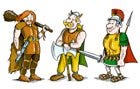
Each decision is a real choice when you've spent all afternoon thinking about it.
There's nothing surprising in the classes, either, whittled down to the starkest of strategic differences. Gauls mean defence and speed (though I'm pushing the semantic boundaries of that word somewhat), Teutons are fighters, and the Romans live to build, balanced in attacking and defending. Each class has its tricks (Gauls, for example, can lay traps for attackers, which can be astonishingly satisfying) but nothing is overpowered.
Once a class has been selected, the player is presented with a starting village and some basic options: build, or begin harvesting the surrounding countryside for resources. This is where Travian plays its trump card, revealing that there are two economies at work here: the material resources themselves, and the sheer time it will take you to build anything from them. That seductive granary may leave you change from your clay reserves, but it will take almost half an hour to construct, and when your workers are hacking away at that, they won't be doing much else. Once you set a building going and start looking about for something else to do, you'll quickly discover that, initially, before you've started levelling up, there isn't anything you can do. You'll have to sit tight for thirty minutes before your little picture of a granary being built turns into a little picture of a granary that has finished being built.
Think about it: when do games normally make you wait? When you're loading? When you're saving? Normally, in fact, it's the games that wait for you, shuffling their feet while you inch towards level thirty, whistling Dixie while you collect fragments of Triforce. Not here.
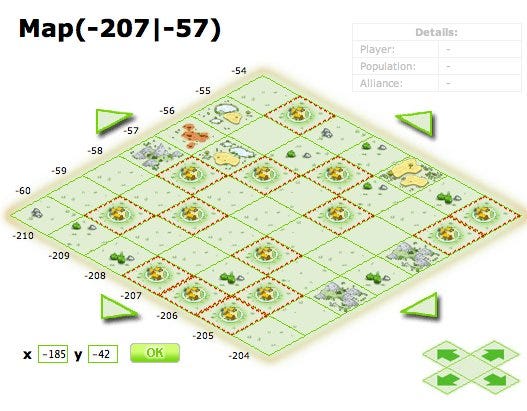
What Advance Wars would look like if it was the product of 19th century puritanical quilters.
In my early days on Travian, I was so intrigued by the game's fascination with time, I completely forgot about the real economy, the resources themselves. After I'd spent my first morning putting up a few buildings, I ran out of these resources entirely and had to stop; there was simply nothing more I could do other than watch my reserves of lumber slowly creep back towards usable levels.
A lot of this was down to native stupidity on my part (Travian very clearly tells you the cost for each building) but it's also a sign of how jarring it can be when a game plays by its own distinct rules. I should have focused on resource-gathering first, levelling up my fledgling clay pits and woodcutters rather than going cash-happy on buildings, creating a cranny and - what was I thinking? - an embassy. Resource before building is a staple of strategy games, of course, but the consequences rarely take half a week to play out when you mess it up.
Eventually, however, the pace of Travian becomes clear. Slowly, towns start to come together as the game's options emerge: create crannies for protecting resources from raids, embassies for forming alliances, a rally point and barracks to construct your own army before thinking about moving outwards.
After a few days of this, you'll start to notice the way the game insinuates itself into your life. This is perfect for playing while waiting for an email, managing your Flickr account, calculating your net worth, or even conducting a low maintenance affair. The pleasure of construction leading into the promise of empire-building is so slickly handled that the timescale has little detrimental effect. And once Travian's got going, each log-in proves opportunity for a few tweaks and stratagems, as your cities improve, your population grows, your resources replenish more quickly and your build times fall.
Factor in the incidental benefits, too: after three days of playing Travian, my house had never been cleaner. I'd rearranged bookcases, located that bit of the Dyson that allows you to sort out the top ledges of doorways, and even found time to read Isaac Asimov's distressingly granular two-volume autobiography (you might want to skip that one). Crucially, none of this activity meant that I'd neglected Travian in the slightest. To the contrary, the handful of decisions I was making every hour meant my empire was quietly thriving, and I was planning on expansion. Six months of this game and you should fully expect to be able to speak Italian, recite the periodic table (also in Italian), and master the piano-accordion - a far cry from the rotten marriages and stale birthday cake left behind in the wake of World of Warcraft.
Alarmingly, none of this is by way of criticism. There's something refreshing about a game that forces you to its pace in an age when most titles can't wait to shower you with trinkets and mini-games just for prodding a few buttons. Travian is an activity that can fit snugly into the fabric of your life. In fact, it only really works when you half-forget it. Like one of those optical illusions where the picture disappears whenever you try to focus on it, playing Travian for hours at a time, even when you're being raided, would be counter-productive. Instead, you log-in, build an iron mine, attack a neighbour, and back out again. You know, a bit like real life.

That couple in the centre will still be shaking hands when the sun finally explodes.
All of this suggests the game is peaceful, but that couldn't be further from the truth. For their first few days, Travian players exist under beginner's protection, free from attack from enemies. Once this period is past, assaults will likely come thick and fast, either to destroy and conquer or farm resources.
Travian tries to protect starters by clumping new players together, but in a game where the object is to expand your territory, warfare is the easiest means of doing so, with new players bearing the brunt of the attacks. It's a legitimate strategy, then, but it can still feel like griefing, and the game's own patchy documentation is slow to brief on the difference between offensive and defensive troops or how to tell a raid (which will leave survivors on both sides) from a full-on attack.
Watching enemy catapults reduce the hard-won levels of your buildings, while your outward-lying cities are captured, can be tough to bear when you don't understand how exactly to fight back or whether you should be upgrading the weapons of your offensive troops or the armour of your defensive. Travian's warfare is deep and customisable, with spies, loyalty, and the speed of your reinforcements all coming into play, but this is only truly revealed over the course of many weeks. The best solution for the early stages is to form an alliance with other, more powerful players until you can fight back on your own.

The Village Overview allows you to bask in your strategic ineptitude.
If a lack of hand-holding can make Travian's surprising levels of aggression bewildering, the paid content is more troubling. Although the game is free, players can buy perks. "Plus" simply offers better management tools, such as a larger map and the ability to cue up builds. More controversially, "Gold" buys you production bonuses, allowing you to harvest resources quicker and get better deals from merchants. Gold has seen many players leaving the game, and, while that might be an extreme reaction, its ethos seems at odds with the rest of the experience.
Ultimately, then, Travian is a risk. In the heat of battle, it can be a lot like grain-by-graining an elaborate sandcastle into existence only to have the big boys step on it. But the quiet charm, coupled with its hard tactical heart and the strange dexterity with which it can coil itself into the roots of your everyday life, means you're unlikely to find a game that's both wilful and accommodating in quite the same way. Travian may not be perfect, but chances are good that you'll find it's still a risk worth taking.
7 / 10
You may also like...
-
App of the Day: Ascension: Chronicle of the Godslayer
-
Gotham City Impostors Review
-
Kingdoms of Amalur: Reckoning Review
-
Grand Slam Tennis 2 Review
-
The Darkness 2 Review
-
Ultimate Marvel vs. Capcom 3 Vita Review
-
Catherine Review
-
One Piece: Unlimited Cruise SP Review
-
App of the Day: Sir Benfro's Brilliant Balloon
-
King Arthur 2 Review
-
App of the Day: Superman
-
App of the Day: Off the Leash
-
App of the Day: Android Humble Bundle
-
Mutant Mudds Review
-
App of the Day: Armed!
-
App of the Day: Puzzlejuice
-
Samsung Galaxy Note Review
-
App of the Day: Squids
-
Retrospective: Star Wars Episode I Racer
-
Mass Effect 3 Demo: The First 20 Minutes
-
Face-Off: Final Fantasy 13-2
-
Why Devs Owe You Nothing
-
Digital Foundry: PS3 Skyrim Lag Fixed?
-
Game of the Week: Catherine
-
Who Killed Rare?


Comments (15) Latest comment 2 years ago
Comments threads automatically close after 30 days, but please feel free to continue chatting on the forum!
Comment below viewing threshold Show
Other than that I do agree with the rest of the review and according to which server you choose you can manage the speed thing a bit.
In the end it can start to take over your life more in terms of being desperate to get online at the correct times.
Comment below viewing threshold Show
PS I don't work for them, really... I just remember it being good... cant find the link though
Comment below viewing threshold Show
Yup, shouldn't happen ...translation booboo
How good is YOUR German btw?
Also playing Ikariam. Nice Asterix syle art.
Comment below viewing threshold Show
(profuse apologies to any competent speakers of German reading this, but at least I'm making an effort, and British people actually trying to speak foreign languages are not that common. Most of my German seems to have been shoved out as Japanese has been shoved in. If it were my job to do this you can be damn sure I'd do it properly.)
Comment below viewing threshold Show
You may have a dual account, meaning that multiple people share the same account. This is okay as long as none of those people have or play another account on the same server.
Unless your playing as a team its pointless to play the game the top players are all teams
The advantage of spending real world money ends up pointless unless you plan to spend hundreds of dollars as the others playing as a team does not run out of their advantage
Morally this game is bankrupt
Comment below viewing threshold Show